A Calamitous Future Beckons
Killing people becomes very easy to do once you’ve convinced yourself you’re supremely good and your opponents are supremely evil.
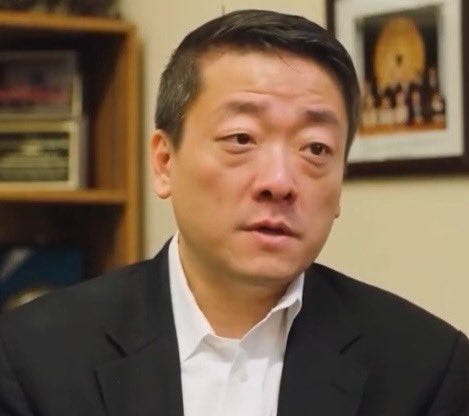
Today, we return to the topic of armed conflict coming to the United States, exploring a number of warning signs as of late. Let’s dive right in.
Chinese Immigrant Threatens Race War
Gene Wu, Texas State Representative and state House Democratic Caucus chair, all but calls for a race war against:

Let’s learn more about Gene Wu, because his background is very much relevant to this story. From a 2014 article:
Born in Guangzhou, China in 1978, Wu came to the US at the age of four when his parents immigrated here. He grew up and still lives in southwest Houston.
So right off the bat, Wu is of foreign origin. He wasn’t even born in the U.S. Strangely, there’s nothing about his immigrant background on his own website, despite being a state representative in one of the most Democratic and diverse parts of Houston. You’d think his immigrant background would help him, right?
Wu’s defenders shamelessly claim he never singled out White people, that this is all just another right-wing “panic.” Okay, who are the “oppressors” Wu was talking about, then? Who’s occupied that role in liberal myth since time immemorial? Was Wu referring to blacks? Hispanics?
Forget about reversing the races - how about reverse the factions? What if a Republican had said something to the effect of, “We are still the majority of this country, we can take it back from the minorities?” We all know exactly how that would go down. The Right is chastised for not being too careful with its language. But we should be conscious of context and nuanced when a Democratic China man says it?
Furthermore, normalizing politics around an “oppressor vs. oppressed” framework is insanely self-destructive. There’s no way to defeat oppression without violence, because a peaceful outcome requires either capitulation from one side or some kind of bargaining. Our politics has been dominated by this framework for some time now and has become normalized in rhetoric. Once it becomes normalized in practice, however, let’s just say things are going to get worse than they already are, and I think we all agree things are bad enough already.
The crazy thing is, Gene Wu has no basis for claiming oppression. Nobody does, Left, Right, White, black, Asian, Hispanic. Oppression isn’t having to hear opinions you don’t like. Oppression isn’t the existence of political opposition. Oppression isn’t enforcing immigration laws. Oppression is, however, having someone’s boot on your neck. Asian Americans, Chinese especially, do extremely well in this country. If they were oppressed, someone like Gene Wu probably wouldn’t be where he’s at in life today. To be oppressed is to be denied the ability to get ahead in life. He certainly wouldn’t be able to call for race war and get away with it, neither.
The Chinese, like all non-White groups, endured their share of challenges in the U.S. It wasn’t pretty. Racial tribalism is the norm throughout history and America was no different, once upon a time. But just as we no longer live in an age of empires, we don’t live in an age of racial conflict, either. The reality is, race relations are probably as peaceful as they’ve ever been, rhetoric aside. I don’t understand how anyone could think someone like Gene Wu is contributing positively to race relations in America.
If Chinese Americans or any minority believes they have it bad in the U.S., they should look beyond our borders. As the cosmopolitan, worldly ones, they ought to know best, right? They should know about events within living memory like the May 1998 Indonesian riots, when the Chinese Indonesian minority, already discriminated against, became the target of horrific violence. It was a terrible time for the country, but it was an especially terrible time and place to be Chinese.
Watch this for a look at how chaotic things got in Indonesia in May 1998:
More remarkable is how the Chinese community responded in the aftermath of the terrible atrocities, despite the Indonesian government doing what’s so often the case outside the West: pretend like it never happened.
Here’s a Chinese Indonesian woman, who was 10 during the riots, explaining how her parents didn’t teach her to hate the ethnic majority, or to further isolate herself from them. This, despite the fact Chinese were mercilessly beaten, murdered, and raped [video set to start at segment]:
The Western mind can’t fathom. I’m not saying this is right or wrong. But this is the reality of what it means to be a minority in the rest of the world beyond the West. Only here in the West do we care so much about what minorities think. It can be a good thing, but just as a society where simply being a majority allowing for dominance of all other groups can lead to abuse and tragedy, a society too easy to indulge minority grievances will end up as chaotic and dysfunctional as the U.S. and Europe have become.
On some level, people need to pick up the pieces and move on. That’s the only way to recover from tragedy, really. Chinese Indonesians still face challenges, but some things have improved, and they continue to make lives for themselves in their country. I doubt they feel sorry for themselves the way minorities of the West do, even as they certainly look back in sadness and a measure of anger. If you want a functional society, if minorities want to thrive, they cannot allow oppression and past atrocities to become an intractable part of their identity. Not only that, minorities who get to speak freely and a “blank check” with which to indulge grievances aren’t exactly marginalized. Just look at America’s black community. Our entire existence revolves around ensuring they’re not offended.
Point being, oppressed minorities don’t threaten race wars because they can’t afford to. They just get crushed, like they were in Indonesia. It’s ugly, but this is the harsh reality of history and the world. Every group either has the boot on their neck or they have their boots on someone else’s. Usually, the strong have their boots on the necks of the weak.
The way Gene Wu talks, it sounds like he’s the one with the boot on someone else’s neck. It’s a luxury - dare I say, privilege - to threaten racial conflict without any fear of consequences. White supremacists who’ve even remotely evoked the specter have been cast out of polite society, ostracized to where they and their views have no safe harbor, no opportunity for respectable living. Wu faces no such sanction. If anything, he’ll be rewarded for it.
A race war would be terrible. Having been reckless enough to open his mouth like that, Wu would become an instant target. There’s no other way he’d be held to account for his rhetoric, either. He’s saying what his voters want him to say and will likely be rewarded for it. That means the only way Wu would ever pay a price is if actual violence did occur. If he managed to survive the ordeal, maybe he can join some truth and reconciliation committee and be a part of the healing process. Or maybe he remains unrepentant and gets charged with war crimes. Either way, he’s got a great future to look forward.
It’s not all about race. It’s mostly about ideology, actually. Here’s Republican Nick Tran, a Vietnamese American, shooting back at Gene Wu:

The fact we’re headed for an ideological war instead of a race war comes as very cold comfort, indeed.
But wait…
Civil War Delayed?
Remember Rudyard “Whatifalthist” Lynch? It’s been over a year since I’ve talked about him, due to him discrediting himself with an outlandish civil war prediction from late 2024.
He’s making something of a comeback, however, and recently re-appeared on the Dad Saves America show. Despite its length of over two hours, the interview is worth watching:
I always give credit and a second chance to anyone who can admit they were wrong at first. This is still too uncommon a practice in this day and age, mainly because people still think admitting that you’re wrong is a sign of weakness. In intellectual circles, however, it never is. If anything, it’s more damaging to your credibility to pretend like you’re never wrong, even when you clearly were.
Whatifalthist had made the prediction that a major civil war would break out in 2025. Not some low-intensity conflict either. A full-blown fracas. He’d also predicted that 1,000 people would’ve died between Election Day 2024 and spring 2025. Both predictions were clearly wildly off the mark. Now that he’s had time to think about it, Whatifalthist is still confident in his original overall thesis, but confesses he no longer know when it’s all going to come to a head.
For my part, I’ve been specific about when I think it’s all going to go down. Not only do I believe the U.S. to have been in a “cold” civil war for years now, I think this year into next, the conflict will escalate, with the usual ebbs and flows. Sometime this year or next, a big blow-up will occur, a major outbreak of violence, similar to 2020, but worse. Eventually, it’ll die down, but it’ll also have the effect of drawing a permanent line in the sand and Americans will have to choose which side of it they’re on.
The next few years will be a period of low-intensity conflict. Call it another “Days of Rage” or “Years of Lead,” it’ll be an era of stark divide. If you think today’s political divisions are intractable, just wait a few years. Americans will try to carry on in this new normal, but by 2032 or 2033, the U.S. will have fought a civil war, a major foreign war, or some other event will occur which concludes the current Fourth Turning, ending the old order, and establishing a new one in its place.
I say all this knowing I could be wrong about all of it. The timing, specific events, everything. The thing is, nothing happening isn’t sustainable. There’s just too much pressure being built up in the system. I think we also have enough examples of black swan events happening at any given moment, drastically altering timelines or speeding events up. More important, history shows that a society-remaking cataclysm occurs every 80-some-odd years, and we’re now over 80 years removed from the last one. If a new order doesn’t replace the old this time, it’d be a first in history.
One thing I haven’t done and will never do it predict the final outcome. I have a guess, but it’s mostly wishful thinking on my part. Honestly, I’m not sure who’s going to win the coming struggle. I’m not confident it’ll be my side. This is difficult for the more ideological thinkers and hardened partisans, but we have to consider the possibility the Left could ultimately win. If then, what do we do? I guess we’ll all need to figure it out then, but it’d be foolishly presumptuous of anyone to believe the “good guys” are going to win out in the end. History is so often the story of the bad guys winning.
Speaking of good guys and bad guys…
Generation Authoritarian
An alarming, though not surprising, testimony on student radicalization from Samuel J. Abrams, a professor at Sarah Lawrence College:
I walked into my politics classroom at Sarah Lawrence last week, ready to teach a lesson about civic protest. The prompt was Minneapolis, where ICE’s Operation Metro Surge has sparked mass protests, a general strike, and violent confrontations between demonstrators and federal agents.
I planned to cover basics: citizens can record police activity, protests must remain nonviolent, participants should comply with lawful orders. My students had other ideas.
“What are we supposed to do?” one asked. “Hold up signs and chant while people are being shot in the street?”
Another jumped in: “You’re asking us to play by rules that only we follow.”
They cited the Black Panthers. They invoked Stonewall. They argued that throughout American history, violence (or the credible threat of it) has driven social change. Several insisted that armed citizens confronting ICE would accomplish what peaceful protest could not.
These weren’t fringe voices. This was classroom consensus.
I study campus culture and have watched these attitudes develop for years in the data. But data is abstract. Percentages don’t argue back. What shook me was hearing my own students, students I know and have taught for months, articulate these views with moral certainty. The numbers had names now.
Important to keep in mind is that these students don’t consider themselves authoritarian. They consider themselves democratic, and that their exercise of violence is in the interest of defending democracy. The problem is, even if they are defending democracy, what typically follows once they win is the furthest thing from it. You cannot have an ideological war end with a democratic outcome, because the whole point of an ideological war is to eliminate dissent and opposition.
Democracies cannot function with an excess of dissent and opposition. Consensus is necessary for it to function. But for consensus to be established, societies must be authoritarian for a time. Once the regime has been in power for some time, it’s rare, not to mention undesirable, for regimes to relinquish power, to transition to democracy. When that transition does happen, it rarely goes smoothly. It’s quite tumultuous, actually. But we’re getting ahead of ourselves here.
More:
But my students weren’t invoking that logic. They were making a different argument: that the system has failed, that ordinary politics moves too slowly in the face of what they see as a humanitarian emergency, that direct action is the only language power understands. These are distinct rationales — one about the nature of speech, the other about the efficacy of institutions — but they converge on the same conclusion. Today’s cohort increasingly accepts violence as an alternative to speech. My students are not outliers. They are exemplars.
I don’t necessarily disagree with the assessments of these students. My own Substack is basically one long argument that the system is failing, if not failed, and that the political process can no longer address our problems. At the same time, I’m not raring to go topple it all either, because wisdom forces me to be pragmatic, realistic, and understand that revolutions are rarely peaceful and demand sacrifice. How much are these students willing to sacrifice? If one isn’t willing to sacrifice comfort, they’re not willing to sacrifice anything.
I often make the observation that nobody really believes in democracy. That seems to be more true with Generation Z than any other cohort:
We might assume openness to political violence is a pathology of the left. The data says otherwise. According to FIRE’s 2026 survey, Republican students now exceed Democrats in support for violence to stop speakers: 35% versus 30%. Support for shouting down speakers has crossed 50% for the first time among strong Republicans. And strong Republicans, and Republicans who accept violence to stop a speaker, have more than tripled in four years.
As one analyst noted, this “spoil[s] what could have been an otherwise very useful tool for Republicans or Democrats who would like to pretend that the problem of political violence is one-sided.”
This is not a left or right problem. It is a generational problem.
I mean, what did you expect? The Left has, for decades, cited protest as a fundamental right and virtue of all Americans on the condition that they reserve that right exclusively for themselves. Meanwhile, similar behavior by the Right is still regarded as wholly illegitimate, motivated by “hate” or a lust for authoritarianism. Eventually, the emotional abuse is going to fall on deaf ears and people will adopt increasingly anti-democratic, un-civil norms as a defensive response, if nothing else.
As I so often say, we’re long overdue for a more critical examination of the Civil Rights era of U.S. history:
The civil rights movement’s moral power came from asymmetry — nonviolent demonstrators versus the clubs and hoses turned against them. That clarity made the injustice undeniable to persuadable observers. But that strategy depended on a shared assumption: that bearing witness, that appealing to conscience, that speaking, even in the face of brutality, could eventually prevail.
Few Americans question the moral legitimacy of the Civil Rights movement. Moral righteousness isn’t everything, however. The Civil Rights movement had detrimental downstream effects which have reached critical mass in the current day. These consequences are morally indefensible and should be corrected.
More importantly, if liberals are going to say things like adherence to the Constitution and the rule of law are what defines the American identity, then there’s nothing with regards to either that says things like civil disobedience or violent resistance are permissible. Nobody’s allowed to disobey the law just because they feel it to be unjust. I consider income taxes unjust, yet if I were to withhold taxes in an act of peaceful civil disobedience, all that would do is run the bill up and eventually land me in prison.
As always, the question is this: what are they willing to sacrifice? Not much:
My students no longer share that assumption. And I understand why. They look at Minneapolis and see federal agents firing on crowds. They see a system that, in their view, responds to speech with silence and to silence with violence. Their question is reasonable: Why should only one side play by the rules?
Oh please. Who’s playing by the rules here? It’s not the Left, that’s for sure. They’re playing by their rules, which isn’t the same as the rules. As I said before, civil obedience and violent resistance aren’t permissible. Engaging in either one is a calculated risk, and participants are in no position to demand restraint in reaction.
Finally:
The data confirms their views are widespread and growing: across party lines, across campuses, across the country. A generation is losing faith in the premise underlying liberal democracy: that we can govern ourselves through words rather than force.
If that faith dies, what replaces it is not hard to imagine. We are already seeing it in Minneapolis with armed standoffs, tear gas, flash grenades, and bodies in the street. Much of that force has been deployed against people engaged in nonviolent protest or simply recording law enforcement. That is what politics looks like when faith in speech as the historical successor to violence erodes on all sides.
But my students were not advocating violence out of cruelty. They were advocating it out of despair.
I’m sure this professor means well, but he’s whistling past the graveyard. Once faith is lost in the system, it’s next to impossible to restore it. The only thing that could is a war. Yet in our fragile state, a war could destroy the republic, union, whatever one wants to call this order at this point, for good.
As for the students not advocating violence out of cruelty, spare me. Again, nobody thinks they’re the villains. It’s because they think they’re the heroes they feel they can act with impunity. Killing people becomes very easy to do once you’ve convinced yourself you’re supremely good and your opponents are supremely evil.
As I’ve been saying, however, I don’t know what else could fix things besides fighting it out. There’s no political solution, things aren’t just going to sort themselves out. Unfortunately, fighting it out could just as easily end this. Unsustainable relationships simply don’t endure. The only way this thing would is by force. By tyranny.
On that note, I’ll close by addressing the widespread belief among liberals that diverse societies are stronger than homogeneous ones. It’s absurd on its face, but it’s worth addressing, because liberals wrongly attribute their supposed strength to the diversity itself. In reality, most diverse, multicultural societies throughout history were empires. Empires were almost all authoritarian. The government is what held diverse societies together, not some sort of fake solidarity among different peoples.
When the empire collapsed, everyone went their separate ways, often forming new states in the process. A lot of time, they ended up fighting. Former neighbors, even former friends, became enemies. But yeah, keep believing diverse societies are stronger.
That does it for this installment. What do you think? Is the future looking nearly as bleak as it seems? How seriously should we take Gene Wu’s threats of racial conflict? Is civil war still coming, just much later down the road? What’s your timeline looking like these days?
Let’s discuss it in the comments section.
Max Remington writes about armed conflict and prepping. Follow him on Twitter at @AgentMax90.
If you liked this post from We're Not At the End, But You Can See It From Here, why not share? If you’re a first-time visitor, please consider subscribing!
I would say social ostracism of those who disagree with you is acceptable and a critical part of maintaining social norms. However, once you decide it's acceptable to hurt people (usually this starts with financial pain -- firing, boycotts, lawsuits, etc...) who disagree with you politically, you've crossed a critical threshold. There is no clear line between getting someone fired, bankrupting them, imprisoning them, doxing them, mobbing their employer, physically attacking them, or firebombing their home with their whole family inside.
This is a continuum of intentionally inflicting pain and suffering, and the Left has walked nearly all the way down it in the last 10 years.
I say "nearly" because, while some journalists and Lefty influencers "celebrated" Charlie Kirk's death, most major Dem officials restricted themselves to, "violence is never acceptable, but his views..." They also haven't quite gotten to celebrating the death of an opponent's kid, although no major Dem leader called out VA candidate (now AG) Jay Jones for wishing such a fate on his opponent, so if it happened, I'm sure we'd get more of the Charlie Kirk type of response.
There's a word for a contest of true good vs true evil... a jihad or holy war. The Left applied Clausewitz's famous dictum 10-20 years ago. The Right appears to be well on the way too. Nothing good comes of this.
“The best thing about a civil war is you know whom you’re killing and why”
-Jean Raspail, Camp of the Saints.