Age Isn't Just A Number
Very simply, older people cause fewer issues.

It’s often noted how the United States, as well as Canada, has had a much better experience with immigration compared to Europe. This isn’t to say immigration to the U.S. and Canada has been problem-free - far from it - but it’s true that things have gone much smoother in the New World as opposed to the Old World. As with all things in life, there are many reasons for why this is, but the biggest reason is the thing you’re all sick and tired of hearing about at this point: age.
Yes, age determines everything. It’s not just a number. In fact, there’s nothing more consequential in someone’s life than how old or young they are. If it affects humans, it inevitably affects societies. The belief that societies are themselves biological organisms is surprisingly controversial, but what are societies if not collections of humans, a biological organism? On top of that, age is the one constant variable in life, because the one thing we all have in common no matter all our other differences is that we’ll all grow old.
How old are immigrants to the U.S.? Estimates vary, ranging from an average age as low as 31 to as high as 46. However, even if you take the low-end estimate, this means that a large percentage of immigrants coming to the U.S. aren’t young. If they’re young, they’re at least well into adulthood.
It’s worth noting that as far back as 60 to 70 years ago, immigrants to the U.S. were even older than they are now. In fact, immigration within our collective lifetimes has trended older than younger. Take a look at this graph:
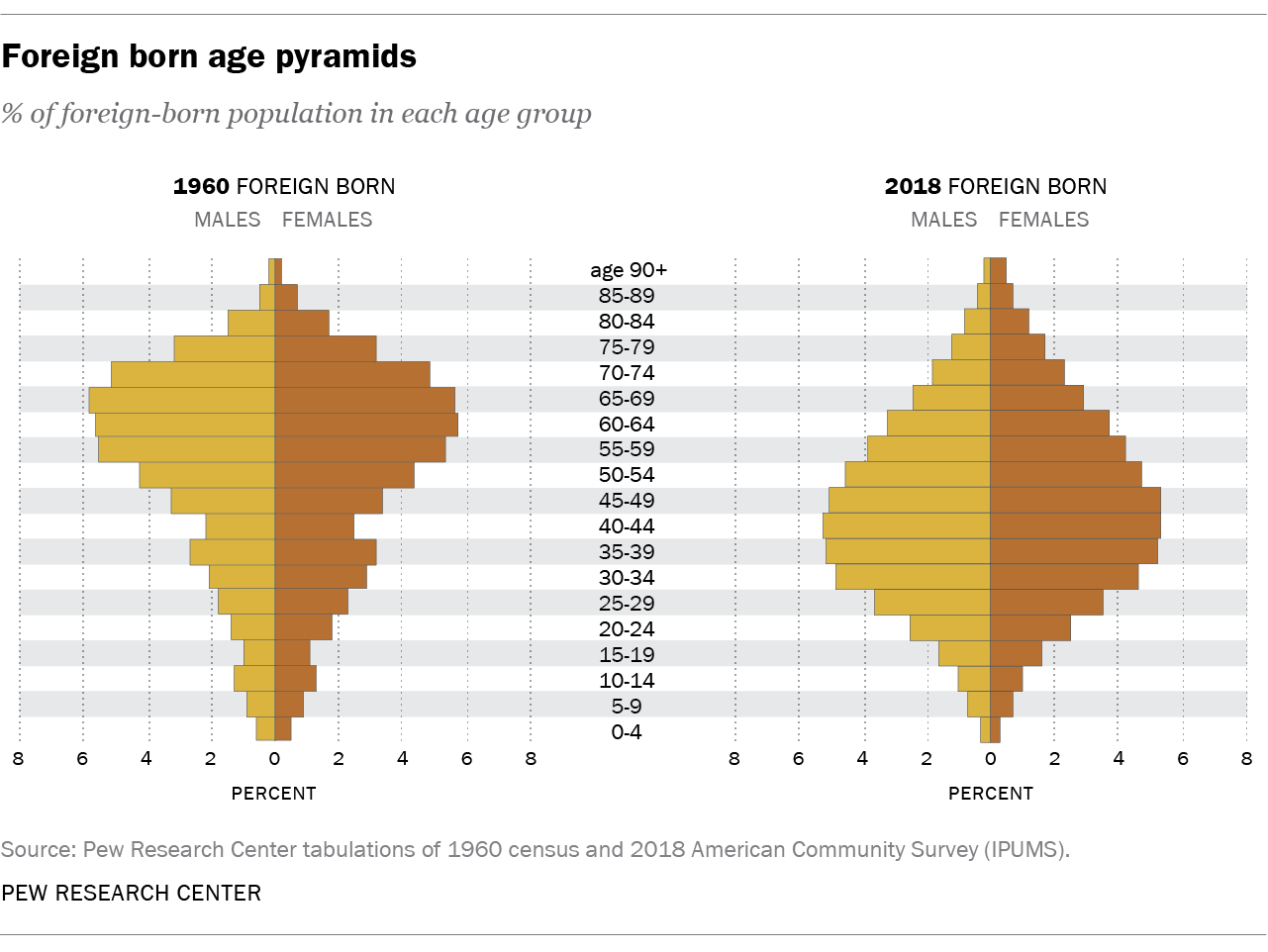
What changed? Mainly the source of migrants. They used to come predominantly from Canada and Europe. As more Latin American, African, and Asian immigrants arrived, the age distribution shifted downward. During the last few generations, we’ve gone through a cycle where the immigrant population got considerably younger, as young as 26 years on average a quarter-century ago, to gradually getting older, with the older age groups comprising a larger share of newcomers as well. It’s unlikely we’re going to return to the days when the 65-to-69 age group was the largest cohort of immigrants, at least not within our lifetimes, but, at least for now and the next generation, those coming to America will remain older than not.
Similar patterns can be seen in Canada. In 2023, the largest age group of migrants was the 25-to-34 age group, by far. This is obviously a young cohort, but for reasons I’ll get to in just a second, they’re hardly a problematic demographic. In fact, the age 15-to-19 group was among the smallest, and it’s this age group, especially its males, who pose the greatest risk when it comes to immigration. Comparatively, the 20-to-24 age group arrived in greater numbers, but nowhere close to the size of the 30-to-34 age group.
As for the situation in Europe, there’s a bit of unpacking required to fully grasp what’s happening on the other side of the Atlantic. Across the continent, the median (not the same as average) age of immigrants was around 30 years. This seems safe, but look at this graph:
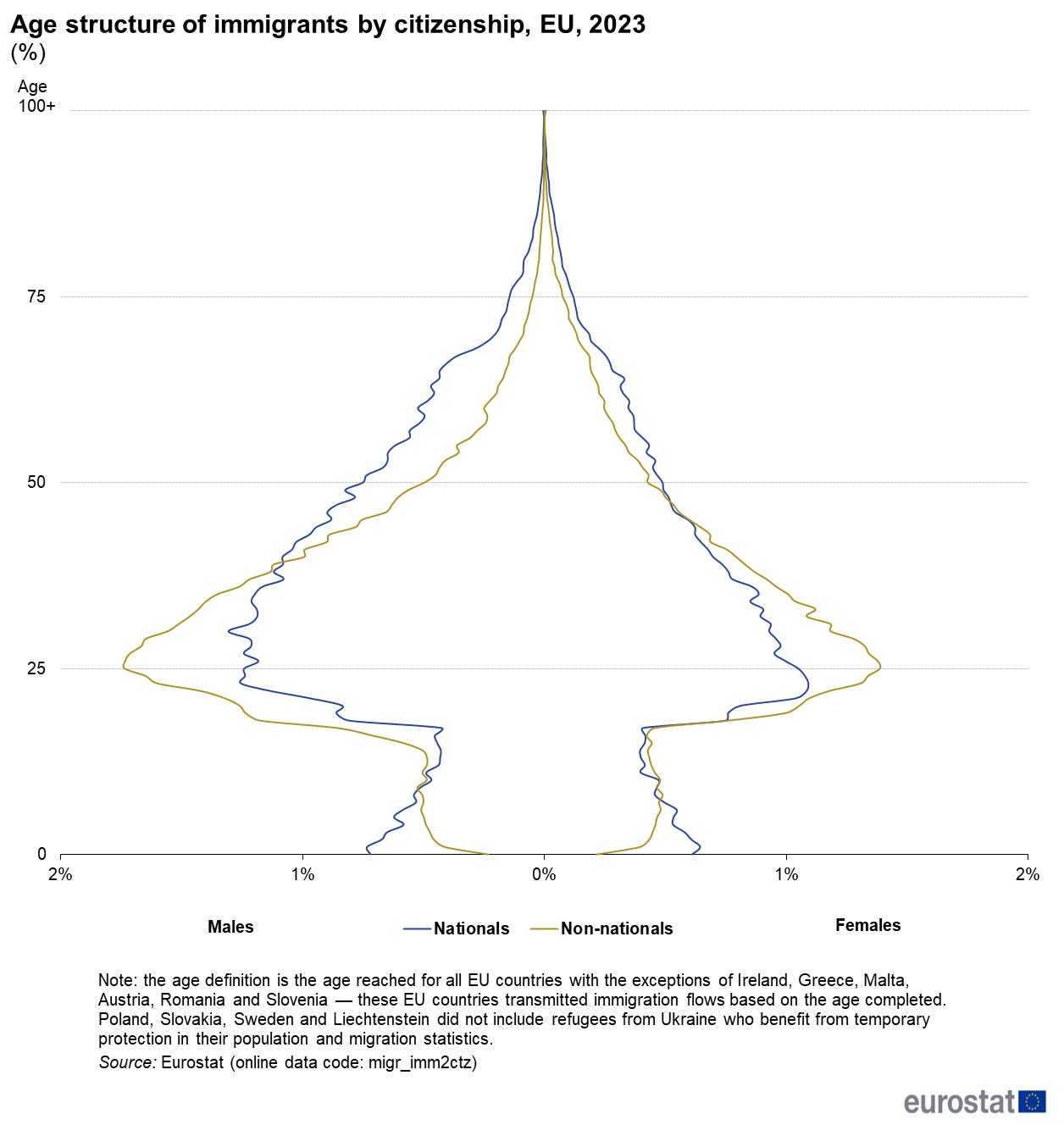
As you can tell, this is a bottom-heavy distribution. This means most of the immigrants coming to Europe are primarily between the ages of 20 to 30, age 25 being the single-largest age group. On top of that, the majority of migrants to Europe are male, by a 55-45 percent spread. You can quickly see why the term “fighting-age male” is employed so often in the conversation. This is a dramatically different pictures from what you see in the U.S. or Canada.
Just as important is where the migrants come from. Europe receives more immigrants from outside the European Union than they do from within. While some of these countries are still located in Europe, many aren’t. Even if they comprise a minority among the total number of immigrants, Europe is still subjected to a large influx of Third World African and Asian newcomers. When you combine youth with the Third World, you get a toxic brew, and the results are what they are.
Why does age matter so much? Very simply, older people cause fewer issues. The older you are, the more money you tend to have, and the more established you are in life. Emigrating to another country, especially the U.S., isn’t cheap, so unless you’re talking about moving to a bordering country, you need to have some money saved up, which means you need to have spent at least several years working. This in turn means older immigrants are more gainfully employable, not to mention more likely to be educated.
The trade-off, of course, is that you sacrifice about a decade’s worth of working time. Over the long term, younger migrants do contribute more to the economy. However, younger migrants also contribute less to the economy in those early years, since they often have to work low-wage jobs, go to school, and in many ways take more out of the public pie than they put into it. An immigrant who’s in their late-20s to early-30s, by virtue of being more established in life, with more work experience and education, is ready to go out of the box, and losing 10 years of productivity is off-set by their ability to contribute more upfront. In the end, the difference is marginal, and the trouble younger migrants often bring to a new country isn’t worth the extra productivity.
Though not always, older migrants also have families. This means they have more responsibilities, and more responsibilities means you’re more likely to keep it on the straight and narrow, since screwing up means you jeopardize more than just your own opportunity in a new country. There’s something to it when people say immigrants commit crime at lower rates than the native-born; they deserve no extra credit for it, of course, since you’re not supposed to commit crime. However, for purely pragmatic reasons, most immigrants, those who came legally, anyway, will try to abide by the law if for no other reason than to ensure they and their families can stay.
Lastly, older people simply don’t have the same propensity for causing mayhem than younger people. Biologically, they just don’t have the same capacity for it. Not to mention the fact that once you hit age 30, you’ve made enough mistakes with your life to know what you’re supposed to do and not supposed to do. When your immigrants tend to be older, they tend to be more mature. That’s a good thing.
Over in Europe, the problem is exacerbated by two contradictory phenomena at work: older societies, far older than the U.S., and mass immigration of young males. In some countries, like Germany and Italy, the median age is in the mid-40s. I went to Italy over the summer and was shocked to see how old many of the workers were. You had middle-aged people doing jobs you’d see 20-somethings doing in America. If they don’t do the job, nobody else will. As our friend Kaiser Bauch says, older societies tend to act like old people. They’re can be nice, safe, and orderly, but this also means they’re vulnerable to an infusion of youth from more feral societies. It’s not entirely about age; who you’re bringing in matters just as much. Young Japanese migrants simply aren’t going to be as troublesome as young Syrian migrants.
America is a good ways away from reaching Europe in terms of aging. As long as our immigrants also tend to be older than not, it’ll save the U.S. the trouble of the problems Europe suffers from immigration. Unfortunately, this doesn’t mean it poses no trouble for the U.S. It just means that we need to understand exactly who the problem is.
Youthful Stupidity, Mature Wisdom
In the run-up to the New York City mayoral election, the following story was published, drawing lots of attention and debate on social media:
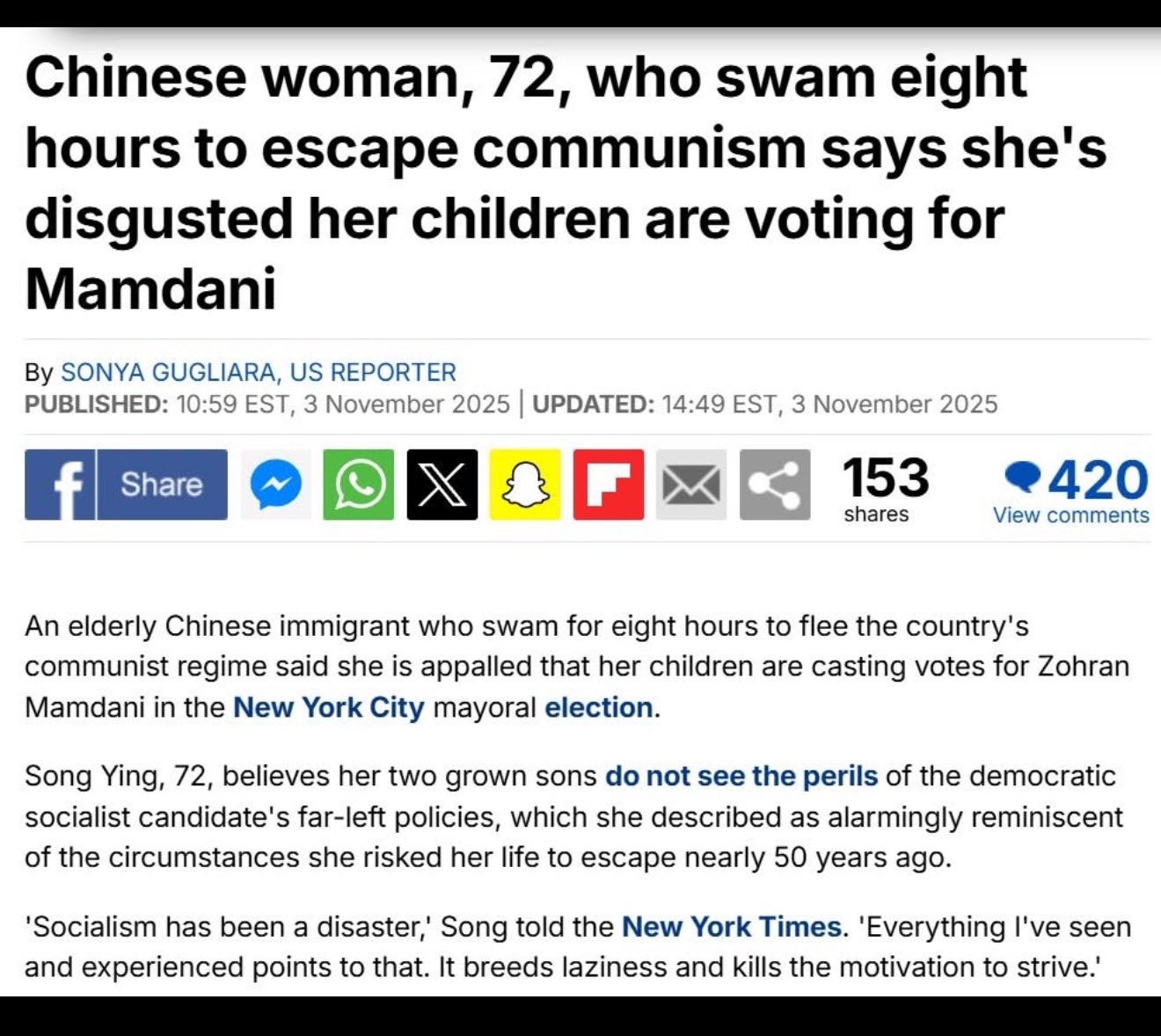
X account Kangmin Lee explained what's happening here:
This is more commonplace than people realize. Asian immigrants are largely conservative, but their children become extremely leftwing because of the:
>language barrier between parents and children
>overemphasis on higher education captured by leftwing ideologues
>desire to fit into the perceived cultural hegemony
>astroturfed boba lib celebs who become the face and spokespeople of the Asian-American community.Asian parents’ primary concern is academic achievement and economic status so much to the point that they will forego passing down their values to their children and then are pikachu shocked.png when they come back gay race communists. They assume if their children have decent grades or are making decent money that they are fine, totally unaware of the kind of content they’re consuming and how they are being radicalized.
This isn’t said enough, but immigration is actually a huge contributing factor to tearing families apart, distancing them from each other literally but also relationally.
I’ve noticed this phenomenon in my personal life as well. Older immigrants tend to be more appreciative of America, and can understand why Americans may feel nationalistic, a sense of ownership, maybe even a little xenophobic about their country. It’s younger immigrants and even the native-born children of immigrants who have a lot more to say about it.
People like this young woman here. Unless you’re really into this sort of thing, I’d advise you not actually listen to it, because you’ve not only heard it all before, a picture speaks a thousand words, anyway:
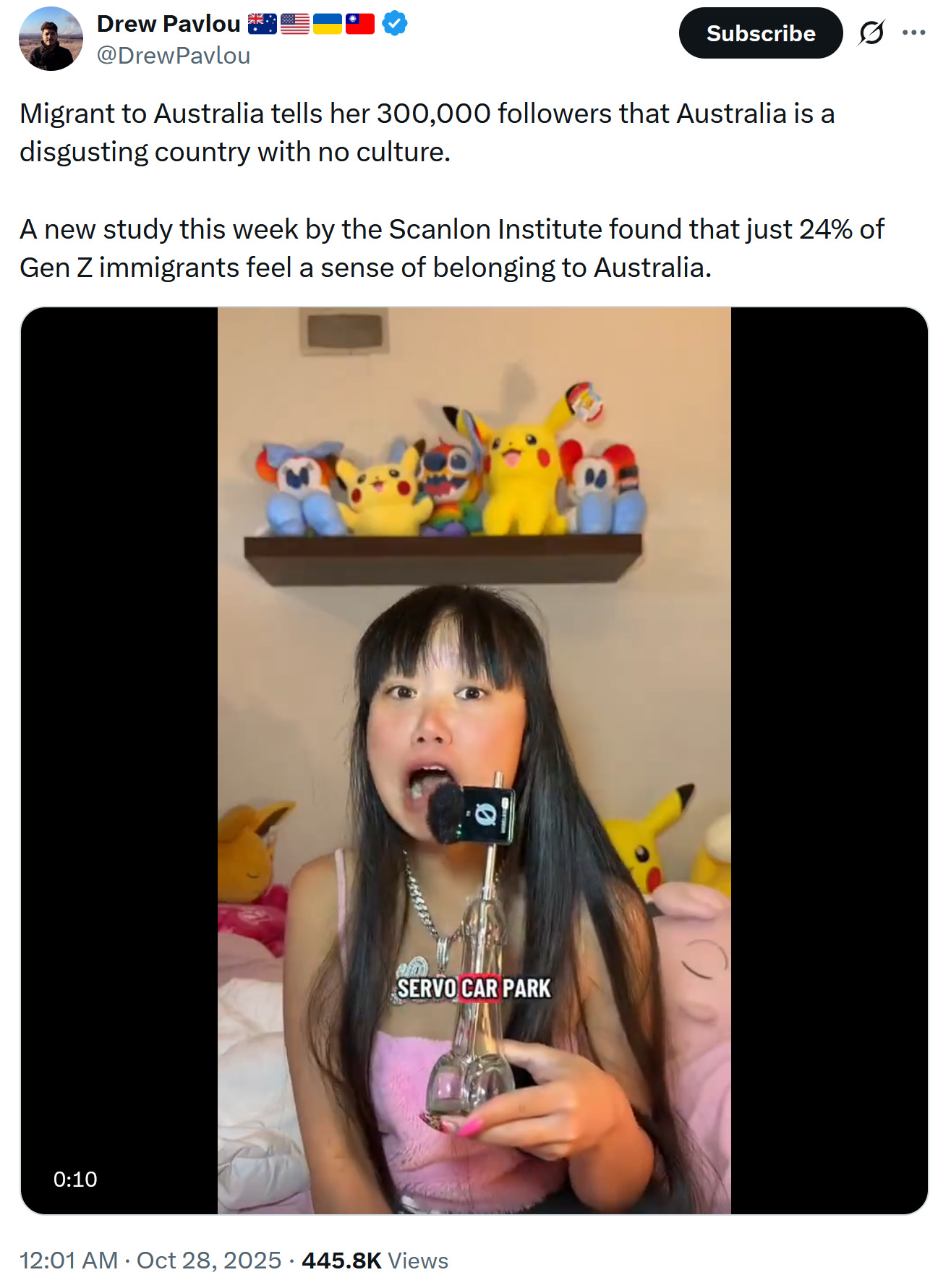
It has it all: the frantic hand-waving, immense amounts of trash-talk, the “I’m not angry you’re angry” act, accompanied with extreme disdain for fellow countrymen. It’d all be fine, honestly, if women like this weren’t considered just as patriotic as the rest of us, the exemplar of what it means to be a citizen of Australia, the U.S., wherever. This young woman will never know a better life than the one she has in Australia, yet this is how she chooses to use her freedom. Choice isn’t a virtue.
What explains the disparity between young and old immigrants? Obviously, indoctrination by Western culture and education, which is profoundly oikophobic and self-loathing, has a tremendous amount to do with it. But a lot of it’s also just decadence and immaturity. Living in America, even for a short amount of time, imbues one with certain expectations of life. Once you become accustomed to abundance, abundance becomes the baseline, and you forget what it means to live without it. You feel entitled to it.
Meanwhile, older immigrants had to make a life for themselves twice: first in their country of origin, now in a new country. They have a frame of reference, and can more easily see how much better life is in America or the West more broadly. They understand that nothing comes for free, they understand the importance of order, and simply have a more pragmatic outlook on life. Young people can be perfectly wonderful folks, but the fact is, they just don’t possess the wisdom that comes with a truly “lived” experience.
Combine decadence with youthful immaturity, that feeling that you know everything, that there’s nothing more to learn in life, that ability to relate with others, you can easily see why young immigrants and native-born children of immigrants diverge so wildly from their elders. Education is supposed to reinforce wisdom, but instead, it has the effect of reinforcing this very immaturity. Our society fails the young at all levels, in every way imaginable.
On being able to relate with others, something I’ve found is that younger people tend to claim more openness to other backgrounds and cultures, but they tend to be less open to other ways of thinking. This isn’t what we’re told, of course. We’re always told that older people who are more rigid in their thinking, and while that’s true in spades, older people also have figured out how to tolerate those who may not think the same as they do, and they understand better when it’s time to speak less and listen more. Maybe there’s a biological component to this as well: young people have a more adventurous outlook on life, a “take on the world” mentality. You can’t maintain civilization without people like this, but when not properly constrained, you get masses who want to saw off the branch we’re all sitting on.
To be clear, I’m not saying older immigrants always have a positive impact. Even they tend to vote Democratic in the U.S. as well, and voting patterns among non-Whites are overwhelmingly left-leaning. Once upon a time, certain groups, like Asians, voted more for Republicans, or at least split the vote, but those days are long over. However, older immigrants, regardless of voting patterns, also tend to be less culturally disruptive to a country. Thus, we see yet another contradiction - older immigrants assimilate less, because they’re more set in their ways, yet they also don’t try to impose their culture on their new society. Older immigrants have a “seen, but not heard” mentality when it comes to it, while younger immigrants or the second generation tend to play the game more and try to stand out more, in large part because our society encourages them to.
In fact, our society has a tendency to inflate the egos of immigrants, and this has a lot to do with why young foreigners or the second and third generations adopt such an adversarial attitude towards the country. If you’re the best thing that ever happened to America, if America needs you more than you need America, of course you’re going to feel like you have license to dress it down, along with a feeling that the country owes you something. You’re the one who built it and saved it from itself, after all. That incurs a lifetime debt, doesn’t it?
If Americans want a healthier discourse when it comes to immigration, it starts with ending the uncritical worship of immigrants and foreigners. I think liberals would or should agree with me on this: in a liberal democracy, there cannot be any sacred cows. Immigrants, of all people, shouldn’t be sacred cows. They’re just people. There’s nothing about them that makes them better than us. That’s not what it’s about, either. Citizenship is a matter of to whom a country holds its obligations to first and foremost. Foreigners should never, ever, have an equal voice in the conversation about what this country is and what it should be. It’s not because they’re lesser people. It’s because the country harbors no obligations to them.
For those who are citizens, but have still managed to adopt this adversarial personality towards their so-called country, it’s still important to end the uncritical worship of immigrants and foreigners. Since the West has such a weak identity, these young folks adopt a bizarre fusion of their stronger ancestral identity while slapping the label of their Western national association. For example, the young Chinese woman above might call herself Chinese, but you better call her Australian. There are millions of these people out there. The only way to combat this is to cultivate a society where the only identity that matters is one’s national identity, and that identity must be strong.
How we’re going to find our way back to strong identities in the West, I don’t know. I just know that’s the only solution.
The Boomers Aren’t Done Yet
Now that we’ve put older people over, let’s now throw them under the bus! Scott Greer writes that though he would’ve defended the Baby Boomer generation once upon a time, he won’t do so, not now:
But I would not write that article today. This generation is now clamoring for one of the most idiotic proposals imaginable–property tax elimination–while insisting their government benefits are fully protected and expanded. Boomer populism is now a cry to cut all their taxes while boosting their Social Security and Medicare. This is a terrible political formula. It will wreck the nation’s future at the expense of the young.
Unfortunately, it may prove successful during election season.
It’s imperative for the Right to reject boomer populism. The old already have disproportionate power over this country. The last thing we need to do is to allow them to extract more wealth from the nation at the public’s expense.
It’s natural for demographic groups to advocate for its own interests, even if these interests make for an illogical combination. Most Americans would love to pay fewer taxes and receive more government benefits. That’s not a workable system, however, which is why it rarely emerges as a serious political agenda. Tax cuts require spending cuts. One cannot have your cake and eat it, too.
Greer once superbly explained why property taxes are actually a good thing, and trying to lower or eliminate them isn’t just selfish, they’ll actually make life worse for us all. It’s ironic that it took someone on the Right, the faction stereotyped as universally opposed to taxation, to make the case for property taxes, but that just goes to underscore how bad the Left is at defending even its most strongly-held positions.
I think we all should agree that Americans pay lots of taxes in absolute terms, but we don’t always get the best bang for the buck. Still, it doesn’t change the fact we do get something about of it, and Medicare and Social Security are the two examples of how we do benefit in some measure from it. To continue funding both, as well as all the services we do derive some benefit from on a daily basis, cutting taxes isn’t the way to do it.
To bring immigration back into the fold:
It’s not an ideal situation as we need to do entitlement reforms–at some point. The obvious issues of financial sustainability and skyrocketing government debt aside, reforming these programs would also undermine demands for immigration. A common argument for increasing immigration is that we need these newcomers to pay into social security to keep it afloat. Reforming it would neuter that argument and make it even less necessary to import third worlders.
This calls to mind something Kaiser Bauch once said on his Substack [all bold mine]:
This is happening everywhere, not only in the West. A very common trope among right-wingers is something like: “Everyone can keep their ethnic homogeneity except the white countries, huh?” The reality, however, is that for a long time, there were basically only two kinds of countries wealthy enough to attract mass immigration: Western nations and a handful of East Asian ones. The rest of the world was either not rich enough to attract migrants, or it didn’t need them because of still-growing demographics.
This meant that the only real point of comparison for Westerners was Japan — which largely refused the path of mass immigration (though the number of foreigners in Japan has been increasing as well, albeit modestly). But my bet, and I am fairly confident in this, is that a couple of decades from now, when a whole range of countries around the globe are both relatively wealthy and beginning to feel the pinch of demographic crises (places like Colombia, Thailand, Malaysia, Chile, Argentina, Brazil, Turkey, Iran, and others are already seeing fertility collapse that will start to bite in about two decades), you will see Africans and South Asians in places you might not expect.
It is not the West that is the outlier — it is East Asia. And it remains to be seen whether even they will be able to withstand the demographic pressure without eventually succumbing to mass immigration.
At the risk of getting off-track, the lesson here is this: immigration is often a practical necessity. Even if you oppose it as much as I do, you wouldn’t be being honest with yourself if you left out the part of the story where a country that doesn’t generate economic activity in sufficient quantities isn’t going to be able to look after any of its people, the elderly especially.
Of course, this is in no way an argument in favor of mass immigration, which is always bad, and exceeds the point of diminishing returns very quickly. But it’s to say that even a country like Japan needs to, at some point, bring in outsiders if its native population isn’t reproducing at replacement level. And when you still have a country like the U.S. still around, why would anyone migrate to Japan?
More:
The demographic factors are locked in a self-reinforcing spiral: ageing populations require a gradual decline in the generosity of state pension systems on a significant scale, but that seems to be the politically undoable issue in the contemporary West. The average public expenditure on pensions in the OECD is 8% of GDP, usually by far the highest category of state spending. Relatively demographically healthier Western states like the United States pay about twice as much on pensions as they do on defense (7.4% of GDP on pensions versus 3.38% on defense). Germany pays six times what it spends on defense (12% versus 2%), France seven times, Italy about eleven times.
Governments of ageing countries thus run increasing budget deficits and accumulate large debts — also because creditors are always eager to lend to rich countries. But if you have large government debt, then you need your economy to grow by almost any means necessary, even if only in nominal terms. The way this whole debt game works is that having economic growth is even more important than the overall size of the debt. A country with debt at 100% of GDP but growing at 3% annually looks safer than one with 70% debt-to-GDP but no growth. Governments borrow by issuing bonds, which must be repaid with interest. If the economy is growing, tax revenues naturally rise. This makes it easier to cover interest payments without dramatically raising taxes or cutting spending.
He goes on to explain that immigration has become a very cheap way to achieve some economic growth. The problem with cheap measures rarely amount to a permanent solution. Western elites don’t just want immigration for cultural reasons - they want it because they know, without it, the effects of aging will come much sooner than anyone wants it to. The U.S. is in the same position, despite better demographic balance than Europe. But it’s still an aging society, and this is creating significant downward pressure because it’s costing more each year to look after retirees and the old, and there’s just so many of them.
I couldn’t even begin to tell you what it’d take to reform entitlements to where immigration becomes totally unnecessary. Maybe such a solution doesn’t exist. I’m of the belief that the system has to totally collapse before anything remotely resembling reform is even an option. If anyone knows an example of a country managing to successfully reform its entitlement system, please mention it, because I’m aware of no such example. In the meantime, we’re left with three choices, all of them bad: raise taxes, just print the money, or cut benefits. Thanks to history, I think we can take a wild guess as to which road we’ll go down. If you need a hint, raising taxes and cutting benefits leads to political disaster in all cases.
Eliminating property taxes wouldn’t even solve anything, anyway, not in the short- nor long-term. The only way cutting taxes works is if you cut spending, but nobody wants a reduction in services, ever. Certainly not with an aging population. This means the difference will need to be made up, and that comes in the form of raising income taxes, sales taxes, or some new tax altogether. Very quickly, neither the math nor the logic adds up.
It certainly won’t make it easier to buy property:
Advocates of eliminating property taxes claim it will help the housing crisis. In fact, it will likely make it worse. In order to offset the costs of not having property taxes, houses will increase in purchase price due to community fees and other assorted means. It also means that fewer boomers will want to sell their homes. The housing market already suffers from the old refusing to sell. Without property taxes, they will be further incentivized to stay right where they are.
A world without property taxes could mean young families have no good schools to send their kids to and hardly any homes to buy.
According to the National Association of Realtors, the average age of a first-time home-buyer is now 40. This is up seven years from only five years ago, a sign of how expensive housing has become. Now, before you declare a crisis, remember that America’s median age is a year or two below 40. The older a population gets, the older the average age of a first-time home-buyer will become as well. It’s mathematically impossible for the average age of a first-time home-buyer to be in the 20s when over 43 percent of the population is age 45 or older.
However, it takes people much longer to buy a home because they’ve become too expensive and wages haven’t kept up with inflation. This is a trend likely to accelerate in the future. Eliminating property taxes would help existing homeowners, most of whom are age 45 or older, but it would further lock anyone younger than that out of home ownership. It’s a recipe for disaster. If the cost of homes is going to rise either way, if the average age of a first-time home-buyer is going to go up either way, why accelerate the trend?
Greer’s bottom line:
It might bring the short-term benefit of electoral victories, but it will come at the price of exacerbating the housing crisis, upending public services, increasing worse taxes, and diminishing the overall quality of life for Boomers and non-Boomers alike.
America is already a gerontocracy. We witnessed this first-hand during COVID when the old forced the country to adopt insane lockdown restrictions to protect themselves. This hit the young the hardest, with many of our children losing valuable years thanks to this madness.
Greer points out how many Red state governors, namely Florida governor Ron DeSantis and Texas governor Greg Abbott, are floating elimination of property taxes as part of 2028 re-election bids. If they win, then this would only validate it as a viable political platform. However, America is still getting old. From a purely age-demographic standpoint, the Right may still have a substantial voter base. But if younger voters keep getting left out in the cold, if life keeps getting worse, not better, not only will this keep pushing young Americans left, it’ll also push them towards even more extreme political figures. They include far-leftists like New York City mayor-elect Zohran Mamdani, but, in the future, it could also include a far-right figure as well.
America has many problems, none of which can be solved with the political platforms of a generation or more ago. Nobody likes taxes besides liberals, but taxes are, in many cases, the only thing keeping things from getting worse more quickly. Older Americans are right to oppose higher taxes, but eliminating them altogether isn’t just selfish. It’s profoundly dangerous.
Aging Brings Stability And Stagnation
Let’s close out this entry with a short video by Peter Zeihan. He discusses something I touched upon recently:
It’s only over two minutes long, so definitely watch it, because he says plenty in a short period of time. One major implication is that Zeihan believes the days of overthrowing governments may well be over because the world lacks the “youth bulges” necessary for true revolutions. This is a profound shift in historical development. There are exceptions of course, like in Africa, where the overall population remains very young. But even elsewhere throughout the Third World, the early stages of aging have set in.
This raises questions worth serious consideration: if the days of overthrowing regimes is indeed over, what happens when they become stagnant? How is changed affected if the ruling classes of a given society feel no real threat to their power?
What are your answers to these questions? What are your thoughts on anything discussed here? Do you think older migrants are better or worse for a country?
Let’s talk about it in the comments section.
Max Remington writes about armed conflict and prepping. Follow him on Twitter at @AgentMax90.
If you liked this post from We're Not At the End, But You Can See It From Here, why not share? If you’re a first-time visitor, please consider subscribing!
One thing often not discussed by people who say "other countries spend less on health care and get better results" is rationing of care to the elderly. Retired? Hip and joint replacement is out-of-pocket. Have a terminal condition? If you're too close to expected life span, you only get palliative care.
I agree with everything you said here. All of these trends amount to using immigration in an attempt to keep the current system going at all costs.
So in Canada we got massive post-Covid immigration in part because big box stores wanted more employees (the immigration minister said that). We have to have more debt, so we need a higher GDP even if GDP per capita goes down. Third rate US colleges need foreign students to operate.
At a certain point we need to accept that sometimes institutions have to shrink and society has to live within its means. But it seems that baby boomers will never accept it.