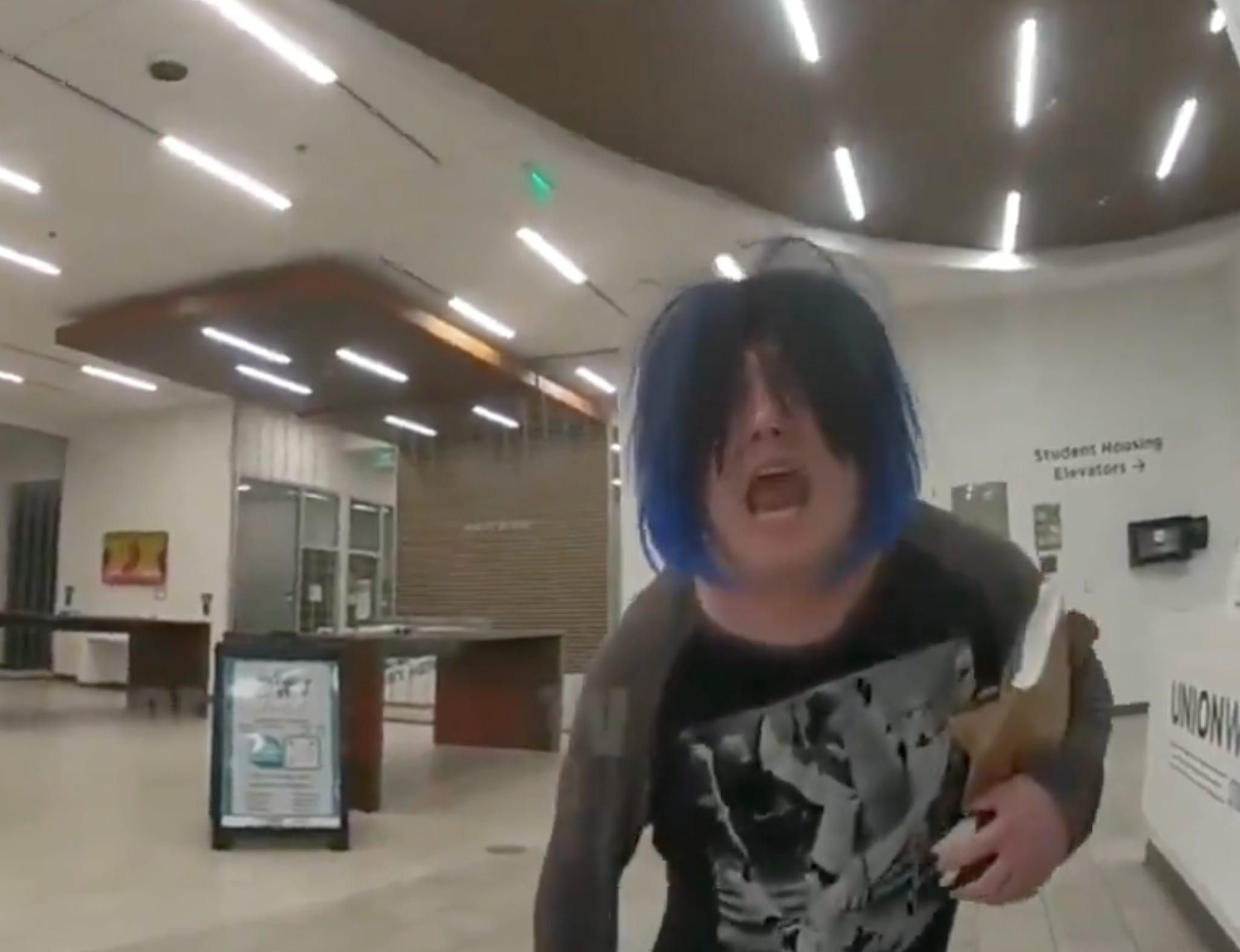
Police bodycam footage from February 2025 showing a transgender woman raging out uncontrollably to a police officer for being misgendered went viral:

A lot of people had a problem with the video. Not what the video captured. With the video itself. They felt like it amounted to public humiliation of someone clearly suffering from a mental illness, someone who deserves help, not shame.
Here’s an example of a less hysterical, but still wrong argument:

Leaving aside the fact that transgenderism isn’t supposed to be a mental illness, according to liberals, first off, this is an incident occurring in a place where nobody has a reasonable expectation of privacy. Second, any interaction with a police officer is a matter of public record, including any audio/visual recordings of the interaction. That this involved a transgender, someone suffering mental illness, doesn’t change that fact.
Third, cameras don’t only record what we want them to record. We only wanted bodycams to capture footage of police brutality, not all public behavior! seems to be the mentality of liberals. Again, it’s not up to them. This was the trade-off (or benefit, depending on your perspective) of police bodycams, that it wouldn’t only capture police conduct or misconduct. It would capture the behavior of everyone involved in or in the periphery of a given interaction with police. This is inevitable. Liberals not understanding trade-offs, not understanding how cameras work in general, remains undefeated.
There are a number of articles on the topic published over the last year addressing the issue of unintended consequences of widespread usage of bodycams by law enforcement. Except nothing about it is unintended nor unexpected. All of these consequences were foreseeable by anyone who pursued the topic with clear-eyed seriousness instead of childish outrage.
To deal with buyer’s remorse, the media is coping by shifting blame, criticizing the fact bodycam videos have become social media content (as if most things aren’t these days). Predictably, the far-left New York magazine ran a “Women Most Impacted”-premised essay on the topic. There really are no surprises left, are there?
Most of these articles are paywalled. Here’s a passage from one that’s not, getting at the heart of what the Left’s beef with bodycams is:
The channel, Code Blue Cam, is based in Wisconsin and boasts a subscriber base of more than 3 million, with total views exceeding 1.15 billion. The platform is a repository of videos showcasing high-speed pursuits, arrests involving intoxicated individuals, and other intense police encounters. These clips are sourced from police body cameras, edited to highlight dramatic moments, and presented with an added layer of commentary and sound effects.
Despite stating its mission as educational, Code Blue Cam has faced criticism for allegedly prioritizing sensationalism over content that truly informs the public. The channel’s creator, LJ, who remains anonymous for privacy and safety reasons, insists that the videos are meant to provide context on police work. However, some viewers and those featured in these videos feel otherwise, citing examples of content that seems to ridicule rather than educate.
Again, as opposed to what? Millions of videos on social media of “Karens,” mostly White women supposedly getting what they deserve for being disrespectful towards service workers and others? Nobody seems to have a problem with that. Besides, what would a society care about ridicule or sensationalism when everyone’s first and last impulse is to take out their phones to record anyone and anything in public, then post it instantly, often for clout, without bothering to provide a better understanding of what’s happening?
Since police bodycams concern a defining political issue for the Left, however, being reasonable, sober, and judicious is suddenly important. An AI-generated article on the topic elaborates on other concerns:
Potential for Biased or Manipulated Footage
Another concern is the potential for body camera footage to be biased or manipulated. Footage can be edited, selectively released, or manipulated to support a particular narrative. This can be particularly problematic in situations where there are conflicting accounts of an incident.
O RLY? You mean like the way supposedly reputable mainstream media outlets, whom we’re all suppose to trust without question, have for decades used videos filmed by the public to propagate inaccurate, incomplete, or even false accounts of interactions with police? I suppose two wrongs don’t make a right, but we’re not trying to right any wrongs here.
The point is that all footage is subject to manipulation, regardless of the source. The concern over police bodycam footage being subject to impropriety was never extended to footage captured by the public. It says less about the high standards we hold our law enforcement officers to and more about the low standards we hold ourselves to.
Furthermore, police bodycam footage cannot be so easily altered. The original recordings are meant to be preserved; nobody, not chiefs, not even system administrators, can alter or delete footage. Bodycams are also provided through contractors, meaning there’s always a third party involved in that chain of custody. Is footage often censored or edited prior to public dissemination? Yes, but there are a million reasons besides lying why an agency might do that: graphic nature, witness protection, evidence preservation, just to name a few. I’ve watched lots of police bodycam videos over the years and agencies always make the full-length videos available. It’s the media that doesn’t.
In the first major incident where supposed police misconduct was caught on video, the media infamously never broadcast the entirety of the footage of Rodney King’s beating in March 1991. Surely, the full-length video being almost nine minutes long had something to do with it. But the media never showed any other parts of it, either, only the outrage-inducing parts. It left out parts that provided important context, not to mention just a complete account of what took place that night.
The full-length video was certainly shown in court and, eventually, other parts of the video were released publicly over the years. But not only did most people never see the whole video, nor have a choice to see it all, when it mattered most, the public saw at most several seconds out of nine minutes. It makes you wonder: how would the Rodney King incident have gone down in the era of bodycams?
Back to the present. Eventually, complaints about bodycams come back around to one of the biggest reasons liberals and police critics demanded them in the first place:
Exacerbating Existing Inequalities
Body cameras can also exacerbate existing inequalities by disproportionately surveilling marginalized communities. Research has shown that police are more likely to stop and search individuals from marginalized communities, and body cameras can provide a permanent record of these interactions.
The Impact of Body Cameras on Marginalized Communities
The impact of body cameras on marginalized communities is a pressing concern. Marginalized communities are already subject to disproportionate policing and surveillance, and body cameras can perpetuate this cycle.
Surveillance and Control of Marginalized Communities
Body cameras can be used to surveil and control marginalized communities, perpetuating systemic racism and inequality. This can have a chilling effect on individuals’ willingness to interact with police or report crimes.
Disproportionate Impact on Communities of Color
Communities of color are disproportionately impacted by body cameras, as they are more likely to be stopped, searched, and arrested by police. Body cameras can provide a permanent record of these interactions, which can be used to justify further policing and surveillance.
Potential for Body Cameras to Perpetuate Systemic Racism
The use of body cameras can perpetuate systemic racism by reinforcing existing biases and stereotypes. Footage can be used to justify discriminatory policing practices, and can be used as evidence in court cases.
Did your eyes roll reading all that? Mine sure did. So, the thing that was supposed to protect marginalized communities, people of color, and fight against systemic racism is now part of the oppression regime. Putting aside the fact no such thing exists, if even bodycams can’t save black people from getting shot by police or going to prison, what can? Have they tried just not committing crime, not causing problems, or not giving police a tough time?
It’s time to cut the crap - the problem isn’t that anyone’s being shamed or publicly humiliated. We all know that’s par for the course. No, the real problem is that bodycams aren’t telling the story liberals intended for them to tell. They don’t show rampant police brutality, they don’t show systemic racism, they don’t show blacks and other criminals behaving like civilized, law-abiding citizens. Instead, police bodycams expose the reality of policing. They show how many criminals actually are black, how violent they can truly be, how much restraint police do exercise, and just how dangerous the profession of law enforcement actually is. I think it’s even humbled the silent majority of liberals.
Without a doubt, bodycams are one of the biggest own-goals by the Left:


Some liberals counter by saying bodycams worked because they incentivize police officers to better behave themselves, therefore, the policy is achieving the intended outcomes. This is cope, because that’s not how it works.
Though based on data nearly a decade old at this point, a 2022 federal government study revealed bodycams didn’t change much:
According to the 2018 BJS report, the main reasons (about 80% each) that local police and sheriffs’ offices had acquired body-worn cameras were to improve officer safety, increase evidence quality, reduce civilian complaints, and reduce agency liability.
Research does not necessarily support the effectiveness of body-worn cameras in achieving those desired outcomes. A comprehensive review of 70 studies of body-worn cameras use found that the larger body of research on body-worn cameras showed no consistent or no statistically significant effects.[3] This meta-analysis was rated by CrimeSolutions and resulted in a No Effects rating for the impact of body-worn cameras on use of force, assaults on officers, officer-initiated calls for service, arrests, traffic stops and tickets, and field interviews (i.e., stop and frisk). See Practice Profile: Body-Worn Cameras’ Effects on Police Officer Behavior. This profile is based on a meta-analysis published in 2020.
The same report shows that in cities with high crime rates, like Washington, D.C., or at least a high rate of police interactions, like New York City, bodycams were to no real benefit or detriment. That’s not to say they didn’t help anywhere - they did, in fact, in many places. It’s to say, however, that overall, the impact they had wasn’t all that strong.
What does this say? This says, most importantly, that bodycams don’t change the nature of crime and disorder in a given area, nor does it change the nature of policing. Bodycams don’t make bad people go away, it doesn’t make bad people less bad, and they absolutely don’t make police kinder and gentler. All they do is provide a record of events. Their greatest benefit is that they provide the facts, a better understanding to any reasonable person who hasn’t been brainwashed as to what actually happens out there.
Furthermore, if the policy is working as liberals intended, then why are police brutality and systemic racism still problems? Do problems ever get solved, in the minds of liberals? Certainly not. These are moral panics and moral panics need to be constantly fueled.
The bottom line is this: bodycams haven’t changed minds. The best they’ve done is that they’ve taken away one less issue for the Left to mobilize over. Millions of Americans still believe in rampant police brutality and systemic racism in the justice system. What they can no longer do is make a big issue out of it. It went from being a foundational one to being a tangential one.
Still, the Left will occasionally make a big deal out of a police shooting. Currently, discord is growing in Madison, Wisconsin over the police shooting of Corey Ruiz, who resisted arrest and allegedly stabbed an officer before being shot and killed.
Here’s the thing: there’s no bodycam footage of the incident. Madison Police Department doesn’t use them. As a result, far-left agitators, including former Madison city councilmember Juliana Bennett, pounced, and are now trying to turn Ruiz into a George Floyd-like martryr. Some things never change.
But wait - there’s a twist to the story! [bold mine]:
In 2015, the council rejected a body-camera pilot by a 19-1 vote. In 2017, it removed $123,000 from the capital budget that would have funded 47 cameras and related equipment. A limited pilot in the North District was eventually approved in 2023 by a 16-4 vote after years of study. The four “no” votes included then-Alder Juliana Bennett, along with Alders Nikki Conklin, Yannette Figueroa Cole and Sabrina Madison. Bennett had previously proposed language directing the city not to pursue either a pilot or full deployment of body cameras. Bennett, who left the council and is now the DSA-endorsed Democratic candidate for the 76th Assembly District
In November 2025, during debate on the 2026 operating budget, Alders Barbara Harrington-McKinney, Isadore Knox Jr. and Joann Pritchett offered a floor amendment that would have redirected approximately $405,000 from the Office of the Independent Monitor to staff positions needed to support a body-camera program. The amendment failed 17-3. Only the three sponsors voted yes. The majority of the council, including progressive members, rejected the funding shift. Body cameras were instead placed on a “horizon list” for possible future consideration.
Says everything, doesn’t it? Why vote down bodycams if they’re so important? I strongly doubt it was out of fiscal prudence or a clear-eyed examination of the benefits and trade-offs. Someone like Juliana Bennett cares about neither, nor do they possess the intellect for doing so. She probably opposed bodycams either because she wanted the money to go to something else or because she knew bodycams wouldn’t help at all.
If even a BLM, “Defund the Police” progressive doesn’t believe in bodycams, what more proof do you need that they were neither the solution nor the problem to begin with? Not a single one of these people cared about Corey Ruiz until he got shot and killed by police. Not a single one of these people’s minds would change if the police had been wearing bodycams. If their minds could be changed, they wouldn’t have jumped to conclusions and called it murder. We’ve seen this play out far too many times to know otherwise. If you already know what happened, then does the evidence matter?
Again, we’ve seen this play out many times before. Bodycam footage was available in both the shootings of Renee Good and Alex Pretti. Everyone still thinks the shootings were murder. So, what would it matter if ICE agents didn’t have their bodycams turned on in the shooting of Johan Sebastián Durán more recently in Maine, cynical as that may be to say? It could show both a legally and morally justified shooting and nobody’s minds would change. That’s because learning the truth never mattered. Upholding the ideology does. Whomever said we live in a “post-truth,” “post-fact” world was correct. They just didn’t realize they were projecting, as usual.
There are many lessons here. I think the most useful one for anyone who hasn’t been completely ideologically captured to learn, but likely never will, is that public outrage is an awful reason to adopt policy change. One can view the implementation of bodycams as a net positive while also acknowledging that it was not the outcome of sober, judicious, reasoned public debate, but rather a moral panic.
As explained by Force Science:
Without question, “accountability” and “transparency” are vital to an ordered society. However, their timing and placement as top priorities of reform activists and politicians served as a not-so-subtle indictment of law enforcement. Calls for accountability did more than imply police were routinely getting away with misconduct; they were often coupled with express accusations of murder, even in cases where racism and misconduct had been ruled out.
Outcomes matter. Widespread use of bodycams by police was objectively the right decision. It’s also true that sometimes, change doesn’t happen absent public outrage. But if liberals really think the consequences of bodycams were truly unintended, that’s because their expectations didn’t align with reality. Furthermore, it demonstrates their inability to think things through, their emotional impulsiveness, and the failure to understand that everything comes with trade-offs, most of which can be clearly seen well ahead of time. It just takes experience, maturity, and wisdom, the kinds of things you can’t learn in school or from scrolling through social media.
It’s yet another reason why such important, consequential decision should never be made by the masses. But when we worship democracy like it’s God, giving everyone the vote at the cost of destroying everything we built is merely the Lord working in mysterious ways.
What The Flock?
Flock cameras (known for by their manufacturer, Flock Safety) are increasingly becoming a public controversy in cities across the country. Deployed in various cities for public safety, concerns about civil liberties and privacy are forcing a debate on the cameras.

I personally find the whole debate intellectually dishonest, given all the other infringements on our privacy we tolerate, but we’ll set that aside for now. There’s still a worthwhile debate to be had.
Former law enforcement officer Keith Vincent, host of the excellent The Common Sense Practical Prepper podcast, covered the topic in a recent episode. He explains why Flock camera might be worth being concerned about, saying:
So the flock cameras, what are they exactly? They are automated license plate readers, ALPRs. They create a searchable digital record of your vehicle’s movements, and they’re not rare. Many cities have hundreds, if not thousands, of these cameras set up. It’s all over the news, it's all over social media. Most of you out there are probably familiar with them here in the States. So Flock Safety alone reportedly has 40,000 cameras deployed across the country, and every single day they add more. And they don’t have them just in high crime areas. They’re in suburbs, schools, residential streets, entrance to neighborhoods. Some HOAs even have them installed at the entrance of their subdivisions, meaning that your HOA, if it’s on private property, your HOA is now part of this surveillance network and they have access to some of that data.
Vincent explains Flock cameras, as well as public safety cameras in general, aren’t useless. In fact, they do the job they’re intended to do:
Now, I will give credit where credit is due. This camera has helped recover stolen vehicles, missing people, murder suspects, kidnapped people, and that side of it works. Perfect. I get it. If your car gets stolen and somebody drives past a flock camera, which they probably will, there’s a real good chance that the police will get a hit on that license plate and they'll find out which direction it's heading. If a child goes missing and the suspect’s plate is in the system, that’s a tool to help bring the child home. I’m not dismissing that. But in anything else, technology needs to be used for good, not evil. These are not just useless toys up on little poles. So the question is not whether they can do good. The question is whether the trade-off is worth it and whether anyone’s actually watching the watchers.
Trade-offs. That thing that grown-ups are supposed to consider, first and foremost, but liberals, The Most Educated People Ever, never do. But I think we’ve beat up on liberals enough. What are the trade-offs, exactly?
Before getting to that, we all already know what a lot of folks would say: Don’t care, I’ve got nothing to hide. I’ve heard this line so many times, including from loved ones. We all have the freedom to think whatever we want, but it doesn’t make it right. It’s dead wrong, in fact, to say we’ve got nothing to worry about as long as we’ve got nothing to hide. Not only that, it’s a dangerous thought.
First and most important, we don’t just allow authorities access to our lives because we have a right to presumption of innocence. That presumption of innocence is upheld by authorities not having access to our personal lives upon demand or monitoring our behavior 24/7. All relationships, even loving relationships, are ultimately upheld by boundaries. It’s one thing to be open and transparent. It’s another thing to have someone looking over your shoulder at all times. That’s a relationship based on mistrust.
Second, as Keith Vincent said:
The “nothing to hide” isn’t an argument. It’s an assumption that the rules won't change. It assumes that people with access to the data will always be trustworthy and the political environment will always be stable. And no one will ever redefine what suspicious means. History tells us otherwise. So let me put this a different way. You might not have anything to hide from the government under these laws today, but data lasts longer than administration's, and once it exists, the data gets used.
To confess, I don’t find it an entirely unreasonable assumption that the political environment will always be stable. It’s been quite stable our whole lives. But I’d also challenge that assumption by having you reflect on how much has changed in just the last quarter-century. I’m not just talking about the USA PATRIOT Act, either. I’m talking about our culture, our way of living. We live in a surveillance society already, despite swearing up and down it’d never come to pass. Though the state remains stable, our politics are becoming more turbulent. Things change. Everything’s fine until it’s not. Welcome to the Fourth Turning.
Vincent offers the United Kingdom as an example of how quickly even a free, liberal, democratic society can become a full-blown surveillance police state. Certainly, the British state has far less restrictions than the American state does in terms of exercising its vast powers. In practice, however, this just means it’s going to take the U.S. longer to get to where the UK is, but get there, it probably will. It also means the American state will simply outsource its surveillance state duties to outside contractors like Flock Safety instead of doing all the dirty work itself.
Listen to the entirety of Keith Vincent’s podcast episode on the topic if you can, it’s not that long. What do I think? At this point, I’m resigned to both the surveillance state and more authoritarian government akin to that of the UK coming to the U.S. As our society fails to self-govern, as we continuously look towards a single source of power for the answer to all our problems, the state’s power will expand, even as we rail against the government, ironically. Each administration, each faction, will find an excuse to employ greater surveillance capabilities, often for ideological reasons.
In some cases, surveillance capabilities will also be dropped for ideological reasons, as was already done with the ShotSpotter system in cities like Chicago, for, like bodycams, revealed the amount of deadly violence that was occurring in neighborhoods predominated by blacks. At the same time, they’ll increase surveillance capabilities in other areas, in the name of combating other threats, such as the mythical far-right White supremacist threat that’s supposed to kick off a civil war and mass racial violence in America at any moment, but never does.
The surveillance state is here to stay. There’s no undoing it. The question is: how do we ensure it’s utilized for non-ideological purposes? Ironically, only a powerful, non-ideological authoritarian state could ensure that.
Between that and tyranny, options are few. The system cannot be reformed. History tells us that. As survivalist and Bosnian War survivor Selco Begovic explains:
In many places and countries in the world, it is where we are now – democracy waiting to become tyranny.
Some regions are more or less in the process, but eventually we are all there.
If I want to strip it down to essence, Plato’s above statement is about democracy bringing too much “freedom “, because people tend to look for “absolute rights and freedoms“. It eventually brings out all kinds of s..t “wrapped” in rights and freedoms, so society goes into social disorder more or less.
Eventually a “saviour“ emerges, who promises to solve all problems, but guess what he turns out to be?
A tyrant, not a saviour.
So then there is Tyranny.
Sounds familiar with all problems in every “western modern“ country?
If you want the state to make everything, including not being offended, a civil right, the state needs to have power to enforce that. Ironically, the very things that were supposed to make us free only end up making the state more powerful in the process.
If anyone wants to argue that it was worth it, by all means do so. Just don’t go off lying acting like these were unintended consequences. The trade-offs were all very clear and obvious to all except the unintelligent and unwise.
Hope It Was Worth It!
This discussion ended up going on much longer than I anticipated, so let’s wrap up here.
Whether bodycams or Flock cameras, both are examples of what many people thought were obvious, no-brainer solutions to seemingly obvious problems. In the case of the former, bodycams were thought to be the solution to police brutality and systemic racism. All they did was reveal how violent the streets could be, the stress police are under, and that black people are a problem. In the case of the latter, you have a solution that worked, but is also contributing to the increasing power of the state as we inch closer to empire, tyranny, or both.
It’s all an expensive, highly contentiuous way of learning among the earliest lessons our parents try to teach us: Think before you act.
What do you think? Were bodycams worth the trouble? Why have liberals and progressives suddenly soured on them? What do you think of Flock cameras? Let’s discuss it in the comments.
Max Remington writes about armed conflict and prepping. Follow him on Twitter at @AgentMax90.
If you liked this post from We're Not At the End, But You Can See It From Here, why not share? If you’re a first-time visitor, please consider subscribing!
It appears police response is mostly dictated by the violence of bad guys not the fear of the bodycam. Even with (maybe especially with) cameras, cops operate by the same rule as anyone who's ever studied self-defense: better to be judged by 12 than carried by 6.
CodeBlueCam is just the old 90's show COPS for the social media generation: "Bad boys, bad boys. Whacha gonna do? Whacha you gonna do when they come for you?" We don't need a ride-along film crew anymore; every cop now carries his own.
Excellent essay. A lot of good observations and lines, but these two I especially liked:
"It says less about the high standards we hold our law enforcement officers to and more about the low standards we hold ourselves to."
"It’s yet another reason why such important, consequential decisions should never be made by the masses. But when we worship democracy like it’s God, giving everyone the vote at the cost of destroying everything we built is merely the Lord working in mysterious ways."