Democracy: Crime's Best Friend
Democracy shouldn't be synonymous with "soft on crime."
I often disagree with Richard Hanania on lots of things, but I also think he’s one of those types who gets it very right when he does. Crime is one of those issues he gets right.
Though generally an anti-populist, Hanania does note that in developing countries with serious institutional problems, sometimes, the only answer is heavy-handed policies often favored by populists [bold mine]:
I think Latin America demonstrates this most clearly. Achieving a monopoly on the use of force is the most basic function of a state. When you see a country with a high murder rate, the costs go way beyond the actual deaths suffered by victims. The numbers are a reflection of the general unpleasantness of life there. Countries with high murder rates suffer from bad behavior that degrades the human experience across the board, from robberies and violent assaults to gang intimidation of normal citizens and loud music in public.
There’s a lot worth taking from that passage. The highlighted statement gets at something that’s at the heart of so many of our problems in America. If you ask most Americans what they think the role of government is, they might agree that safety is one of those responsibilities. However, you may get push-back when you say safety, established through a monopoly on the use of force, is the top priority or even the only true responsibility of the government.
In America, because safety is more or less a given, government is expected to do much more besides provide protection. They’re supposed to guarantee life outcomes, ensure equality and fairness in all arenas of life, make life affordable, the list goes on and on. With too many responsibilities, however, government can quickly lose sight of what’s most important, which is to provide order.
In fact, nothing can destroy the legitimacy of political leaders or even the state as quickly as failing to maintain order:

Sure, in cities run by Democrat leadership, which is most cities in the United States, the party continues to dominate politics despite perpetual failure to ensure order. Election results are a poor metric by which to judge governance, however, because politics has become so factionalized in the U.S. The high levels of discontent expressed by citizens is a much better way to assess whether government is doing its job or not. They may keep voting for the same people and the same party, but it doesn’t mean they approve of what they’re doing, strange as that sounds.
Still, crime isn’t a major issue in America today, not like it once was. Though many on the Right would balk, the reality is, we live in a safer country today than we did when we were kids. As I’ve explained many times before, the problem in America today is disorder, not that crime is out of control.
What about countries where crime is a serious problem, like in Latin America? First, it’s worth considering just how dangerous it really is south of the border:
Latin America really stands out. Nations like Brazil (homicide rate: 20.6), Colombia (24.9), and Mexico (24.9) have incomes that are similar to China (0.5), Azerbaijan (2.0), and Georgia (2.0). Honduras (31.4) is about as wealthy as Pakistan (4.3) and Kenya (4.9).
Hanania’s argument is that economic development isn’t a strong predictor of what countries are safe and which ones aren’t. Forms of government are, however, and not in the way conventional wisdom might have you expect:
We see here that, for non-democracies, wealth pretty much predicts murder rate in a straightforward way. Not a single dictatorship has an unusually high murder rate, at least compared to the residuals we get for Latin America. The Substacker Inquisitive Bird has argued that the homicide numbers in Africa are largely made up and can’t be trusted. To test whether this is a problem for my theory, I simply added 10 homicides per 100,000 for each sub-Saharan African country, and the results were similar. The more violent Latin American states still had massive residuals, nearly unchanged.
Latin America isn’t wealthy. But they’re far removed from Third World destitution. They’re developing world, middle-income countries where the standard of living is still significantly higher than most of the world. Yet, crime remains a huge problem. According to Hanania, there appears to be a correlation with democracy.
Like most things in life, it’s important to think critically about the topic, but not overthink it. Most people will travel to authoritarian or less-than-democratic countries and report how safe it is, while more democratic Latin America is consistently described as unsafe:
Even if authoritarian regimes fudge the data, the official statistics roughly fit with what we know about the world. It is assumed by travelers that your risk of being kidnapped or murdered is astronomically higher in Mexico or Colombia than China or Jordan. The numbers here pass the commonsense test.
If you go to websites like Numbeo.com or Nomads.com, you can get a sense of what vox populi think about various places in the world. Latin American cities and countries consistently rank as not safe, even if not dangerous, either. Not everything’s based off a negative stereotype. By the way, how did the stereotype come about, anyway?
It’s important not to misunderstand what Hanania is saying: democracy doesn’t cause crime, but democracy and high crime rates go together. For the purposes of discussion, he categorizes countries into three broad categories: rich and safe countries, authoritarian and safe, and democratic middle-to-lower-income countries, which are both safe and violent, and most of Latin America falls into that third group.
How strong is that relationship between crime and democracy?
Most Latin American nations fall into category three. The same is true for the three major non-Latin American outliers with unusually high murder rates: Trinidad and Tobago, Jamaica, and South Africa. Each of these gets a Polity score of 9. Note that Cuba, the most authoritarian country in Latin America, is not known for street violence, even though we don’t have numbers. Venezuela, in contrast, has in recent years had an unusual combination of authoritarianism and wide scale violence. But there just aren’t that many dictatorships with a very high murder rate.
That point about Venezuela is interesting, because though it serves as a poster child for the failures of authoritarianism, it’s also an outlier. You really don’t see many examples of it elsewhere in the world. Hanania mentions Cuba, but you could also cite China, Vietnam, even North Korea, as examples of authoritarian states which don’t have high rates of crime. How this outcome is achieved is certainly a controversial, yet separate matter.
So what’s the relationship between crime and democracy? After all, everything is nice in a democracy and when you let people live freely as possible, it leads to human flourishing, and henceforth less crime, no?
If only life were so easy:
Why would democracy be such a good predictor of societal violence? Note that the way we define “democracy” in political science generally includes a respect for civil liberties. This means you don’t torture suspects or keep them locked up without strong evidence. Such nations get warrants before making searches, grant defendants lawyers, and remind them of their right to remain silent.
That’s good, right? Sure, but our privilege is showing:
In a rich country, these are luxuries that society can afford. The police are paid relatively well and get some basic level of training. They have larger budgets with which to fight crime, and, since corruption is more under control, less of it is stolen or wasted. The court system is more reliable, and is pretty good at distinguishing those who pose a danger to the community from those who don’t.
Even in America’s early days, we resorted to what we today would absolutely consider heavy-handed or mob justice to maintain order. Civil rights, due process, all these things Americans hold sacred, can only exist in an orderly setting. One of the great crisis of our time is that Americans seem intent on creating as chaotic and disorderly a society as possible, while still insisting that we all retain our civil and due process rights.
In less developed countries, obsessing over civil rights isn’t an affordable luxury:
In contrast, if you’re a relatively poor country with few resources and little state capacity, granting protections to suspected and convicted criminals is a major hindrance to keeping order. Law enforcement and court officials can be intimidated or bribed, and their attention and resources are stretched thin. Gangs are able to control more territory, murderers are less likely to be punished, and deterrence breaks down. In recent years in the US, the murder clearance rate has been about 50%-60%. That’s very bad from a first world perspective, but in countries like Mexico and Honduras, it’s closer to 10-20%, and this is quite remarkable given that state officials themselves are often the targets. In Latin America, there are stories of gang bosses running their empires from prison, which would be unthinkable in most dictatorships. The US regularly pressures Mexico to send us their drug lords, because otherwise they might escape from prison at home.
For the U.S. or any other First World country to condemn a Second or Third World country for using heavy-handed, “un-democratic” means of dealing with crime is to do exactly what the same liberals accuse the “privileged,” be they White, male, or wealthy of doing: lecturing the less fortunate and oppressed in how to fix their problems. Strangely, that rule no longer applies when it comes to other countries.
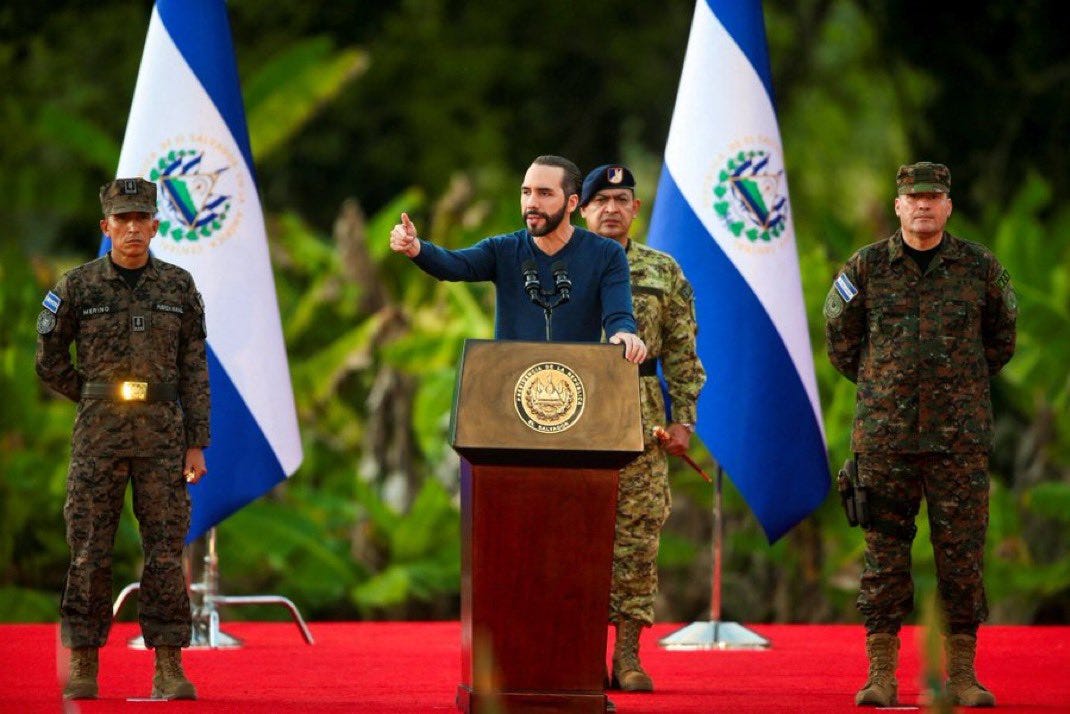
We see this most clearly when it comes to El Salvador and how the country under the leadership of President Nayib Bukele became one of the safest in the region. Bukele has endured relentless criticism from leftist politicians and the media for using “un-democratic” means of making life better for the people. That’s not the whole story, either - I bet these same people would either praise Bukele or at least say nothing if he used the power of the state to provide free healthcare or college for all. It’s the fact he’s battling crime that pisses them off. Tolerance of crime has, unfortunately, become a liberal value.
Another liberal value is that there’s no trade-off between civil liberty and safety. The logic is that a truly guilty party will be found guilty even when their civil rights are fully protected. If anything, the fact that one’s civil rights were protected gives prosecution and conviction more credibility. That makes sense in theory, but it assumes a perfect balance is struck between civil rights and safety. Perfect balances exist only in theory. In reality, you gravitate towards one or the other, and in the U.S. as well as most of the First World, protecting one’s civil rights seems to have firmly taken precedence over safety.
In fact, attempting to strike that balance has very much become an indelible part of American culture to where it’s depicted quite regularly in popular culture:
The idea that there’s a tradeoff between civil liberties protecting criminal suspects and public safety is a staple of police dramas like The Shield. The cops pick up some bad character who everyone knows is guilty or has information important for breaking a case. But there’s no proof that could hold up in court. So the antihero turns off the camera, and does what needs to be done. The criminal is like “I exercise my right to a lawyer” and the cop goes “oh I’ve got your lawyer right here” and starts stabbing him with a pen. The case is eventually solved, and we are left to ponder the moral ambiguity of the story. Seems like writers for TV shows are more comfortable with unpleasant tradeoffs than most people who analyze politics.
I actually finished watching The Shield from start to finish last year. The show very much lives up to the hype as one the best ever. As Hanania says, the show excellently depicts the struggle inherent in trying to put bad people away while also doing so “the right way.” It also shows that sometimes the only way to put bad guys away is to do it the “wrong way,” it’s just that the line between the justifiable and the unethical/immoral is very thin.
Again, however, few countries have the luxury of doing everything the right way because the right way is only possible in countries that have gotten their crime situation under control and established order. El Salvador is the most recent example - how else exactly was Nayib Bukele supposed to bring law and order to a lawless and disorderly country while sticking to democratic norms? Suggestions are lacking because there are none. Left unsaid is that democracy and rights in general mean nothing when your society is effectively anarchical, functioning in accordance with Darwinistic principles. Under such conditions, democracy reinforces Darwinism and “might is right.”
Liberals are loathe to admit, but safety stems from strength, and one overwhelmingly strong entity - the state - must impose it:
So in the case of Bukele, we’ve seen a move away from civil liberties coincide with an increase in public safety. We’ve also observed this process moving in the other direction: democratization accompanied by the breakdown of public order. In 1980, Brazil had a murder rate of 11.7 per 100,000. It inched up the next few years, and in 1985, military rule ended. The homicide rate shot up over the next two decades, reaching 28.9 in 2003. It’s decreased somewhat since then, but the homicide rate remains highly elevated compared to what it was in the last years of authoritarian rule, even though Brazil is 50% wealthier.
That’s an interesting fact I never knew, that Brazil’s crime rate shot up after the military dictatorship ended. But should we be surprised? In fact, those nostalgic for authoritarian times often cite less crime and safety as a reason. South Korea is the only country I can think of which didn’t become more dangerous after becoming democratic. Hanania further cites Russia’s high-crime period during the 1990s, followed by gradual decline once Vladimir Putin came to power. Putin is less a blunt dictator and more accurately described as an autocrat, but the same lesson applies: the more authoritarian a government, the more orderly a society, and thus the more safe it is.
The question then becomes: is that orderliness and safety worth trading off political freedom? Americans are of the mind that the answer should be an empathic “no,” but I don’t think the answer should be that obvious. If we are allowed a wider latitude with which to defend ourselves, our families, and our property, it might be worth it to enjoy more political freedom.
But we actually have strict restrictions imposed on our ability to use force in defense of self, others, and property. This suggests that, over time, the state becomes more powerful, and as it does, it ultimately trends towards possessing an even greater monopoly on the use of force. It’s not all that different from a state becoming increasingly democratic, only to become a tyranny as a result.
This essay isn’t the place to dress down democracy or philosophically debate the virtues of authoritarianism versus democracy. But as Hanania explains, if there’s anything authoritarianism does well, it’s in its most basic, most fundamental of duties [bold mine]:
You’re probably tempted to say that the problem is not democracy and rights for criminals per se, but state capacity. Which is true enough. But, again, it seems like you need the combination of both low state capacity and rights for criminals to get an unusually high murder rate. Authoritarian governments don’t do a lot of things well, but they can at least maintain order, even while being incompetent in other areas. I suspect that this is because maintaining order is easy, relative to all other things governments try to do. When civil liberties protections aren’t in the way, you just need to target the troublemakers, and who they are isn’t an unsolvable mystery. Criminals are pretty dumb, and in some cases, they even get tattoos on their faces and make things as easy as possible for the authorities. El Salvador is an extreme case in the number of mass arrests, but that’s usually not necessary, since under most authoritarian regimes you end up with a less violent equilibrium and law enforcement can zero in on the few individuals who might be a problem. That is to say that Bukele’s roundups probably don’t need to go on indefinitely.
In the U.S., you hear things like “complicated” and “no easy answers” when people debate crime. This is all nonsense, of course. It’s only complicated because, thanks to the Civil Rights revolution, among other things, America has pathologized crime into something to empathize with rather than a problem to deal with. Like Hanania says, crime isn’t a difficult problem to solve. It takes effort, certainly. But it’s not some big mystery how to solve it. At some point, you want more crime or less crime.
The frustration with our society pathologizing crime and our elected representatives coming up with all sorts of retarded excuses for why we can’t deal with crime contributes to populist sentiment, specifically on the Right:
All over the world, populists say that the system is broken, and you need a strongman who is going to bulldoze over opposition and democratic niceties. This is probably not a very good argument in a country where things are going relatively well, like the United States. But if your nation truly is broken, then you may rationally be willing to take a chance on something radical. A country that has a murder rate of 30 per 100,000 should be considered a failed state, and one that is inevitably going to lose legitimacy. There’s a reason that Bukele’s approval rating is almost always found to be over 90%. His popularity indicates that Western elites have massively underestimated the importance of public order.
Without trying to speak for Hanania, when he says “things are going relatively well,” I doubt he means there are no problems in the U.S. However, the U.S. is still nowhere near as bad as it is in most countries. That’s just a fact. It’s not just crime, either. Our immigration problem, which overlaps with crime, is nowhere nearly as big a crisis as it’s in Europe. I think the Right too often overstates our problems to a hyperbolic degree, which opens it up to accusations from both the Left and the general public of fearmongering, making the arguments much more difficult to be received. It’s why Donald Trump is still too much for most Americans. Forcing people to swallow a lot at one time never works.
Hanania made mention of Nayib Bukele’s popularity, citing it as an indicative of how important creating an orderly society is for political legitimacy:


In my opinion, there’s no big mystery to this. Nor does it have any useful application to an American context. El Salvador was one of the world’s most violent countries, arguably the most violent in the Western Hemisphere, for generations. They lived with this for decades before finally reaching a breaking point. As I keep saying, things have to be bad for a long time before people are willing to give someone like Bukele a chance. This isn’t the sort of thing that happened in an election cycle.
Sure, Americans are a highly indoctrinated, psy-opped people. But that’s not the only reason why there’s so little demand for a truly radical right-wing Caesar-like leader such as Nayib Bukele just yet. The other reason is mere pragmatism; things just aren’t bad enough to demand such drastic, heavy-handed leadership, a fact that the Right, again, really struggles with. In some ways, Trump, who’s always been somewhere between a conventional but bombastic president and a true populist, is a better fit for America’s current moment, even as he remains a bit much.
Hanania makes note of something that’s always bugged me:
If a government massacres a hundred citizens, there’s an international outcry. But if it lets an order of magnitude more people be killed in the name of civil liberties, no one cares all that much, and if human rights NGOs express concern, it’s usually over what methods the government might take in response.
To liberals, who dominate politics today, state violence is the gravest sin a government can commit. Strangely, though, the failure of the state to fulfill its most basic function, which is to protect, doesn’t create anything remotely close to the same level of condemnation and outrage. A state will receive far more criticism, as Hanania says, for not responding “correctly” to problems like crime and disorder. The reaction to the Trump administration’s anti-illegal immigration enforcement operations have drawn far more criticism than illegal immigration itself, and the police always receive more criticism than the criminals.
Part of what explains this mentality is the belief, especially among Americans, that authorities must always act ethically and morally. It’s not wrong; there’s nothing more American than to believe in doing the right thing no matter what. That said, liberals not only weaponize this belief, they also fail to understand that the “right” thing isn’t always what does the least amount of harm.
To fix a big problem, the right way is to take strong measures. To deal with violent criminals, violence must be employed against them. Most importantly, anything other than protecting people is missing the point. If the state, in the interest of doing as little harm as possible, protecting civil liberties, costs lives and property, then not only does this constitute dereliction of duty, the state is responsible for those losses. I’ve written about this in length, but not only have countless lives been lost to anarcho-tyranny, not only will we never know how many, there will never be any justice for the victims, aside from the collapse of the Regime and everyone being tossed from power.
There’s plenty of attention paid to how states directly harm their people. There’s next to nothing said about how states indirectly do so by failing or outright refusing to deal with a problem because they prioritize upholding civil rights at all costs.
Speaking of cost, Hanania also notes that economic growth has been more sluggish in Latin America than Asia. I personally think this is more of a structural problem, but I also believe a country like Mexico, for example, which has been mired in a low-grade civil war with its drug cartels for generations now, can never become an economic powerhouse even if it had everything else it needed.
Right-wing populism has undergone a swift rebuke over the last few years, but it’s important to remember that they’re not uniformly good or bad as a group:
I think people struggle with nuance here. Trump, Orban, Bolsonaro, Bukele, and Milei all fall under the umbrella of right-wing populists. Observers tend to have the same view of all of them, either in favor or against. But they each face a set of completely different challenges. Maybe if Trump was born in El Salvador, he’d be a great leader, because you need a thuggish brute in order to get control of a country as violent as that nation was before Bukele. But in America, violence isn’t that big of a problem, we can afford to grant the full menu of civil liberties protections, and the president doesn’t even have much influence over non-federal crimes anyway, so Trump’s thuggish instincts are directed toward trying to lock up his enemies. I probably wouldn’t vote for Bukele if he were running for president of the United States. But someone like him might make a good mayor of Baltimore.
Most Americans who support Trump did so for pragmatic reasons: he became a nominee, he became president twice, so are we really going to say “no?” This doesn’t make him above criticism, as MAGA insists, however. He has serious defects, has failed in many ways, and we need to allow ourselves to be honest about it. I once observed that Trump was a president ahead of his time in the sense that things weren’t so apparently bad that we needed someone so radical in office. The fact he was so early to the game, I think, worked against him and has ended up hurting more than helping.
I bring this up because, as Hanania says, America might be in trouble, but it’s far, far removed from a country in genuine crisis like El Salvador. He mentions Jair Bolsonaro and Javier Milei; both Brazil and Argentina have been dealing with far worse in every respect than the U.S. for generations now. Though neither country is anything to aspire to, they prove that there’s a lot of ruin to be had in a republic, as someone once said. In the end, Trump’s legacy might be that he served as a wake-up call to the trouble America was in, only to bring that trouble to a crisis much sooner than anyone would’ve liked.
My point is this: in a true crisis, there won’t be anywhere near as much hand-wringing about “authoritarianism,” except in elite, establishment circles. Trump isn’t liked throughout Latin America, but he’s not an unusual type of leader down there, either. I also think part of Trump’s ineffectiveness is due to the fact the U.S. isn’t a country built for an autocrat. Latin America has a much longer history of autocracy, on the other hand, and their states more conducive to authoritarian rule.
The U.S. might be headed for authoritarianism, but I also think it’ll be of a different kind, and again, the country isn’t set up well for a Bukele or even Orban-type leader. As Hanania says, I think populist or even Caesar-like leadership will prove more decisive at the local or state level, while being less so at the national level. Like Hanania also says, crime isn’t really something to be fixed at the national level, anyway. A cultural shift against crime and disorder is going to be more critical than anything the president can do.
I feel like I’ve shared most of his essay, but do read it in its entirety to get the whole picture. Again, the argument isn’t so much that democracy leads to more crime, but high crime rates and democracy go together. One of the most difficult points to get across to people when discussing politics is that there are very real trade-offs in every policy choice made. In a democracy, both leaders and the citizenry have to be clear-eyed and upfront about them to achieve functional governance.
Politics does need a moral foundation, but that morality must have a pragmatic foundation also. It doesn’t make much practical sense to so steadfastly defend the civil rights regime as people are being killed and criminals are racking up large rap sheets before they get put down for the count. It’s nice to think we can have both, but again, in reality, that balance is difficult to strike. It’s not that we shouldn’t try, but obsessing over it ends up missing the point entirely. Besides, in trying to strike that balance, America, along with the West as a whole, ended up favoring upholding the civil rights regime at all cost, because we decided that was more important than making society safer. How else do you think a phrase like “law and order” became fascist-coded? It’s not by accident.
The health of our democracy, governance, and politics would be much better if we were honest about the trade-offs we’re making. Unfortunately, we’re not. All failures are characterized as moral or systemic, when in reality they’re often the product of very deliberate policy and personal choices. If the law says you can’t arrest a criminal because ‘X’, ‘Y’, and ‘Z’ weren’t checked off, you’re making a trade-off to where they can continue offending until either all ‘i’s are dotted and ‘t’s crossed or they’re killed by police, at which point a tidal wave of outrage from the Left and racialists will ensue as to the injustice of it all. Meanwhile, not only is there next to nothing said in the public discourse about the injustice of upholding civil rights for criminals at all costs, complaining about crime in general is deemed low-status, so most people say nothing.
This is very much a cultural problem as it is political. In New York, a black criminal was arrested recently for murdering a 76-year-old man after shoving him down a flight of steps. As you might imagine, this was not his first rodeo, and the reason why it took a murder for him to finally face some real justice is infuriating [bold mine]:
She said the attack left her and her friend “in shock,” but they ultimately chose not to cooperate with prosecutors — a decision she now regrets after Burke was charged with murder on Friday for allegedly hurling 76-year-old stranger Ross Falzone to his death at a Chelsea subway station Thursday night.
Police had taken the violent brute to Bellevue Hospital for “acting erratically” Thursday afternoon before he was released about an hour later and allegedly launched the deadly unprovoked attack later that night.
“I regret it 100% and I actually feel really bad that a man lost his life,” the woman said.
“Maybe a part of me was just like, I don’t want to put another black man in jail, but, you know, at some point, if you are a criminal, you’re a criminal, and he was scary, he was a scary guy.”
It sounds satirical, but it’s not. It’s real-life. Richard Hanania is correct that democracy hurts more than helps when it comes to dealing with crime and disorder. But no political solution will ever endure as long as we have a culture that excuses, pathologizes, and rationalizes it.
Your Privilege Is Showing
Only a liberal could say something so mindlessly absurd:

Leaving aside the fact nobody really “chooses” anarchy or fascism, imagine the level of privilege a person must enjoy to say such a thing. It’s like a child who grows up in a wealthy household saying she can endure living in a shack as long as she’s happy. When you want for nothing, having everything feels burdensome.
When a person has known nothing but civilization and order their whole lives, that too feels burdensome and stifling. And in a way, it ought to be. They don’t come for free. If a person doesn’t feel the burden of responsibility for maintaining civilization and order from time to time, they can’t be expected to be good citizens.
But that’s not what’s happening here. This is a person, one among many, who feels like order itself is the problem, that it oppresses rather than liberates, that it stifles rather than inspires, that order is the source of injustice rather than
In fact, anarchy is arguably the most oppressive state of (dis)order because your entire existence is centered on physical, life-or-death survival. At least under fascism, there’s order, most if not all of your basic needs are met, and you can go to bed at the end of each day with the reasonable expectation you’ll wake up the next day alive and well. This isn’t the case with anarchy, which is ruthlessly Darwinistic, where the strong crush the weak, where the barbaric overwhelm the civilized.
In fact, it’s most ironic for a liberal to prefer anarchy, since they’re so fairness and justice-minded. One of the chief virtues of liberals is that might doesn’t make right, that the strong shouldn’t be allowed to dominate the weak by default, that the weak and less fortunate should be protected by the strong. You need civilization and order to make that possible, however. Read the memoirs of people like Selco Begovic, people who’ve actually lived through anarchy. You’re going to get killed quicker than you can cite your civil rights to anything.
Fascism is, of course, an ideology built off Social Darwinism and the “might makes right,” “only the strong survive” principles. But the suggestion that liberal virtues are safer under anarchy is retarded, the idea that a state of complete disorder - anarchy - is preferable to a state of complete order - fascism - even more so. The fact that such a choice might have to even be made further suggests they’d have lots of problems to worry about that go well beyond ideological disputes. If you have to debate the virtues of anarchy versus fascism, prepare to die, basically.
By the way, I feel the same towards conservatives who say they’d rather live under fascism than what we live under now. I can understand the sentiment to an extent - fascism is predictable, and predictability is a crucial component of order. But as with liberals who prefer anarchy over fascism, conservatives who prefer fascism over what we have now have never lived in a world with less political freedom. In both cases, the problem is that both liberals and conservatives believe they’ll be just fine under their desired state.
They won’t.
Final Thoughts
Democracy shouldn’t be synonymous with “soft on crime.” Unfortunately, it seems this is much tougher to achieve in practice. It’s not just democracy, either. As I hope I’ve convincingly explained here and there, culture matters, also. Democracy has come to be synonymous with being soft on crime because civil rights ideology is a state religion.
Still, if democracy can so easily turn society into a free-for-all, then democracy itself must be on the hook. All forms of government should be judged on their outcomes, not their virtues, yet democracy is the one form of government which seems exempt from this rule. Yet the easiest way to make people lose faith in democracy is to deliver bad outcomes. It’s not so much that people will ask for their right to vote to be taken away - if anything, people will insist on more democracy - it’s that people will use democracy to vote in the kinds of people who shouldn’t be anywhere near power. Remember: you don’t elect Caesar. Caesar saves you from the elected.
Richard Hanania gets much wrong on a range of topics, but he gets this much right:

What do you think? Is there a relationship between crime and democracy? Share your thoughts in the comments.
Max Remington writes about armed conflict and prepping. Follow him on Twitter at @AgentMax90.
If you liked this post from We're Not At the End, But You Can See It From Here, why not share? If you’re a first-time visitor, please consider subscribing!
Tolerance of crime is a luxury belief, one whose prevalence is highly correlated to personal income. This is true everywhere in the world, whether in gated suburbs in America or private armed guards in Brazil.
"Anarchy is preferable to fascism" LOL! That hilarious. even more so that sucuh comments usually derive from college educated women. When I give my students the list of government systems, I describe authoritarianism (fascism) is "do what the king says" and anarchy as "do whatever you want until someone with a bigger stick comes around; then do what he wants." The boys are, "yeah, I'll get the biggest stick." However, the expressions on the girls faces... they immediately understand what anarchy means for them. And yet universities manage to make them forget.
I wouldn’t blame democracy, exactly. In Canada, for example, the majority traditionally supported the death penalty, but governments including supposedly right wing governments did nothing about it. Currently crime is going up, as the courts and legal system have basically decided crime is ok.
I think that rule by lawyers and bureaucrats is basically the problem. Practical men like veterans, police and business leaders need not apply. Basically soft men and women creating hard times.