Make America Walkable Again (MAWA)
I’m not a moralistic thinker, but I think America could benefit from a non-ideological discussion on how our lives have become too far apart, too dependent on automobiles.
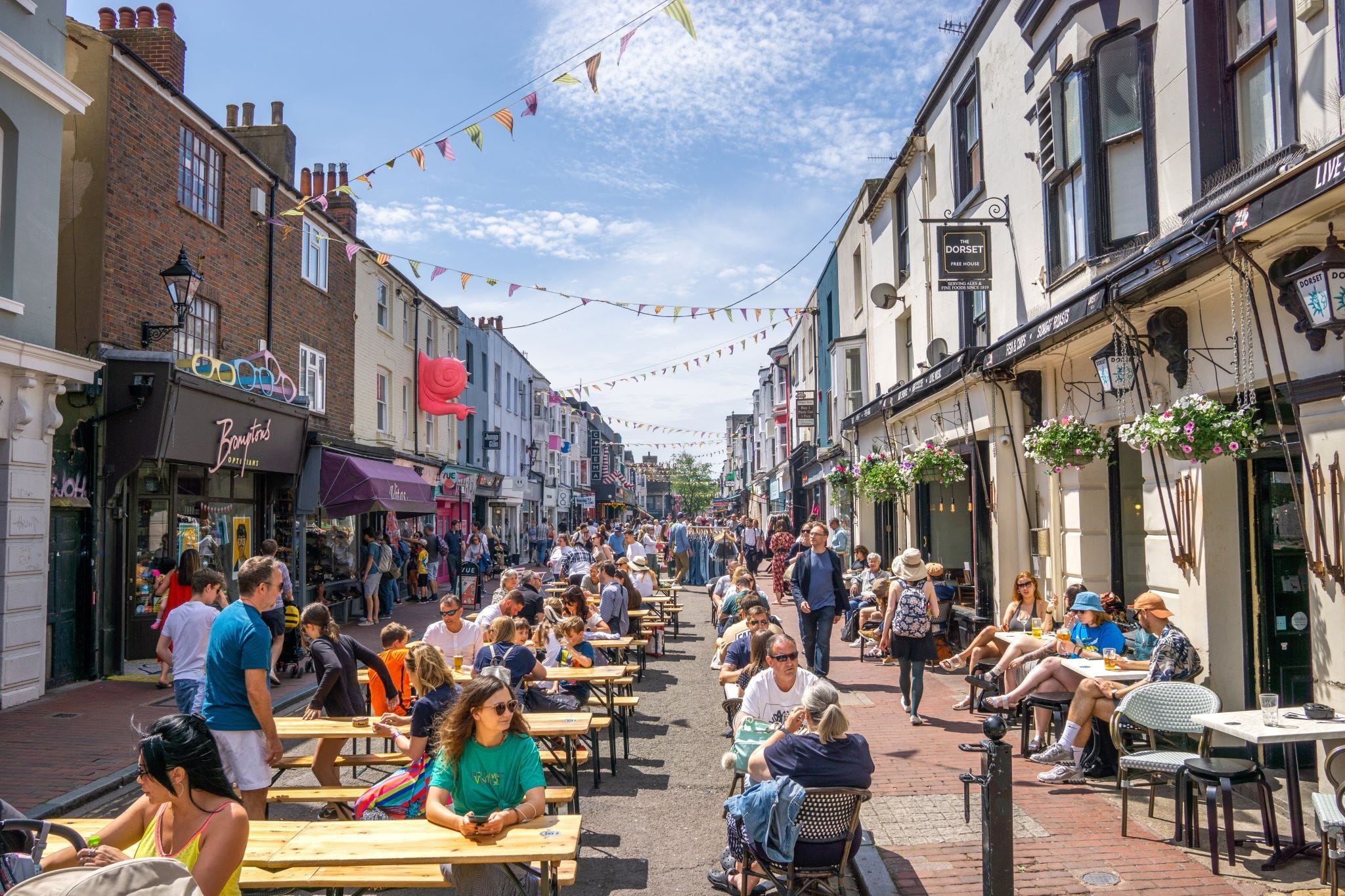
Let’s talk about something else today. I came across this excellent video made by the excellent YouTuber “flurfdesign” asking the question:
This is sort of a departure from my usual fare. However, urban design doesn’t exist in a vacuum. It says a lot about a society, how it functions, and what it values more and what it values less. I’m not a moralistic thinker, but I think America could benefit from a non-ideological discussion on how our lives have become too far apart, too dependent on automobiles.
Clocking in at almost 18 minutes, I hope you’ll all watch the video, as flurfdesign, whose real name is Brice, makes a supremely convincing argument. As someone who travels the world frequently, one of the things this exposes to me is how chaotic, disorderly, and nonsensical American life can be. I’m supremely proud to be American (though not in a Lee Greenwood, “God Bless the USA” kind of way), and I refuse to badmouth my country in front of foreigners. However, I also don’t pretend like we don’t have problems, nor do I pretend like we do everything right. America does, in fact, do a lot of things wrong. Our automobile culture is one of them.
Don’t get me wrong - though not a motorhead, I love cars and I love having my own. I simply recognize that having your entire culture, your entire society, centered on owning and operating a motor vehicle does come with significant trade-offs. Yes, it’s nice having autonomy. Yes, it’s nice being able to move large amounts of goods at once on your own. It does make life easier in many ways. But it also sucks having to travel relatively long distances for the most mundane of things. It sucks being stuck in traffic on a daily basis (something I, thankfully, don’t really deal with). It sucks having to be constantly on alert for dangerous drivers when being a pedestrian.
Moreover, a strong argument can be made for our automobile culture and the increasing suburbanization of America leading to today’s social atomization. The fact is, both have literally driven Americans apart. If you go to any other country, even in rural areas, people often live close to one another. There isn’t a big distance between one’s personal life and professional life, either. That’s not to say long commutes don’t exist in other countries. But it’s to say that you don’t have this thing where a person lives two hours one way from where they work because that’s not only what they can afford, it also offers their family the best quality of life.
Brice offers some history as to how America became so automobile-centric and suburbanized. What I’ll add is that America is such a big country and, unlike other big countries, was established with the intention of taking advantage of all this available land. How big is the U.S.? So big, despite one of the world’s largest populations, it has one of the world’s lowest population densities. Even China, despite a greater landmass and a population several times larger, has a significantly higher population density.
For a land mass and population of its size, the U.S. is also unique in that it lacks something which has become so common throughout the world: the megacity. Only New York and Los Angeles fit the description. This isn’t a bad thing; high-density living isn’t all that its cracked up to be. But it does show the extent to how dispersed American life is. When people can choose to far proximity to others, our lifestyles, mores, and norms will reflect that preference for distance. In some ways, suburban sprawl is a substitute for urban development.
It never comes down to any one reason for why any of this is. But culture has a lot to do with it. A culture which values individualism, like the U.S., will obviously value autonomy more. A culture with values collectivism, like China, will obviously value community more. Each system has its advantages and disadvantages. People come to America precisely because people prefer having greater autonomy than not. Even more community-oriented societies aren’t necessarily better at taking care of people; China routinely sees hundreds or even thousands die from natural disaster, despite its collectivist orientation. Totalitarian states are pretty good at sacrificing the lives of its people, aren’t they?
At the same time, China is, in many ways, a safer society than America. I’m tired of hearing it, but that doesn’t make it false - despite being the most developed, most powerful country ever, the U.S. is, relatively speaking, a violent country. We’ll speak more on that later, but for now, the point is that our culture of autonomy has downsides, one of them being that it makes people into competitors more than cooperators. Driving exacerbates this tendency.
Enjoy Responsibly. But How?
Brice’s video focuses on alcohol consumption, the role that plays in socialization, and how drinking culture is in many ways what makes people belong. America isn’t any different, but our automobile dependence makes drinking more dangerous than it ought to be. Far too many people die annually as a result of driving while intoxicated, but even if you managed to bring such fatalities down to a minimal level, this could really only come about as a result of people just quitting going out and drinking, which would have the trade-off of our societies becoming even more atomized, even lonelier. The fact is, socializing out in public over alcoholic beverages is important to the cohesiveness of society.
Brice also points out that the U.S. raised the drinking age to 21 because of the number of youth deaths as a result of drinking and driving. While this, along with other measures, did bring down drunk driving deaths, they’ve also leveled off, meaning there’s not going to be any fewer such deaths without big-time lifestyle changes. As long as Americans remain car-dependent, drunk driving will remain a major risk. Compare this to other countries which have much lower drinking ages, but alcohol-related deaths are much, much fewer.
A key point to Brice’s argument is that personal responsibility will only take you so far. Like most Americans, I think personal responsibility is important. But I don’t think this is a uniquely American value, either. If anything, I think Americans struggle with personal responsibility in large part because our culture fails to instill any kind of real moral framework in people. I often point out that the only thing Americans seem to agree on is “Mind Your Own Business.” But a society cannot be built around such an anti-social ethos. Americans seem to want a more community-oriented society, but this inevitably entails minding the business of others, since one of the tenants of community is that our actions do affect others.
The answer isn’t to shift away from personal responsibility, like liberals seem to want. Individuals must always retain agency. However, we do need institutions to incentivize personal responsibility, as well as mitigate the human propensity for error. Americans, especially many on the Right, can be overly reactionary to such propositions. But just think - if you can very clearly do something that’ll prevent hundreds of unnecessary deaths a year, why wouldn’t you do it?
Remember that once upon a time, many Americans were resistant to seat-belt laws. But there’s no question seat-belt laws saved lives. So did drunk-driving laws, which weren’t always enforced, as Brice points out. What critics of such policy remedies willfully ignore is that things like drunk driving don’t just put the drunk driver at risk - they put everyone else at risk. Are hundreds of even thousands of more deaths per year worth some abstract notion of liberty and freedom from a “nanny state?”
In an unrelated example, consider the resistance to installing netting around the infield stands at Major League Baseball parks. “Get off your phone, pay attention to the game!” those in opposition said. But here’s the thing - even when you pay attention, the ball still comes at you real fast. Even fly balls, which many deem relatively harmless compared to a line drive, fall fast due to this thing called gravity. Moreover, it’s simply not practical to be 100 percent focused on the game at all times. Distractions exist. Humans are imperfect, thus it makes sense to take measures to mitigate the impact of human imperfection.
Since installing netting, nobody that I’m aware of has even suffered a major injury from a ball hit into the stands. Certainly, nobody has died. Anyone still want to argue against the measure?
The thing is, even when you do everything right, nothing will save you from someone who decides they’re going to barrel through an intersection on a red light, anyway. For my part, I always wait one second and look both ways before going on green. It costs me nothing and if it saves me from getting T-boned, it’s worth more than winning the lottery, honestly. Even then, I sometimes wonder how many accidents I’ve been able to avoid simply because other drivers chose not to drive recklessly. I may have eliminated the risk of traffic accidents at intersections, but what about when driving next another vehicle and them changing lanes without checking? How do I protect myself against something like that?
It’s for this reason our dependence on automobiles needs to be lessened through policy measures. Routine diminishes a sense of danger, but the danger remains. Millions of Americans take great risks daily simply by hitting the roads. If we want fewer deaths, if we want to be able to enjoy things like an alcoholic beverage with friends, we need to be willing to make policy changes instead of simply relying on personal responsibility.
This doesn’t mean all measures are justifiable or worth doing. For example, I’ve stood consistently opposed to red light or even speeding cameras. This isn’t because I run red lights or because I speed. It’s because these cameras, in practice, become distractions, yet another thing for drivers to fixate on while performing an already dangerous task, because who wants to be slapped with a $70 fine? Sometimes, the better choice is to run a yellow, if not a red, because stopping so suddenly is quite dangerous, especially in busy intersections.
Similarly, Brice argues in his video that highway safety messages not only don’t make us safer, they also become distractions. Again, the difference between theory and practice rears its ugly head. Though policy changes like seat belt laws and raising the drinking age did lower deaths, beyond that, little else really made an impact, because the underlying issue is that Americans are so car-dependent, and operating a motor vehicle is the most dangerous thing most Americans will ever do in their daily lives.
Few Fixes
The only thing left? Land usage and urban design. But that’d entail a wholesale re-conceptualization of life in America. For one, zoning laws would need to be revised or even abolished. Few things are more “American” than zoning laws, which segregate commercial and residential spaces. The obvious downside is that it creates automobile dependence through distance. At the same time, if people had to bear the noise created by living near businesses and human traffic, they might come to appreciate zoning laws.
One potential remedy is to create smaller residential neighborhoods. The thing about suburban sprawl is exactly that - it’s just too damn big. I personally live in an area comprised of both homes and apartments, which is also small enough that I don’t have to go very far to reach a commercial area. Thus, my car repair shop, convenience stores, even a bar, are all within walking distance. There’s even doctors and dentists a short distance away. There’s a tremendous amount of vehicle traffic in the area, yet when at home, I hardly hear any of it.
At the same time, because of automobile dependency, vehicle traffic is much greater than foot traffic by an order of magnitude. As Brice points out in his video, I agree that sometimes I feel very exposed, as if all eyes are on me, as I walk to the bar or some other establishment. I can’t be the only one who feels this way. Pedestrianism begets pedestrianism - if you want people to use their feet more than their wheels, you need to make them feel safe in doing so. Having more people walking is one way of doing it.
Once a society is made automobile-dependent, though, is there really any way to turn the car around, pun intended? Let’s say someone re-designed a neighborhood in a city to be more walkable. This wouldn’t change the number of cars. They’d need to be re-directed somehow, potentially causing even more traffic problems due to less road availability. Let’s say a city also tried to make a city more walkable by reducing the number of lanes in a road - how do you think that’d go down? Remember that many of these vehicles are driven by people who don’t live there and don’t have as much a reason to walk around as those who live there. Is it worth inconveniencing that many people so the few who live in a given neighborhood can better enjoy life?
Another potential solution is to improve public transit. However, in America, even public transit has to travel long distances to move people around, since everything is so far apart. Sometimes, the hardest thing to do is to comprehend a transit map. Trying to use public transit which isn’t extensive or well-developed can be complicated, involving multiple route changes in the process. It’s much easier in a city like, say, London, because the system is so extensive and you don’t need to go too far for the simplest of things.
In the U.S., there’s comparatively less investment in public transit because of automobile dependency. There’s just no big incentive for it. But again, since everything is so far apart, even with a more extensive public transit system, it wouldn’t always be reliable. In Los Angeles, the distance between the west side of the city and downtown is over 10 miles, and that’s drawing a straight line. Imagine if you had to rely on public transportation to make that commute daily. I’m sure some people have done this, but that doesn’t make it a good idea.
Even in cities with relatively decent public transit, cars are still part of the equation. I once lived in a metropolitan area where you had to drive in order to get to the subway station. Then you had to park your car - which wasn’t for free - before getting on the train. Point being, when your society is designed around using land inefficiently, in the sense you try giving everyone a large plot of land and draw a stark line between one’s work and personal lives, you can’t do it without relying on automobiles.
As Brice explained in another video, walkable cities need to be designed with public transit foremost in mind. There are many examples of neighborhoods designed with walkability and public transit use in mind, but because public transit wasn’t in place as people and businesses began to move in, it created dependency on automobiles. Once that dependency is established, it’s very difficult to reverse course because you’d have to force people to re-adapt to new ways of living. To have walkable cities, the transportation infrastructure has to be in place and operational first.
There’s also the issue of cost. American urban areas are notoriously expensive to live in, a big reason people move out to the suburbs. Yes, homes are expensive, too. But at least with a home, you get more for your money. In cities, even studio apartments can be ridiculously pricey. That and it’s not easy to raise families in close quarters. Even in other countries, raising families in cities is tough, with urbanization playing a major role in declining birthrates. I don’t know how to begin to address the cost problem. Do you?
I haven’t even mentioned safety, which we’ll discuss in a moment. For now, it’s enough to say that improving walkability as well as reducing automobile dependence entails a wholesale re-imagining of American life, and to undo over two-and-a-half centuries of our history. It’s not going to happen, not like that. As long as things like home ownership, having your “slice of heaven,” are the only ways to get ahead in life, as long as cities remain notoriously expensive places, walkability will remain under the “Nice To Have” column.
U.S. Cities Are Literal Jungles
Let’s talk safety and how this makes walkability a moot point. I mentioned earlier that the U.S. is probably the most violent developed country in the world. I think this isn’t always the most fair characterization, since one’s risk of victimization is contingent on a whole host of other variables, but it’s a simple fact that America has lots of criminals, lots of violent people. Unless you eliminate them from society, unless we take crime more seriously, most people are going to resist walking around on foot.
The reason why mass immigration has become the defining issue in Europe is because the entire continent was such a safe place until Third Worlders began showing up en masse. Even now, despite the extreme savagery of these Third Worlders, Europe is still a safer place than the U.S. Mass immigration certainly doesn’t help, but I’ll level with liberals in saying that America’s violence problem cannot be blamed on immigration. We were a violent country even during more homogeneous times.
Of course, the blame for a lot of our violence falls on the black community. This is the thing most people throughout the world don’t understand - our rates of crime are driven by this one group alone. It’s not Whites who are doing the vast majority of our killing. In addition, blacks populate much of our urban centers. As long as this toxic combination remains intact, cities can never be safer places.
How direct is the connection between blackness and crime? Take a look at data out of Cincinnati:


Even as a greater proportion of the population, Whites are still grossly underrepresented in crime and violence. I’m not sure how much longer we can keep pretending like this connection doesn’t exist, or that it’s the fault of White supremacy. No matter the reason, cities where downtowns are routinely overrun by violent “youths,” a often-used media euphemism for young blacks, aren’t going to draw anyone in, no matter how walkable it might be.
In fact, one of the reasons the demand for suburban living never waned is because of how dangerous American urban areas became during the 1960s-onward. Cities today are less White than they’ve ever been because they departed generations ago due to crime. There’s a saying which goes something like, “The goal of American life is to make as much money as possible to get away from the consequences of the Civil Rights Act.” Even liberals refuse to live in areas with lots of blacks, though they cite safety, not racial animus, as their reason for doing so, as if safety has nothing to do with the kinds of people who live in a certain area.
The bottom line is that unless Americans kick their addiction to disorder, unless we stop viewing law enforcement as a civil rights violation, unless Americans quit making excuses for the black community, we cannot have safer cities. Incidents like the savage murder of Iryna Zarutska on a light rail train in Charlotte, North Carolina show just how many dangerous people are walking our streets. You cannot expect anyone to use something like public transportation regularly if they have reason to believe that, at some point during the year, they’ll have to share a ride with someone like Zarutska’s murderer. Again, Europe is in turmoil because the introduction of Third World migrants has upended their tranquility, and they find themselves completely defenseless in the face of it.
It can’t all be blamed on blacks, either. As I said before, because America values autonomy, it has the effect of making Americans into direct competitors with one another. Nowhere is this more apparent than on the roadways. On the road, behind the wheel of a moving vehicle, otherwise law-abiding, peaceful Americans can turn into violent savages as well. Road rage is a huge problem in the U.S., turning people into criminals or victims like no other. It stems mainly from frustration with traffic, whereas a less vehicle-dependent society would have more pedestrians, and thus greater incentive for drivers to exercise restraint, since hitting a pedestrian is an absolute no-no.
There’s nothing more senseless than road rage. There’s literally no prize in the end, aside from a brief boost to your ego. Yet in an atomized, vehicle-dependent society, every other motorist is potential threat. Even in more homogeneous, cohesive societies, you see this problem. I can’t find it now, but several years ago, a dashcam video from China went viral showing a male motorist assaulting a female motorist in a road rage incident. Driving is like drinking: it can make people crazy. Now combine driving with drinking!
Americans Are A Primitive People
Finally, we have to consider that maybe safe, walkable urban areas may not be, shall we say, in the American DNA? Our friend Kaiser Bauch, who enviably lives in a country with safe, walkable cities, cites his intellectual hero Emmanuel Todd:
Now that was a lot of stats, so let’s try to look also into the “discourse” surrounding these data and what might be its psychological underpinnings (while also looking at a bunch more data). Emmanuel Todd, in his book Lineages of Modernity, postulates a provocative thesis: Americans are simply anthropologically more primitive than Europeans, and that this is essentially one of their—if not the main—sources of strength. Americans are the closest modern equivalent to the original Homo sapiens hunter-gatherer way of life.
Todd argues that many defining features of American society are not signs of modernity’s failure but survivals of humanity’s oldest anthropological patterns. Unlike Europe—where centuries of state formation, stable lineages, and controlled violence transformed social behavior—the United States retains traits characteristic of hunter-gatherer societies: high mobility, weak attachment to place, an extractive attitude toward natural resources, and a persistently high level of interpersonal violence due to an incomplete state monopoly on force. The American combination of rugged masculinity, assertive feminism, individualism, and gender-role tension likewise mirrors the primordial sexual division of labor among early Homo sapiens. In this view, Homo americanus is technologically modern but anthropologically much closer to original Homo sapiens than Europeans are.
Provocative? Yes. Wrong? Kaiser explains this is what underpins the world’s envious derision of Americans, especially among Europeans - we the people really are uncivilized compared to much of the world. Yet we still managed to create the most powerful, most prosperous society in history. Is this just coincidence? Or is the fact that we’re anthropologically still a hunter-gatherer society have something to do with it?
And does being hunter-gatherers at heart explain why American insist on living so far apart from one another? Remember that hunter-gatherer societies precede even agrarian societies, meaning they also precede the rise of permanently settled, large-scale, complex societies. Safe, walkable cities with well-developed infrastructure such as that of Europe are the product of centuries of development, learning, and warring. The U.S., by comparison, is only now two-and-a-half centuries old. That means we may not have had enough time to learn civilized living to the extent of Europe. Even compared to British commonwealth countries, like Australia, Canada, and New Zealand, the U.S. seems uncivilized. But unlike those countries, the U.S. wasn’t a British colony for long. Just look at former British colonies like Malaysia and Singapore - even these countries seem more civilized than the U.S. Having access to centuries of wisdom on how to run society thanks to more advanced societies like Britain has its benefits.
Hunter-gatherers also don’t do very well with other hunter-gatherers. They’re always in conflict. Now, don’t over-interpret this - millions of Americans interact daily without any problems. But there’s also something about the way Americans interact versus the way people elsewhere do. It’s hard for me to put a finger on what it is. I just know it’s there. I feel like Americans struggle to resolve conflict, often resorting to intervention from an authority figure like a police officer, while people of other societies seem to figure things out on their own. Unless we really want to live in a police state, Americans need to figure out how to manage social relations on their own without it devolving into conflict if we’re going to have nicer urban areas and live in even closer proximity to one another. As hunter-gatherers, we haven’t gotten there quite yet.
America is still stuck in old ways of living. It hasn’t anthropologically transitioned to more modern forms of social organization. That we’re still a hunter-gatherer society at heart is the source of our greatness as well as the source of our problems. As a proud American, I wouldn’t have it any other way. At the same time, having safe, walkable cities would be nice.
The thing to remember is that cities were built out of necessity, not want. Humans discovered long, long ago that it was better to live together than apart, that our life expectancies increased the closer we lived to one another. Cities are simply an evolution of that very simple discovery. Likewise, walkable cities where we don’t need to depend on automobiles are the outcome of centuries of civilizational development, preceding the founding of the U.S. This is why expecting public policy to make American cities better is somewhat misguided. One would have to undo centuries of America’s own unique history to get to where Europe or even Canada ended up.
However, trying nothing is also foolish. As I stated before, if you can fix a problem, you just do it. You don’t come up with silly excuses about why you shouldn’t. The key is to be realistic about potential outcomes. America absolutely needs to take crime and disorder more seriously. America needs to quit turning everything into a civil rights cause. America needs to become less ideological and more practical, even when it comes to politics. Honestly, I don’t know how we’re going to get to any of this. What I do know is these are the things which need to happen.
Even if we managed to achieve these goals, our dependence on automobiles may remain. We may still elect to live further apart than not. But with a safer, more orderly society, with greater social solidarity, future generations may see the benefits of living closer to one another. Maybe some future economic crisis, awful as it might be, will give us the nudge we all need to quit trying to own some mini-estate in a sprawling suburb. Nobody lives with parents or roommates unless we need to, after all.
The secret ingredient is to create incentives and a sense of investment in the outcome. Again, America has a lot to overcome before things become so straightforward. But if everyone, liberal or conservative, would prefer safe, walkable cities over the alternative, and if problems are meant to be solved, not weaponized ideologically, then I’d hope we can all agree that achieving the outcome is the only thing that matters.
Rethinking The American Dream
I’ll close by saying there are genuinely people out there who prefer suburbs, automobile dependency, having your own slice of heaven over walkable cities. At least that’s what they say. To each their own, but while I’m not a fan of living in a concrete jungle, I also wouldn’t mind something of a blend; maybe our suburbs can be made smaller, constituting little towns with real town squares, as opposed to hundreds of square miles of McMansions. Maybe our houses and the plots of land they reside on ought to be smaller, too. Maybe quit going overboard with the zoning laws, while being smart enough not to put a hopping sports bar next to single-family homes full of families with children.
Some of my preferences come from a sense of resignation - home ownership is beyond my means of achieving. For me, the American Dream is not having stuff, but having a country to call my own, surrounded by people I call my own, to be able to enjoy life without foraging for it. Unlike many Americans, I don’t understand the desire to own things like home gyms and swimming pools. Sure, it might be cheaper in the long run. But things like exercise and being in the water also serve as reasons to get out of the house. The benefit of going out to a gym and being able to socialize even a little bit makes the cost of membership worthwhile in my view.
Without disclosing where I lived, one of the happiest times of my life came when I lived in a major American city, where everything I frequented was within walking distance. Ironically, the only place I needed to drive to besides work was the grocery store. I felt I had a much better social life back then and it was all because all I had to do was just walk outside to go to the bar, the gym, wherever. This stuff matters a lot.
What about you? What kind of living do you prefer? What solutions do you propose to make America more livable and reduce dependency on automobiles? Share your thoughts on anything covered in this essay in the comments.
Max Remington writes about armed conflict and prepping. Follow him on Twitter at @AgentMax90.
If you liked this post from We're Not At the End, But You Can See It From Here, why not share? If you’re a first-time visitor, please consider subscribing!
Whoo, boy, did that generate a lot of thoughts. I don't generally comment, because as much as I enjoy your work, it is controversial. That being said, I appreciated the change of pace here, and as always, you provide a thoughtful, and well-reasoned set of arguments.
That being said, I'll try to condense my thoughts to a few points.
1. On an overarching social contract about morality and what we agree on.
We cannot even agree on the biological basis of sex as a society, as a warring cultural issue. Most people demand "mind your own business", but to impose a shared set of values means having an honest discussion about which values we extol, requiring honest discussion. Our country is too large, as well as regionally and religiously diverse. Do we go with east, west coast, midwest, southern values? Lower class, working class, middle class, or upper class ones? Do we impose secular views? What sides are there? Which arguments? Who argues for one group or another? We're too big to have an agora or other form of public square, especially given the information overload related to all forms of media and the ever increasing sphere that is the internet.
You have at various points intoned that you're agnostic (?) of some flavor, I think?
If we had religious morality to determine codes of conduct, everyone, even the religious, would scream "theocracy! no kings!" Protestants would have an issue with Catholicism, because "they're idolaters who worship the Pope", Catholics have issues of doctrine and execution around the varies copy-paste watered down versions of Protestant Christianty 2.0, whilst Judaism has its secular, religious, more orthodox, and zealous extremes; or do we go the route of Hinduism, Buddhist, or, Islam, in it's various forms?
To your point, it would take centuries of distillation, as the Brits have done, to reach that conclusion--but the democratizing effect of internet information distribution has scuttled any real discussion, and if we throw in AI, such discussion is near impossible, as not only can we not determine if what we're seeing is legitimate, but we would struggle to determine legitimacy in good faith arguments. Did the speaker do their own research and reason it through themselves, or did they rely on a computer to do their thinking for them?
2. There's an interesting theory I subscribe to that's a little out of left field. There's a therapist by the name of Elaine Aron who has pioneered some research related to the concept of "the highly sensitive person"; her basic argument is based in genetics. As there are different environmental adaptions in species, there are different survival strategies. Most of your population is non-sensitive; they're the cows eating the grass and not noticing subtle stimuli. Your HSPs are wired at a genetic level to process information more deeply, and because they struggle to block out more of that information, on many levels (color, sound, temperature, light) it stresses out their nervous systems and makes them more "sensitive". I read through the neurological studies she did and the science is fairly substantial to support her argument; your HSP cows, or any other species, being more sensitive, is more likely to notice the wolf or lion in the grass and alert the herd to the danger. Her theory was this: your HSP types in humans stayed in Europe; they take safer, more calculated risks than the rest of the population due to that hypersensitivity and deeper processing in the brain; I'm safe here, why go abroad where there are dangers I can't account for?
Susan Cain in her book "Quiet: The Secret Power of Introverts" also discusses American society being more extroverted; most spaces are designed for extroverts with higher levels of stimulation, loud music, open spaces in buildings where sound bounces and magnifies--things which both introverts and HSPs struggle with because they have lower thresholds for both dopamine production and extra-sensory stimulation.
With all that explanation in mind, basically, the high-risk, high-reward seeking extroverts utilizing that adaptive strategy, were the more likely ones to strike out in colonizing America (and other parts of the world); as an adaptive strategy, and living in Europe where by the time the Renaissance period approached, most of the land was already owned by lords and Kings, and had been over-hunted, moving to the New World made sense: abundant resources and no over-arching existing hierarchy to determine how the rules were played. Your crazy risk-taking extroverts, who appreciate competition and aren't the most cooperative, have fueled a society that is as dog-eat-dog as you can get in the US. I'm not saying it's the right theory, but adds I think, some support to your hunter-gatherer explanation, if we're considering survival strategies and the subgroups that make up who, how, what, and where populations go/behave.
The US is designed for extroverts; I'm biased as a strong introvert. Our culture is designed to foster FOMO and go-go-go, something that extroverts, with a higher tolerance and threshold for dopamine, thrive in.
3. Many people live in rural areas, and places that had organically sprouted up more "traditional" town squares, have greater walkability because they were smaller hamlets of people, as you stated. The problem with zoning is that you really need a grocery store like...every mile or two? Something that is in walking distance. This isn't really feasible for rural areas, where you have farmers who require multiple acres in order to produce enough food to feed the people that rely on them, or to at least remain financially stable in the long run because of the high risk-reward system related to food production as dependent on climate and weather patterns. Community gardens are one thought, but there too, would have to be all those things consistently built in patterns to accommodate everyone, within a decent walking distance, and not everyone wants to get down in the dirt and grow their own food. There's inefficient use of land in part, not just because of zoning (or maybe it is because of zoning) due to historic preservation districts that prevent the tearing down of buildings. I am in favor of this to an extent, in part because older homes are more beautiful to me for their craftsmanship, which with our current copy-pasta aesthetic, the homes aren't built well, to last, are cheap, and all continue in that soviet-bloc brutalist style. So we preserve, but at the cost of efficient use of space; but how do we determine how much is enough for each person based on their need? How do we determine what is pleasing versus a perspective of utility? Can we have both?
Perhaps you want a garden to feed your family of five, but your neighbor wants a lawn? Is everything equally divvied among all, or does someone grease the palms of the guy who draws the maps (I forgot the word I was looking for) and so-and-so gets a bigger slice of lawn? There's many routes the discussion could take related to urban planning and development than this comment box can accommodate.
That's all I've got. I apologize if that third point doesn't make sense; my child is awake and my brain has now spent all of it's fired neurons before I go get him.
I never really understood the hate of suburbs. Maybe I live in a unique one. I have .75 acres. Chickens, bees, giant garden. I can walk to a hardware and grocery store plus a dozen other. Drive 5 minutes We have a town square. Ice-cream shops, music venues, main drag with local shops from the 1900s. Lots of parks and forests. Major metropolitan area is 25 minutes away.