Nobody Truly Disappears
Most of the time, being prepared, being prudent, these are enough to keep trouble away from us. Sometimes, it just doesn’t matter.

Rest assured: I’m not turning this blog into a true-crime blog! I’m struggling to complete my other drafts, however, so instead of having nothing to talk about, I’d rather have something to talk about. Besides, crime is a major theme of my writing, and so is personal safety. I know this might not be why many of you subscribe, but this isn’t a departure from my subject matter, either.
In my last post, I discussed the mysterious disappearance of 27-year-old Brian Shaffer in April 2006. Today, we’ll discuss the disappearance of 24-year-old Jennifer Kesse, who, coincidentally, in January of the same year. Is it just me or did lots of people go missing in 2006?
Anyway, as in my essay about the Brian Shaffer case, I won’t do a deep-dive analysis of the Jennifer Kesse case, either. I recommend you watch this YouTube video for an exhaustive rundown of this case to familiarize yourself with it:
The Jennifer Kesse case is a contrast to the Brian Shaffer case. There’s far more evidence in hers, while his is defined by a total lack of evidence. There were issues with law enforcement in both, but the hers saw what can only be characterized as inattention and negligence, while his saw a bigger and better commitment by police in its investigation. For all the talk of “missing White woman syndrome”, the Kesse family didn’t benefit from it at all.
One common thread that emerges when investigating missing persons cases is that law enforcement has never gotten good at it. Both the Kesse and Shaffer cases have led to changes in how their respective states handle missing persons incidents. It seems when someone is reported missing, police rarely take early action, are often dismissive of such claims, thereby wasting valuable time in the process despite time being of the essence.
It’s important to keep things in context. As I explained previously, around 600,000 people are reported missing annually in the United States. Police departments receive such reports all the time and most missing persons are eventually found. Every case is different, but when people go missing and are usually found, you can understand why police may not treat these cases with the utmost urgency right from the get-go. It becomes a matter of routine.
Law enforcement is manpower intensive and cops are busy around the clock, day in, day out. Finding a missing person demands a large commitment of resources. Before police divert such resources towards finding a single person, before they start calling officers in on their off days, before they begin authorizing overtime, they need to be absolutely certain the more likely explanations have been exhausted first. If your agency has 1,000 sworn officers, and you devote 200 officers just to finding one person, that’s going to put tremendous strain on your manpower to continue responding to all other calls for service, as well as being able to give officers sufficient rest in the process.
Still, none of this means police can’t do better. For one, police should never dismiss any missing persons report upfront. Typically, someone is reported missing because they’ve been out of contact for much longer than usual, they deviate from their usual routine without prior notice, or they’re part of a vulnerable population, such as children or elderly. Even if most missing persons eventually turn up, police shouldn’t presume outcomes in the case. I personally see no harm in taking a report and putting it out on the air that a person is reported missing as a matter of routine.
Worst of all, contrary to popular opinion, there’s no minimum amount of time which must pass before someone is considered missing. Yet in many of these cases, the police pull that exact card. Why do they do it and how do they get away with it? Because these cases have become a matter of routine, my guess is that agencies are implementing what amounts to an unwritten rule, which they have discretion to do, to eliminate false positives and not divert resources without greater confidence someone is actually missing.
However, police cannot outright refuse to file a missing persons report based on the amount of time a person is missing. It’s intimidating squaring off with a cop, but if you genuinely believe someone is missing or in danger, call the police out on their lie as courteously as possible and persist in getting a report filed. If they threaten to arrest you, I don’t know about you, but isn’t finding a loved one something worth going to jail over?
It’s also rich of anyone, police especially, to say adults have a “right” to be missing. Yes, they actually say this! Spare me. Most of us don’t even have rights to our own property. It’s amazing how the state protects our right to be gone, but not our right to be present. Yet another thing about our age that makes no sense.
Let’s refocus our attention onto the Kesse case. What’s most troubling about her disappearance is that it’s actually not all that big a mystery what happened. Again, I’ll leave you to read and watch up on the case, but evidence shows that whatever happened to her happened between when she left her condominium and went to the parking lot. Long ago, I wrote an essay about the importance of being on heightened alert in transitional spaces, such as hallways and parking lots. These are the places where most violence occurs, because we’re more exposed, our attention is often preoccupied, therefore making us more vulnerable to attack.
Adding to the tragedy of Kesse’s case is the fact that she was very much safety-oriented, not at all oblivious to the risks around her. She did everything correctly and engaged in personal safety best practices. She was close to her family and kept in constant touch with them. Yet, someone still got to her. It proves that we can all be as careful as we’d like, but if someone wants to hurt us, they’ll stop at nothing to do so.
The other troubling aspect of Kesse’s disappearance is that whatever happened to her, it happened in close proximity to home. This shows that home isn’t always the safe haven we think it to be. Where you live matters so much more. Americans do long commutes because the alternative is often to live in less-than-ideal neighborhoods. From what I can gather, Kesse didn’t live in a dangerous neighborhood, but as you’ll see in a bit, where specifically she was living was highly problematic.
Like most of us, Kesse had her fair share of drama in her personal life. But it was nothing crazy, nothing most people couldn’t manage. Again, the contrast between her and Shaffer is stark. Kesse wasn’t dealing with a death in the family, she had a loving, strong relationship with all her family members, and nobody in her social circle was ever seriously considered to be a suspect or even a person of interest.
Kesse’s disappearance was very much what we’d consider random stranger violence. It’s what people are preoccupied with when concerning themselves with crime. But it’s also one of the least-likely forms of victimization we’re likely to encounter. As the saying goes, “Better the devil you know than the devil you don’t.”
But living according to statistical realities is an easy way to lose. At the end of the day, it’s not really up to us to decide when trouble gets to find us. Most of the time, it doesn’t. Most of the time, being prepared, being prudent, these are enough to keep trouble away from us. Sometimes, it just doesn’t matter.
A Lifetime Problem
This is where the case has present-day relevance. Jennifer Kesse resided in a condominium complex called Mosiac At Millennia when she went missing. At the time, Mosaic was partially complete, with many of the buildings and units in the complex still under construction. As has been the case for most of our lifetimes, many of the construction workers and laborers were foreigners, and many were illegal immigrants. Even worse, many of them lived on-site, in unoccupied condos, a policy I find unfathomable, even for 20 years ago.
What’s more many of these workers, hard as they might’ve worked, are known to have made residents, women especially, uncomfortable. Even Kesse herself reported cat-calling, advances, while other women reported workers showing up uninvited in their units. They threw loud, boisterous social gatherings involving alcohol, the kind of thing that drives down property values and makes a place unlivable. Some of these individuals were revealed to be criminals, and many didn’t speak English.
We don’t know if the suspect in Kesse’s case was an illegal immigrant. We do know illegal immigrants were employed in large numbers at Mosaic, engaged in troublesome behavior, and lived on the premises. We do know many who worked there were in a position to not only know where she lived, but to know what her routine was. What do predators often do before capturing their prey? Nail down their routines to make it easier to catch.
In fact, there exists photos of the suspect in Kesse’s disappearance caught on a security camera in a nearby apartment complex where her car was found. He appears to be dressed as a construction worker or laborer would, though the low resolution of the photos makes that observation inconclusive. Worse, lucky for the suspect, his face is obscured in each frame by the fence he’s captured walking behind. Unbelievable.
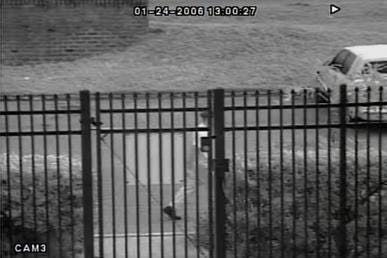
Based on available evidence, it seems pretty likely whomever is responsible for Kesse’s disappearance worked at the Mosiac. They’re the only suspects who possess the means and opportunity for doing so. The only thing missing is a motive, but I don’t think one is difficult to suss out. There are unfortunately violent men out there who think they can take whatever they want, when they want. Maybe human trafficking is involved. Point is, when you have large numbers of young, foreign men, many of whom with no right to be in the country, gathered in one place, especially one where lots of lone women are located, trouble follows. Anyone who denies the connection is being willfully obtuse.
The case is a reminder that illegal immigration isn’t a problem that came about when Trump ran for president. He was merely the first presidential candidate to speak bluntly about it, making it an issue which could no longer be swept under the rug. Kesse’s disappearance shows just how derelict American political leadership has been in handling this problem, regardless of whether or not the person who made Kesse disappear was an illegal or not.
It also shows that whatever benefits illegals provide, it comes at a high cost which cannot be quantified solely in economic terms. The idea we have some kind of obligation, moral or otherwise, to people who aren’t even supposed to be in the country, regardless of how or why they’re here, is preposterous by any reasonable standard.
Illegal immigration has been the norm for so long, however, that most Americans are content to just leave it alone. Hence, the moral outrage over the ICE deportations. “Woke” may not be as prominent as it was in 2020, but it’s still more normalized than ever before. Racism, xenophobia, these are still the highest crimes in the land.
Most Americans claim they have no problem with deporting illegals who commit serious crimes. The fatal flaw in this logic, of course, is that we have to wait until someone who’s not supposed to be here does something awful, like killing someone, before we can take any action against them. Even then, we can’t deport them:


Though claiming that Americans hate their own country may seem hyperbolic, it’s not to say they’ve become so cynical about it, they’re willing to implement self-destructive policies under the guise of focusing on the “real issues,” like cost of living and health care. Like immigration has no relation to either of those issues. But LGBTQ+ issues absolutely do, right?
Immigration has been a problem our entire lives. It’ll continue being a problem for the rest of our lives. 20 years ago, a young woman may very well have lost her life because of this problem we refuse to confront. How many more of them will need to be sacrificed before we realize how badly we’re failing?
No Longer A Cold Case
Perhaps time and persistence eventually brings about good news, or as close to good news as can be had. In October 2025, it was reported that not only has the case turned up new evidence, it’s no longer cold:
Nearly 20 years after Jennifer Kesse disappeared, her father says Florida investigators have made significant progress in the case. They’ve narrowed the list of persons of interest to just a few people.
Drew Kesse spoke about new developments in his daughter’s case, including DNA evidence that had never been tested and the use of artificial intelligence technology. Jennifer Kesse vanished from her Orlando condominium complex in January 2006. She was 24 years old.
“FDLE informed us that they are down to just a few people,” Drew Kesse said. “They have been able to just disqualify a lot of the people just through the investigations and interrogations that they have done.”
The Florida Department of Law Enforcement took over the case from the Orlando police. Drew Kesse said investigators told the family Jennifer’s case is no longer considered cold.
I explained earlier how law enforcement still struggles with missing persons cases. This gives me hope not only for learning what happened to Jennifer Kesse, but it also gives me hope that we’ll have fewer and fewer of these cases with time, cases where families must spend years or even decades waiting to find what came of their loved ones.
There’s also apparently a Netflix documentary on her disappearance that was supposed to be released early this year, though it still has yet to be. It’ll be interesting to watch what the story so far is, 20 years on, what new narratives have surfaced.
Breakthrough In The Shaffer Case?
Just a few days ago, a major development in the case of Brian Shaffer surfaced. Kelly Bruce, a local Ohio woman who has dedicated herself to studying the disappearance of Shaffer, shared this on her Facebook group devoted to information on the case:
I mentioned a couple weeks ago about a tip that came in to the page. I shared what I had permission to share, but now I have permission to share everything I know except for the name. In 2006, a name was given to CPD by 2 different people. Both people stated this man may have harmed Brian or have knowledge as to what happened to Brian. I cannot find a connection between the 2 tipsters. One of the tipsters was out with Brian that night. CPD searched an area on High Street connected to this man in 2006. Nothing was found. In 2020, 2 detectives began discussing this man again. The 2 detectives decided to go to the house where this man lived in 2006.
Skipping to the end of the story, the detectives found nothing in the house. The reason why Kelly Bruce thought this was a significant development was because not only is it the first big break in the case in a long time, but obtaining a warrant to explore what was effectively a 14-year-old lead at the time suggests the detectives had established a convincing case for doing so.
Not only that, the fact that this tip, which was sent to Kelly Bruce just weeks ago, comes from the third person to name this specific individual in question. According to Bruce, this is the first time she ever heard the name, and the detective she shared this tip with was surprised to hear her say it. Clearly, this name was never divulged publicly by police, never officially declared a suspect or person of interest. Yet three people have now pointed to this person, and detectives six years ago decided the lead was credible enough to pursue. A pattern appears to be developing here. Could this be the breakthrough this case needs?
The podcast True Crime Garage, which has a YouTube channel, released a six-part series dedicated to just the Brian Shaffer case earlier this year. The team studied the case for 10 years before producing this series. I binge-listened to all six episodes in about 24 hours; this is the deepest dive yet of the case. There’s information in this series that’s not found in most other accounts, much of it to the credit of Kelly Bruce, who is interviewed during the entire series. Together, they are planning to provide more details on this latest development.
What this all says to me is that Brian Shaffer was, unfortunately, likely the victim of foul play. As I stated before, I don’t buy the idea he ran away. He may have had reason to, and the True Crime Garage series on his disappearance shares many clues which had me at least keeping an open mind to the possibility. But this latest tip received and divulged by Kelly Bruce tells me my instincts were correct.
Again, if Shaffer ran away, it was either premeditated or an impulsive, spur-of-the-moment decision. A premeditated disappearance that apparently worked so well requires tremendous amounts of not just planning, but collusion as well. Who were his co-conspirators? On the other hand, I can see an outside chance of this being an on-the-spot decision and an unfortunate fate befalling him in the process. What I don’t see is this being a spur-of-the-moment decision that he just kept rolling with and managed to successfully pull off.
There’s more about Shaffer’s personal life as well, details which may or may not hold clues to his disappearance. Clint Florence, Shaffer’s friend who is viewed with suspicion by many for refusing a polygraph and being the only person involved in the case to lawyer up, gets a second look, and comes off less suspicious than he did before. For one, Florence is revealed to be less of a close friend and more of a drinking buddy. For two, Florence was far more concerned and cooperative than described in other accounts, proving how little of the real story often makes it to mainstream coverage.
The podcast also reveals there were more sightings of Shaffer following his disappearance than I’d previously been led to believe. The problem is that they place him all across the geographic board in a wide-variety of get-ups: a waiter named Brian in the U.S. Virgin Islands, a homeless man named Brian drifting between San Diego and Tijuana, an unnamed man playing in a rock band somewhere or eating in a restaurant in Puerto Vallarta. If any of these sightings are authentic, then it can only be one. The likelihood he went from being a waiter in the Virgin Islands to ending up homeless in Tijuana is improbable. Otherwise, none of these sightings are of Brian.
I’m also tired of hearing police say things like, “They probably ran off to start a new life.” I’m sure this happens. But not only is it not a common phenomenon, it’s not easy leaving everything you know and love behind, assuming a new identity, beginning a new life, all while remaining undetected. If you exist in this world, if you participate in it, you’ll leave behind footprints. Even if it were possible in 2006, it’s far less possible in 2026. You can’t even leave your residence these days without some computer server somewhere noticing. If it requires no effort on your part to be seen, then it requires tremendous effort to be unseen.
I’m going to keep an eye on this case for further developments, and so should you. Maybe, 20 years almost to the day since his disappearance, we’ll finally learn the truth, or at least develop a clearer picture of what happened to him? In doing so, could it provide hope for all ongoing missing persons cases, reminding us all nobody truly vanishes, and someone always knows what happened. Most of all, it’d be a much needed bit of positive, if not good, news, and a reminder that some of us do care about our fellow countrymen, whether we know them personally or not.
We All Need Someone Watching Out For Us
As we close out this essay, troubling news out of Barcelona:
Police now suspect foul play in the disappearance of a University of Alabama student who has gone missing in Spain, according to local media covering the case.
In an interview with CBS 42, Gisela Macedo, a reporter for El Periódico in Barcelona, said that the Mossos d’Esquadra police force have looked at CCTV footage showing James “Jimmy” Paul Gracey outside Shôko, a restaurant and club located in Olympic Village, at approximately 3 a.m. Tuesday. Macedo said that based on the footage, which has not been released to the public, Gracey left the club with someone else, leading authorities to suspect that foul play was involved in his disappearance.
Gracey’s mother, Therese, said her son was visiting with friends who were studying abroad in Barcelona. On Monday night, he reportedly went out with them, but never made it back to where he was staying. She added that the police have his phone.
Police have since discovered both James Gracey’s phone and wallet. At least there’s evidence, unlike in Brian Shaffer’s case, definitely more than in Jennifer Kesse’s. Still, it’s still a mystery what happened to him. All I can say is: when out and about, Condition Yellow at all times. When out and about in a foreign country, you should be on yellow alert even more frequently than usual. I can’t stress this enough, either: never go out alone, especially at night. There’s safety in numbers. Even one other person can mean the difference between life and death, between getting home and disappearing forever.
I love traveling the world, more than most people, actually. I also understand full well the whole world isn’t my home. It’s just nice to think it is. But that’s all it is: a nice thought. We all need someone watching out for us. Fellow travelers, friends, family, a country. Humans didn’t survive for thousands of years by trying to make it on their own. Nothing has really changed in that respect. We still very much depend on others just to go about our days safely.
Your turn: are you familiar with the Jennifer Kesse case? What do you think happened to her? Any thoughts on the latest news concerning Brian Shaffer or anything else covered today? Share your thoughts about in the comments.
Max Remington writes about armed conflict and prepping. Follow him on Twitter at @AgentMax90.
If you liked this post from We're Not At the End, But You Can See It From Here, why not share? If you’re a first-time visitor, please consider subscribing!
I have personal knowledge of one case where an alcoholic guy left and eventually disappeared. Even then, there was some sporadic contact before full disappearance. I suspect a full hard stop is quite rare, especially for normies.
Police failure can have tragic consequences. In Canada we had the Laura Babcock case where a mixed up woman disappeared and the police refused to investigate. Eventually her killers killed a family man for his truck before getting caught. People need to understand that in a real medical or police emergency you have to push the authorities and not just trust them to do their best for you.
As a healthy young man with a travel bug I avoided solo drinking and late nights out. Perhaps I missed out on some fun but I stayed safe.