Rioting Isn’t The Right Way. It’s Also The Only Way
The thing to understand about politics in general is that it’s not merely an alternative to violence - it is violence.
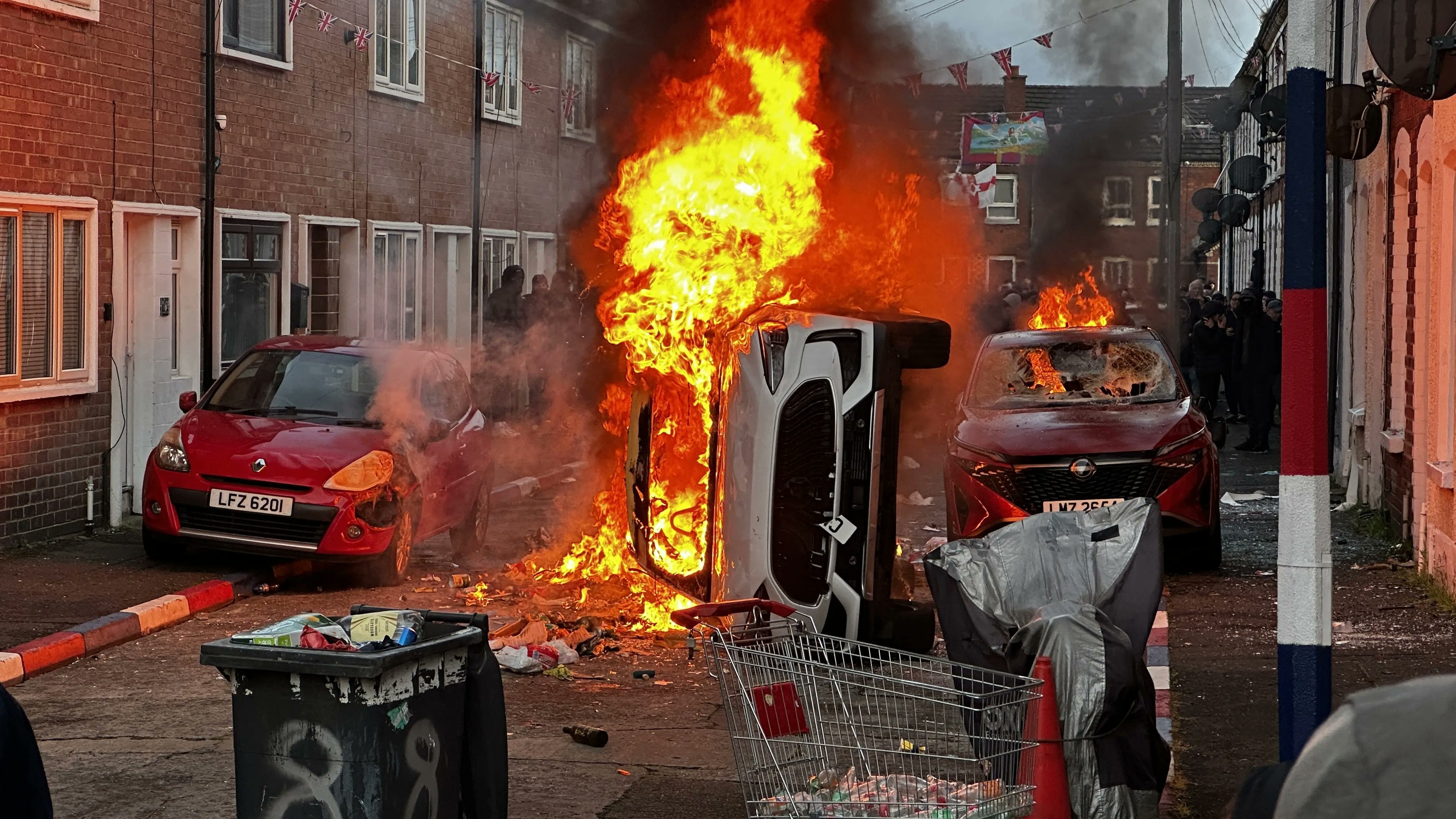
The mainstream response regarding the protests and rioting in Belfast and elsewhere throughout Britain has been, as you might imagine, negative. The Left is forcing the Right to reconcile their usual stance in opposition to protest and political violence with the fact the radicals on their side have adopted it for themselves.
I don’t think there’s anything to reconcile, honestly. Most on the Right, myself included, still generally oppose rioting and regard protest as a right to exercise with great discretion. We don’t like people’s homes and property being burned, even those of Third World foreigners. We don’t like public safety being threatened. I’d hope that the rioters understand they’re not going to make friends with anyone, that everyone hates them already, that the state will use the rioting as an excuse to further tighten the screws on the Right.
It’s also worth reiterating something I explain to the Left all the time: the state has no obligation to make it safe for anyone to engage in civil disobedience. The term itself implies a calculated disregard for the law in hopes of influencing political change. Anyone who engages in otherwise illegal or disorderly conduct is taking a risk in doing so and shouldn’t be surprised if authorities respond with the full force of the law. That’s how it goes, even in a so-called democracy.
That said, absolutely nothing else has worked. The Right is all but banned from participating in politics. Even in ultra-liberal Britain, there’s never, ever, been a consensus nor mandate for unrestricted mass immigration, particularly from the Third World. Yet all they’ve done is open the floodgates to the whole world. If the state does the opposite of what the public prefers, when policies lead to such disastrous outcomes, what are a people to do?
The thing to understand about politics in general is that it’s not merely an alternative to violence - it is violence. This is why rioting actually works - not because it changes anyone’s minds, but because the ability destroy or even kill is the essential substance of power. It’s why, despite decades of terrorism and murder of innocents, Muslims continue to rise in power and prominence throughout the West. Having lost the will the resist, the liberal leadership of the West has instead chosen to negotiate its own gradual surrender.
Again, nobody voted for this. So again, what are a people to do? It seems for the Right’s radicals, they’ve decided to show the state they actually do have power and are willing to use it:


More:
If politics is an alternative to violence, then politics is a proxy for violence.
And that means you have to dole out power in proportion to capacity for violence. Or someone's going to figure out they can do better by flipping the table.
Monarchy wasn’t replaced by democracy because of fine-sounding philosophical ideals and eloquent documents declaring this or that.
Democracy happened because if you added rifling to the flintlock firearm, suddenly a individual farmer with a tube was the pinnacle of military technology, and now you had to keep all the farmers with tubes happy by giving them political power.
Rioting is bad because it undermines public order and safety. In it of itself, however, it’s an expression of power, a reminder that the people do have a say, no matter how hard the state tries to undermine them or tune them out. The compromise of democracy was that the state would have authority, but the people would have the power. If the state insists on having both authority and power, as is the case in Britain, then the social contract has been violated and democracy has failed. So, again, what are a people to do?
Takes like these are so oblivious, I wonder if they’re just mocking us:


They’re trying to ban immigration restrictionist parties and candidates across the West. They’ve even been met with violence. If running for office worked, we wouldn't be in the situation we’re in today. Not to mention, both culture and institutions have been so thoroughly captured, there’s no way for immigration restrictionism to win at the ballot box at this point. Telling someone to play a rigged game is no solution at all.
More importantly, the Left has no moral authority to lecture anyone else about violence, given their indulgence of it on their side. The fact of the matter is, the Right rarely riots and seldom protests. When they do so peacefully, they’re met with violence or scrutiny. It’s been made clear time and again that only the Left is allowed to protest. When it turns violent, too bad, their cause is more important than your life or property. I’ve always said: to whom you must submit is whom has power over you.
Ultimately, the role protest and even violence will play in the troubles to come is a matter for the Right to settle amongst itself. The Left doesn’t get to have a say and neither does the British state. If they want to find a solution to the problem, fine, we can talk like grown-ups. That’s all anyone wants, at the end of the day: do your damn jobs, let’s work out our problems instead of always arguing about it.
But if the Left and the state insists on resisting even the mildest restriction or reform on immigration, if they insist on labeling anything less than full-throated support for mass immigration and multiculturalism as racism and xenophobia, if they continue to insist the far-right is the biggest problem, then there’s no solution to be had, there’s no compromise to be had. In that case, nobody should be surprised even the Right will resort to violence. It’s the voice of the unheard, right?
As I explained yesterday, one of the reasons why the situation will continue worsen is because the one entity in a position to do anything about it, the British government, is digging its heels in, no matter how bad the situation gets:
White people are ultimately left in a situation where they must endure rising migrant crime and all the associated ills of mass immigration silently. If they protest, they are ignored. If they form political parties, they are demonized, lose their jobs, and hunted by activist journalists. If they are violent, they are met with the full force of the law. It is quite untenable, but it is very much the status quo.
While the rioting in Belfast is the inevitable outcome of the government’s ant-White, pro-immigration policies, one should not expect the state to change course even an iota. Whether it is the Tory conservatives or the Labour leftists, the rotating ruling class will instead continue to double down on mass immigration until White people are a minority in Britain, just as they are fast approaching a minority in the United States. In fact, it is the same policy of almost every single Western nation.
One gets the sense the government is willing to risk further violence, maybe even civil war, out of principle, at best, out of spite, at worst. Can’t give into the bigots, goes the thinking. The difference between the way they treat the Right and Whites versus the Left and non-Whites is that they know and outright allow the latter to use violence while completely outlawing it for the former. They’re expecting this policy to deter the Right and Whites, and it’s worked thus far. Will it continue to work?
In the short run, it probably will. In the long term? That remains to be seen. I think the British government believes time is on its side, and it’s not entirely wrong to think that. Opposition to immigration and multiculturalism is most pronounced among older Britons, the demographic least likely to wage war, spark civil unrest, and threaten the social order. It may consider the coming waves of violence to be of the manageable sort, even more so than The Troubles.
The underlying assumption is state stability, of course. According to Pete North, this is no longer guaranteed. After explaining how the Reform UK party will likely fail at its efforts to fix anything even if it wins the coming election, he says:
As such, there are two possible futures ahead of us. There is one in which Reform wins, probably needing to lean on the support of the rump Tory party, which bites off more than it can chew, running into consequences it never anticipated. If they are also in the process of scrambling the constitution by leaving the ECHR, they’re going to find themselves far out of their depth, to find themselves rudderless - and firefighting for the rest of their term in the same way Labour is now.
The result of this is more or less exactly where we are now, only Reform is as hated as the Tories, and the riots and protests are more violent - while everything else spirals out of control. The other possibility is that Reform doesn’t manage to close the deal in 2029, resulting in a rainbow blocking coalition, calling itself a government of national unity. That results in more of the same chaos, perhaps giving rise to an actual far right. In my view, the era of stable government is over for the foreseeable future.
Anarchy seems to be Britain’s future:
What seems more likely is a state of low grade civil war which loosely follows recent patterns in Belfast, where migrants will be encouraged to leave by the natives, using shall we say, unsanctioned methods. There won’t be much that an overstretched and demoralised police force can do about it. While the state will clamp down on social media, they’re completely behind the curve in tracking private communications networks. You can’t keep a lid on this sort of thing when there’s a camera phone in everyone’s pocket.
Essentially, I think we’re past the point where elections could prevent a wider unravelling. Fixing the fundamentals would, at the very least, require a reset of energy and welfare policies, neither of which will happen soon, and will take at least a decade to sort out. The sand timer has run out.
I keep reiterating: the more dramatic scenarios, like a full-blown civil war or dictatorship - remain well beyond our sightlines. The point is that violence will once again become normal, and Britain will no longer be the orderly, peaceful place it’s known for being. The state’s power will never truly be threatened, but it’ll also prove unable to do much besides contain the unrest to allow economically vital areas of the country, primarily the cities, to keep calm and carry on, and protect minority groups, specifically Muslims.
Nothing gets fixed, but that’s because nobody wants to fix anything, anyway:
We should also recall that there is enormous opposition to fixing anything in Britain. While the majority may want something done about immigration, they may not be persuaded by mass deportations. Meanwhile, there is major structural opposition to welfare reform, and renewable energy is quite popular. No government is going to have a big enough mandate to do what needs to be done.
Comfort is a hell of a drug. Change is easy to advocate for if someone thinks it can be done at little to no cost. Once the costs are laid bare, change becomes unfathomable. Nobody aside from Reform UK supporters and the online right really wants to do anything about immigration not only because of the costs involved, but because Britain has so many problems, for many, immigration simply isn’t a major concern.
Which brings us back to the matter of violence:
Ultimately civil wars happen when government loses all legitimacy, and confidence in the capacity of politics to fix things evaporates. We might already be at that point. We needed a Reform-like entity circa 2016 to deliver fully on Brexit to avert what is to come. Where we should have recalibrated energy, welfare and immigration policy, we doubled down on all the worst choices of the last thirty years. I doubt there is a peaceful way to row back from that.
Riots like the one we saw in reaction to the attempted beheading in Belfast are back and here to stay, even if a civil war doesn’t occur. Loss of legitimacy doesn’t always result in the upending of the social order. It does mean fewer people are willing to shut up and simply go along with the charade. That matters a whole lot, because a state which once enjoyed an abundance of consent will find that it’ll need to spill blood to remain in power. It cannot just bully and intimidate its way into doing so.
The only question is: are they ready for a fight? Are British patriots ready for a fight? Everyone thinks they are until the bullets and punches start flying.
What about you? Do you think the riots help or hurt the cause? Do you think they’re morally justifiable? If there’s no political solution, what are a people to do? Share your thoughts in the comments section.
Max Remington writes about armed conflict and prepping. Follow him on Twitter at @AgentMax90.
If you liked this post from We're Not At the End, But You Can See It From Here, why not share? If you’re a first-time visitor, please consider subscribing!
'Most on the Right, myself included, still generally oppose rioting and regard protest as a right to exercise with great discretion. We don’t like people’s homes and property being burned, even those of Third World foreigners.'
That's why most of you can never be trusted with power again.
For a long time now, when I see people on the right proudly saying "When (such and such) happened, we didn't riot and destroy", I always think, "Has it occurred to you that's exactly the problem?"
Violence is a terrible thing, I've experienced enough to know this. But they don't tell people being abducted to resist, and do whatever it takes to stop it for no reason. If you acquiesce, go with them meekly, you are dead, and probably in the most horrible ways. There really are times when you have nothing to lose, and you fight, victory or death, regardless of the cost.