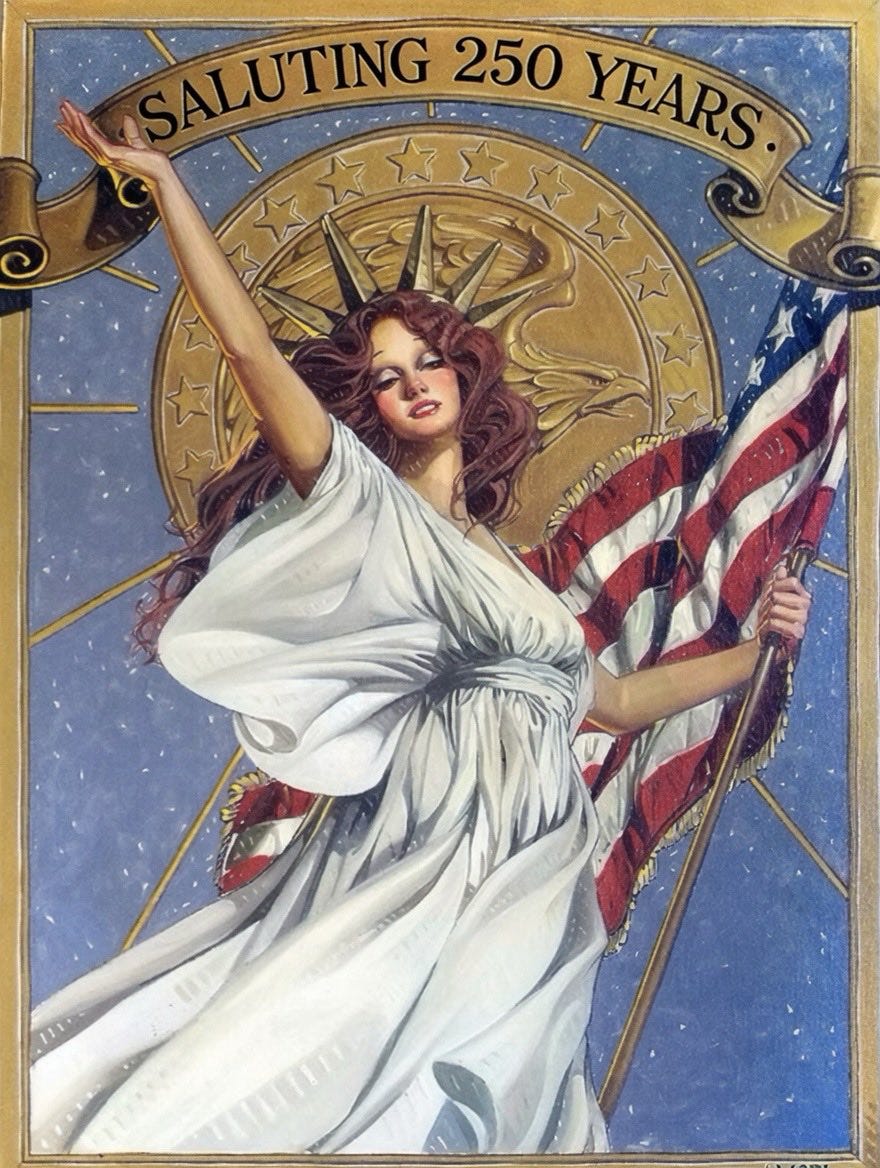
Originally, I had something special planned for the 250 anniversary of the United States of America’s declaration of independence from the British Empire. It was a draft I’d begun almost two years ago and I’d planned for it to be written as a letter from the future, from a 90-year-old Max Remington on July 4, 2076, the 300th anniversary of the USA’s separation of Britain, looking back on the last 50 years of his country’s history. I thought I had plenty of time to formulate a narrative, but as is so often the case, not only did the last two years fly by, I had plenty of ideas, but no way to weave them all together.
Instead of trying to drive a broken car, I’m going to instead discuss the state of the union, as it were, as well as provide a summary of what I think the next five to ten years holds for the U.S. My original essay was always going to be speculative, not an authoritative look at what I think is going to happen to America. Still, I try to keep things as academic and as fact-based as possible, because my intent is always to inform, not obfuscate.
As you might suspect, my prognosis for the U.S. is pessimistic. There are four general trends I see as defining America’s near-term future: the rise of the far-left and the fall of the Right, continued leftist cultural dominance, rising imperialism, and a protracted period of crisis culminating in the end of one era of American statehood and the beginning of another.
At the same time, my prognosis isn’t doom, either. Age lends wisdom and that wisdom tells me that while things are likely to get worse, they’re not likely to crash and burn, either. At the very least, I’ve come to realize that predicting a crash-and-burn is about as useful as predicting one’s own death. So, what’s the point?
Let’s discuss what the next five to ten, if not the next 250, holds for America.
Far-Left Ascendant
All over the country, you see far-left Democrats winning elections:

Ever since Zohran Mamdani was elected Mayor of New York City, it seems the floodgates have opened for the far-left and I’m not sure there’s anything to stop it. If anything, it seems like a coalescing of trends which have been building for over a decade at this point.
With both Millennials and Zoomers set to comprise a plurality, if not majority, of the voting public, we have arguably the most leftist body politic ever in American history:


Exploring this phenomenon would take an entire essay or two to give it the necessary treatment. For now, it’s enough to say that America is trending leftward. MAGA and Donald Trump represented a brief resistance movement, but it was never going to last. There are many reasons for this, but demographics is undoubtedly near the top of the list. Non-Whites and the young favor the Left, giving it long-term staying power. MAGA and the Right is favored by Whites and older Americans. The former is in decline and though America will continue aging as a society, the current crop of Republican voters will likely fade out within a generation or two.
MAGA and Trump are both ultimately transitory. Their legacy is not some major realignment as often suspected, but a last-ditch attempt to preserve the America that the vast majority of us still remember. Unfortunately, that America has also lost favor with emerging generations, who’ve been brought up on decades of programming propagating narratives of the U.S. as a mostly-failed attempt at creating utopia, therefore the past must be completely wiped away so that feminists and people of color, most of whom have never accomplished anything meaningful or come from failed, archaic societies, can establish a kinder, more equitable society for all.
None of this is to say we’re going to be living under a far-left totalitarian regime for the next 80 years. I certainly hope not. It’s to say that the Left will enjoy a period of strong growth, even as the presidency changes hands regularly. As you’ll see later, the U.S. is entering a period of power struggle, and it’s this very power struggle that’ll not only define the current Fourth Turning, but the rest of this century. One of these days will become the proverbial First Day Of The Rest Of Our Lives.
Woke Has Won
I’m sure nobody on the Right wants to hear this. But it’s true. Now, let’s unpack it.
When I say the Left has won the culture war, what I mean is that there’s no viable way forward for the Right to propagate its values. The Left has so thoroughly achieved total institutional capture, there’s just no way through, because it’s the institutions that propagate culture. I’m not just talking about institutions in a bureaucratic sense, either.
The good news? I personally don’t see Wokeness being able to make any greater gains than they already have. In that sense, Woke has peaked. Thinking about it in economic terms, after years of strong growth, it has begun to slow down, while becoming increasingly competitive. In other words, Woke is in the phase of consolidating gains. After the 2028 election, which I fully expect a super-liberal candidate to win, we’ll see the most leftward push in American history, far exceeding what we saw during the Obama administration.
I think many Americans who voted for Trump did so out of a lack of a better option or because they genuinely overestimated his ability to act as a bulwark and countervailing force. I’ve mentioned time and again the level of wish-casting when it came to Trump, how so many needed him to be somebody that he’s not, how so much of their admiration of Trump stems from a desperate need for leadership.
Trump has had some successes, no doubt. But not only can many of them be reversed, there simply haven’t been enough of them, nor is it possible for any of these changes to be truly enduring. Trump hasn’t changed much about the way politics work in America, except to maybe demonstrate how powerful the presidency truly is, even when manned by someone without institutional backing. Depending on one’s perspective, Trump was either a radical or reactionary figure. He’s actually a combination of both, and those who voted for him wanted him to make things better without creating too many waves, while others wanted him to make as many waves as possible. In many ways, he captures where America is at 250: at a crossroads, adrift at sea with two crews fighting for control of the helm.
I don’t see any kind of pendulum swinging back the other way. The thing is, it doesn’t, not really. The only way that might happen is if something like a collapse were to occur and a series of wars erupts resulting in the establishment of new states and social orders. As you might imagine, I don’t see that happening, not this Fourth Turning. What I do see is the Left consolidating its gains and the Right resisting when it can, where it can. Eventually, as the crisis becomes impossible to overcome, many of these problems - feminism, transgenderism - will simply fade out as they prove unable to withstand real-world rigors.
Not the dramatic, satisfying finish most people imagined, no. But it’s likely better than the alternative.
Rise Of The Empire
Financial analyst Brent Johnson explained recently on MacroVoices:
Not particularly, but this is the way it is now, and I don’t think that’s going to change, and I don’t think it’s gonna change dramatically even if Trump was no longer president because I think in many ways the world is fracturing. We are moving from a world that was globalizing to a world that is now de-globalizing, and I think as that happens Despite the numerous problems that the United States has, and I could spend hours and hours going over all the problems the United States has and the mistakes the United States has made, despite all of that, I think the United States is still relatively in a better position than virtually anybody else on the globe.
Johnson isn’t alone in this assessment. Especially within right-leaning circles, you hear so much about America being in decline, of a collapse coming. Since the 2024 election, this talk has faded and even many on the Right have backed off it. If you look at even my Substack in its early days, I spent a lot of time discussing decline and collapse, in large part because that was the zeitgeist for most of the Biden administration, especially following the calamity of 2020.
However, according to many commentators, myself included, the economy or the U.S. as a union was supposed to have collapsed once or twice by now. It hasn’t. When grandiose predictions fail to materialize, it’s prudent to re-consider your priors. We still have many years to go in this crisis period, but we’re also at the point where trying to predict when it’s all going to fall down is an exercise in futility. Pretty much all the doomers have been wrong.
Regarding the fate of the U.S., if only a few years ago it seemed the U.S. was on its last throes, the reality now is that we’re actually transitioning into the next stage of our evolution [bold mine]:
And as a result, as we go through this fourth turning, I think a lot of people are assuming we’re gonna have this great calamity in the winter, and then when the spring comes around, some new power is going to be in charge. And I think it’s possible a new power is going to be in charge, but I don’t think it’s gonna be some other country. I think it’s probably still gonna be the United States, but I think we will potentially will have transitioned from a republic to an empire. Now again, conviction versus confliction. I don’t necessarily like this arc that we’re on. I don’t know that this is going to be a good thing. I hope that it is. I hope it works out well.
It’s something I’ve speculated on as well. I really can’t tell you what it’s going to look like - it’s not going to be any traditional empire due to a lack of young people. But maybe there’s ways of becoming an empire that doesn’t require an endless supply of warm bodies, conquering the world, and colonizing foreign lands. Power comes in many forms and I think us becoming an empire is going to be defined by the central American state throwing its weight around more, both abroad and at home.
One advantage, for example, is the U.S. dollar. We’ve been hearing for years about how the dollar was losing potency, that it’s time as world reserve currency was up. Yet there’s currently next to no sign it’s losing either potency nor world reserve status. Maybe it’ll happen suddenly, but things which happen suddenly are by their nature difficult to predict. Until it happens, saying so is premature, which probably explains why fewer and fewer people are talking about it. Aside from the more click-baity financial analysts like Peter Schiff, more reputable people in the field all say dollar hegemony isn’t nigh, and Brent Johnson is one of him.
His explanation for why that’s so is tough even for me to relay onto you, but the gist of it is that the system simply doesn’t work the way people think it does. The global financial system is complex and the U.S., with the almighty dollar, has ways of leveraging it that other global powers don’t have access to. Other thinkers like Peter Zeihan have made the point that the U.S. has actually been quite restrained in the exercise of its power up until now. The more unrestrained it becomes, the more imperial it becomes.
Which brings us to the question: are we late-stage Soviet Union? Or are we late-stage Roman Republic? Brent Johnson says:
So I think it’s more likely we see the fall of the republic and the rise of the empire than the fall of the empire and some new power takeover. And the last point I would make on this is I know there’s a lot of people who think that the United States already is an empire, and it has been for a long time, and that its best days are behind it and the empire is dying I think, and listen, I can be wrong on this, but it, my interpretation of this is that people believe this because it’s been a long time since we’ve had an empire running the world, and most of the people who are analyzing it aren’t familiar with how an empire actually asks, acts, and rules things.
And I think that as we move forward in time, we will become reacquainted with how that happens, and this gets back to the, real world versus the world we would like. For most of h- history, there were dictatorships, there were monarchies, there were empires. The last 100 years, in my opinion, is the exception to the rule, not the norm.
And as we move from globalization to de-globalization, I think we probably start to move back towards the norm rather than staying in the exception.
It’s difficult to understate the points Johnson is making: people today have a very distorted, false view of how the world actually has been for most of history. It’s nice to think we should strive to overcome it, but a nice thought is all it is. Even today, the same dynamic prevails as it has throughout history: the strong run the table, the weak follow along. Anyone who pretends like this isn’t how things work has been indoctrinated into the Cult Of Liberal Democracy.
The only thing that’s changing is that the blinders which used to be in place that made it things like a “world community” existed are now falling. As it has for 250 years, America will lead the way.
I mentioned earlier that the Fourth Turning will be defined, at least in the U.S., by internal power struggles. As Brent Johnson explains, that’s exactly what defined late-stage Roman Republic:
And the... We may have talked about this in previous times, Eric, so I apologize if I’m repeating myself ‘cause I’ve talked about this many times. But there’s a great book called The Storm Before the Storm, and it takes place from 130 to 60 BC, so it’s like a 60, 70, 80-year period of time in Rome.
And it basically documents the fall of the Roman Republic. And during that, there was many of these exact things that you’re talking about, political factions that swing back and forth from one political party to the other. A lot of the same things that we are experiencing now, they experienced over the 70 to 80-year period.
Applied to present-day America, Trump isn’t the end. He’s a waypoint in a much longer-term cycle which began in 2008 with the Great Recession and the election of Barack Obama. We have at least two more presidential election cycles to go before the current Fourth Turning has closed the loop. That’s two more opportunities for power to change hands. What does it all lead to?
This:
But what ultimately came out of it was not the failure of Rome as a power, it was the failure of the Republic. But what came after the failure of the Republic was the rise of the empire, and that is when things had gotten so bad and they have swung so many times back and forth, that a strongman eventually showed up and enforced his will on everybody else and said, “We’re not gonna do this anymore and this is the way it is Now, I don’t know that it’s gonna happen exactly like that in the United States, and I certainly hope that we don’t go into this an evil empire stage.
Johnson is, of course, speaking of Caesar. My mind has evolved on the viability of an American strongman. A real strongman, not a liberal’s idea of one (Trump). A while back, I surmised that American Caesar won’t be a single person - though there certainly will be a front-man - but instead a non-ideological vast security apparatus whose singular focus is the order and stability of the American state. Think of something similar to what emerged in post-communist Russia, especially under Vladimir Putin. It’ll be resisted, no doubt. But resistance will only make it stronger, the same way Caesar’s assassination led to the emergence of an even more powerful figure in Augustus, thereby establishing the Roman Empire.
I’m probably the only person on record as saying this imperial regime will effectively be a junta of federal law enforcement officers and spies running things from behind the scenes. They’ll probably have the backing of tech companies, the business oligarchs of our times. But it’s not an entirely original thought, either. It’s a common trope in conspiracy theories: secret cabals running the world from smoke-filled rooms, for example. Except I don’t think this is anything conspiratorial about this. If it were to come to pass, it’d be the result of over a generation of expanding the size and power of the central state, combined with a crisis which threatens to destabilize the American state. Somebody would need to intervene then, no?
The Crisis Of The 2030s
As I often say, there’s a lot of history to cover between now and then. In the near-term, what becomes of America? I confidently say civil war isn’t in the cards, though this is prognosis is based on current trends.
It’s hard to be specific but I see something like this consuming the next five to ten years:
Political tensions and instability wrought by the culture wars, exacerbated by AI, leads to a major wave of civil unrest coalescing around the 2028 elections, marking the beginning of a period of low-intensity conflict in the U.S.
Crime will remain low by historical standards, but society won’t be peaceful, either. Disorder - the uneven application of the law, in some cases no application of the law - will become normalized, deepening distrust and social conflict.
The security-surveillance state will expand power and reach as it struggles to keep the peace not just between factions, but between demographic groups. Americans will pursue self-segregation, while some groups will press their lucky and continue to encroach.
The long-anticipated global financial crisis on the level of 2008 occurs around 2030. Though it causes political instability, it also has the effect of strengthening the federal government, as everyone and everything looks to it to save the country from financial ruin.
As the Executive Branch is expected to do more to solve problems, this has the effect of weakening the other branches of government and consolidating power in a single office: the presidency.
The presidency changes parties every election. By 2036, the crisis will have gone on for so long and deepened to much that Caesarism will finally be on the table. If the republic isn’t dead by then, it’ll certainly be on its last throes.
Not much to look forward to, is there? The problem is, the bill eventually comes due, and everything has to come full circle at some point. The trend lines are pointing towards the 2030s as the decade of crisis, not the 2020s. As with so many things we discuss here, we’re not quite there yet, but you can see it from here.
For an even more speculative look at the near and far future, watch this video from YouTuber “Emperor of Turkmenistan”:
Note that he sees many of the clearly-visible problems looming on the horizon coming to a head around the 2040 timeframe. By then, Zoomers will be as old as Millennials are today, Boomers will no longer be a significant force in politics or otherwise, and Xers will be quietly fading out. As crisis mounts, those with more power will be able to shape events to their benefit, while those with less power will be at greater mercy of history. The video also highlights the demon that are black swans: there are many more to come and as they do, our outlook will change as well.
But, never get ahead of yourself, whether assessing current and future events or your own lives. One thing at a time.
Around For The Long Haul
That does it for the first part of this series. In the second part of the series, I’m going to talk more about what America is as a society and what it says about America going forward.
For now, the point I want to get across is this: whether you like where America is at today or you don’t, this is a country far from any sort of collapse. This is a major shift in my thinking from since I began this Substack. But my mind is allowed to change based on new information. I recommend everyone allow their minds to change based on new information as well.
The fact is, the U.S. is still too big and too powerful a country to go down just because we can’t agree on what a woman is or even what an American is. It’s not that I think America is built of some tough social fabric, either. It’s that power, raw power, still drives world events, and the U.S. still has plenty of it. Not only that, the nature of the game changes, and adaptability, not denial of change, is what lends survival.
Let’s apply a soccer analogy with the World Cup going on. An analyst explained how today’s game rewards pace, explosive transitions, one-on-one specialists, and athletic pressing. This wasn’t always the case. Once upon a time, not too long ago, possession and lots of passing were in. Teams need to still be good at attacking and defending. But the way teams attack and defend well have clearly changed.
Blessed with both power and resources, America, not these other powers like China, is best equipped to adapt to new realities. That’s what gives this country staying power. No, not all change is good. No, not all change should be embraced. But change is inevitable. America, since it’s earliest days, has been more amenable change compared to most societies. That’s a big reason why we became what we are today. Not everyone like it, of course, but that’s not the point.
Of course, none of this really gets at what life will be like for the average American going forward. I’d imagine it’d get more difficult with time and that the Boomer generation was probably the luckiest generation there ever was. I’d also imagine that Millennials, who entered this world on a high without historical precedent, will collectively fade to black on a low. It’s not something to get too wrapped up in, however. We’re discussing broad historical trends, after all. At the end of the day, all we can do is tell people what’s coming up the road, leaving it to them to make the necessary changes to make worthwhile lives for themselves in light of these realities, and stick around for the long haul.
The lesson is: don’t bet against America. I don’t say that out of super-patriotic sentiment. I say that because the only way we made it 250 years is because we overcame so my challenges and changes along the way. It wasn’t a smooth ride, no. It never is. But we’re here and that counts for something. Falling apart, national divorce, it’d all solve many of our problems, yes. But it’d create a whole lot of others, and many of us who wanted to see it all unravel would inevitably wonder if it was all worth it in the end.
Besides, if we’re on the verge of collapse, not only is there no way of knowing for sure, do you think you’d really want to know? The answer isn’t as clear as you might think. I, for one, am here for the long haul. If an empire is what the future holds in store, then I’ll be here for it. Really, where else would you rather go? If you think the future is bleak for America, it’s not going to be much better anywhere else in the world. If any place is geared to whether the storm in a very imperfect way, it’s right here, in the US-of-A.
But what do you think? How much more mileage do you think the United States of America has left in it? What do you think America looks like five to ten years from now? Share your thoughts in the comments section.
Max Remington writes about armed conflict and prepping. Follow him on Twitter at @AgentMax90.
If you liked this post from We're Not At the End, But You Can See It From Here, why not share? If you’re a first-time visitor, please consider subscribing!
You’re essentially right, especially over alarmists, but I don’t think the transition to empire will be more than a managed decline with increased aggression.
Just the aging population alone makes it a fight against collapsing supply chains (or AI saves us).
That’s not even getting into demographic conflict, bioleninism, ect.
"Woke has won. There’s no viable way forward for the Right to propagate its values."
I don't want this to be true, but I strongly suspect it is. Although not for the reasons you specify.
--- Puts on philosophy teacher hat ---
The Left's values can be derived from a simple assumption about man: "the purpose of life is to live however you want as you've not hurting someone else." This bastardization of J.S. Mill conquered America decades ago.
The Right's values require a transcendental source -- God or country, religion or nationalism -- since limiting man's on freedom must be based on something beyond man. Modern America has killed God (thanks Nietzsche for pointing that out) and our national mythos is in tatters. Hence, the Right has no path to enforce it's vision of "the good".
So we end up with bastardized John Stuart Mill. At least until we go broke.
--- Puts on economics teacher hat ---
Brent Johnson;'s assessment is right on: in a less globalized world, I'd much rather be American than German or Hungarian. A continent spanning, industrialized country protected by oceans is in situated to do well.
However, I still maintain the "collapse" is coming, and unlike Johnson, I still put my money on a currency / debt crisis: the United States getting Liz Trussed by the global bond market. WHEN it will happen I have no idea (Japan is up to 200%+ of GDP with no interest rate effects.) THAT it will happen I have no doubt. Our recent misadventures in Iran have only made it more likely. This may well be your 2030 economic crisis.
Our imperial Franco may come before or after that, but he will come in response to economics (debt crisis or a very extended govt shutdown) not political violence.
So, door A, severe economic contraction caused by a debt crisis; door B, a woke, left-wing, globe-spanning, American empire. What great choices.