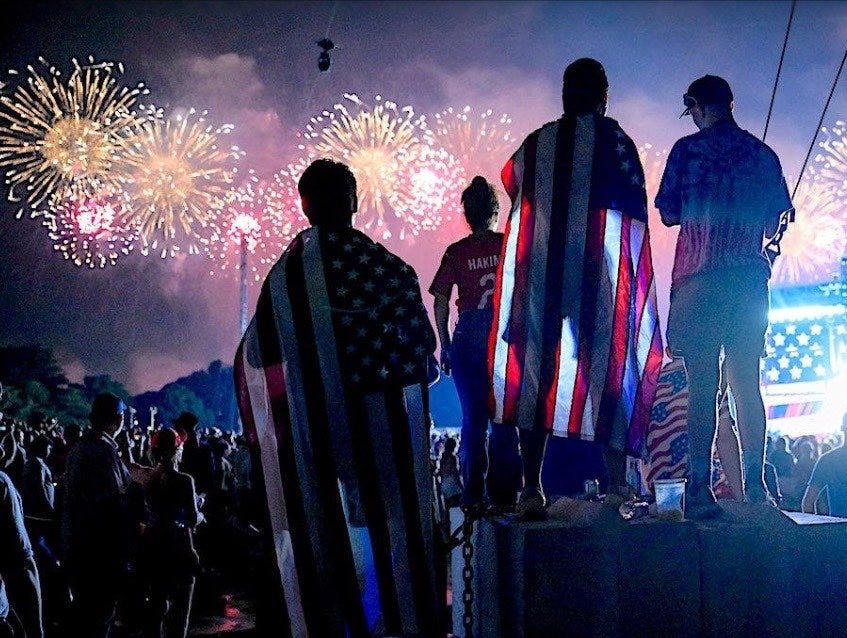
Before completing this three-part series commemorating the 250th birthday of the United States of America, an important myth needs to be busted right up front.
July 4, 2026 wasn’t the 250th anniversary of America’s founding. It’s the 250th anniversary of America’s Declaration of Independence from the British Empire. To many, it’s a difference without a distinction, but I think it matters. One, until the U.S. defeated Britain and forced them to recognize our independence on September 3, 1783 - arguably our actual birthday - our statehood was very much in doubt. It could’ve all ended before it really began.
Two, the failure to observe this distinction gets at the heart of the problem: Americans today have no idea what our history actually is. A people without any awareness of its true history can never be one people, and if we cannot be one people, we can never be a nation. Almost all of our problems today stem in large part from the fact we’re all supposed to be some cohesive whole, yet we’ve done everything imaginable to make the formation of such a cohesive whole impossible.
This isn’t the moment to set our historical record straight. That takes a lot of time, many essays. But if we ever are to be some kind of cohesive, collective whole, if American nationhood means anything to anyone, it begins with correcting seemingly trivial facts like this. It may be a futile effort, but I’d rather go down having tried rather than not at all. As long as I’m here, I’ll never let our history nor our identity be written and defined by those who neither know it nor have any intention of preserving it.
Who Are We? Why Are We Here?
Last week, the Supreme Court ruled in favor of upholding birthright citizenship. I’m opposed to the decision, of course. But I’m not upset over it, either. One, I wasn’t expecting them to rule against it. Two, I think the birthright citizenship debate is whistling past the graveyard. Citizenship, at least as we understand it today, is linked to nationhood and republicanism. America isn’t a nation nor is it a republic any longer in any real sense of the term. For most of its history, it was a federation, and now, if people like Brent Johnson are correct, it’s becoming an empire.
Kenneth Taylor, who appears to speak from a more liberal perspective, explains why America isn’t a nation:
America is not a nation. It is only a place. Or so I will argue in this blog entry. And this fact, I claim, has great significance for understanding the potential demise of the republic we once dreamt of.
Taylor gets things off to a good start by at least saying America is a place. This is a whole lot better than most liberals who claim America is merely an idea.
Continued:
Why do I say that? Well, there’s a short answer and a slightly longer answer. The short answer is that too many Americans hate, or at least really dislike other Americans for us to count as a nation. The longer answer is similar in spirit, but will take some work to spell out in detail. Spelling out the longer answer requires me to say a bit more about what I mean by a nation. There are, I think, two different conceptions of nationhood. In one of these senses of ‘nation’ America is as much a nation as any other. But that, I shall argue, is hardly a sense of ‘nation’ worth caring much about.
On the one hand, you have a nation wherever you have an intact state, held together by some means or other, under the unified jurisdiction of some central government, with the power and authority to make laws, defend itself, etc. In this sense, American is clearly a nation and a pretty powerful one at that. But in this sense, Iraq under Saddam Hussein was a nation. So too were the former Soviet Union under the Communist Party and the former Yugoslavia under Tito. And I hope these examples will help you see where I am headed.
The point is that despite the power of the glue that holds nations so understood together, nations in this sense can in fact be pretty fragile and precarious things, especially when they are held together, not by common bonds of citizenship or common projects and values, but by little more than force and fear. The coercive glue that held the old Soviet nation together was composed partly of the Communist Party, partly of the KGB, and partly of the Red Army. But as the coercive power of that glue began to weaken its hold on the disparate peoples of the Soviet Union, it quickly ceased to exist, even as a nation-considered-as-state. That’s because the Soviet Union was, in fact, never really a nation in the deeper and more important sense that I outline below. It too was ultimately merely a place.
To grasp the deeper sense of nationhood I have in mind, think of a nation not as defined by the potentially coercive instruments of statehood, but by mutual bonds of sympathy, respect, and tolerance among citizens. Such bonds may serve to gather people into a single or at least unified collectivity. They may serve as the basis of a shared national identity, grounded in a set of mutually endorsed commitments, projects, and values. To participate in the life of a nation in this sense — call it nation-as-shared-project — is not merely to be subject to the coercive power of this or that state. It is to participate willingly in set of shared commitment and projects. And it is for one’s participation in those shared projects and commitments to form an important component of one’s identity as a being in a world. When I am a citizen of a nation so understood, I identify with my fellow citizens as partners in a set of joint national projects and they, in turn, identify with me.
This is all very well-stated, again by a liberal, and it gets at something I once said: America, to the extent it’s a nation, isn’t a nation state, but a state nation. In a nation state, like Croatia, France, Ireland, or Japan, you can take away the state, but a national identity will remain. In the U.S., as was the case with Iraq, the Soviet Union, or Yugoslavia, take away the state, then the nation ceases to exist, as Taylor explains.
The state really is at the heart of what America is:
So I hope it is clear that when I say that America is not a nation, but merely a place, I certainly do not mean to deny the existence of the America state. As I have already conceded, the American state definitely exists. Again, it is a highly consequential and powerful state. What there is not is an American nation-as-shared-project, defined by a set of mutually endorsed values, projects and commitments that serve to unite the inhabitants of the place that is America into a single people of a single nation-as-shared-project.
This is a uniquely American conception of nationhood Taylor propagates here, but I think his point is strong. America not only lacks a shared anything, but it deliberately eschews it. Speaking English is arguably the only thing we have in common and making it the official language was resisted ferociously for years. America in 2026 isn’t just not a nation; it’s an anti-nation.
In terms of nationhood, we may be only as strong as the communist states we once opposed:
To some extent, this means that America is somewhat akin to the now defunct Soviet Union. It too was merely a place, as I have already argued. Of course, the glue that holds the American state together is rather different in character from the glue that once held the Soviet state together. The instruments of state power here are more democratic in character than were the instruments of Soviet state power. But we should not let this dissimilarity blind us to the possibility that just as the glue of the Soviet state dissolved and weakened to the point of ineffectiveness, so too may the glue of the American state. If that day should come, not only will America not be a nation-as-state, it could possibly cease to exist as even a place — at least in one sense. Of course, there will still be the land mass once occupied by the American state. But just as ‘the Soviet Union’ no longer serves in common parlance even as a geographical designation for a stretch of land, so too might ‘America’ cease to function in common parlance as a geographical designation, should the American nation-as-state cease to exist.
Now it should be said that in both the old Soviet Union, and in the Eastern bloc nation states that fell under its sway, people knew how to mouth the slogans of nationhood. Indeed, the Soviets were extremely determined to create what they called the ‘Soviet man’ whose identification with the Soviet-nation-as-shared project would run deep indeed. And the peoples who toiled under the sway of the Soviet state did appear to go along, at least outwardly. They learned the ins and outs of dialectical materialism from an early age. They learned to sing the songs and chant the chants. But in their heart of hearts, very few were true believers. Perhaps it is the same with us Americans. To test this thought, imagine that you are an alien cultural anthropologist, sent to study America. You want to know what commitments truly define the American body politic, as a collectivity, in their heart of hearts. You are determined to look past the official declarations, documents, and pronouncements of the ruling elites. You are determined to search deep into the everyday lives and consciousness of Americans at large. What would you find there? Would you find a people deeply committed to democracy, equality, tolerance, and a reasonable pluralism? I am not sure. Part of me suspects not. I suspect that you would find that though many have been socially conditioned to mouth the slogans of American nationhood, our true level of commitment to such ideals runs pretty shallow.
Once upon a time, perhaps America had more of a claim of being a nation-as-shared-project than it now has. This is a tempting thought, but I doubt that it is true. I suspect America has never been a nation-as-shared-project — at least not for very many of the inhabitants of the place that is America. Or perhaps I should say that if America ever was a nation in the sense that concerns me here, it was a nation that excluded very many of the inhabitants of the land mass that housed the people of that nation. Or to put it differently, it may have been a nation-as-project for the few, but it was a mere place for the many. This is evidenced by the fact that America has seldom welcomed into its bosom the full range of peoples who have from time to time dwelled in this place. Think of how many of the inhabitants of this land mass were brutalized, exploited, enslaved, even exterminated in the name of one after another of America’s putatively defining “shared” projects.
I’m sharing these long passages in whole because he says what I’ve long wanted to say and because it’s all very important. This is all a long way of saying that just because the people who can kill you - the state - say you’re a nation, doesn’t mean you are. Without the state, there really is nothing except a mass of people from all different backgrounds and nothing to bind them together. Some with strong in-group identities will manage to pull together, certainly. But we’re talking about the “American” identity here. There’s nothing to give it legitimacy except the state.
Taylor goes on to say that America can only become a nation by starting over again:
What is needed is a fresh start. We must build a new American Republic, one with an entirely different constitution and an entirely different civic ethos. The current Republic is not the real thing. It is a best pseudo-republic. And it is rapidly collapsing unto itself. Even if it were possible to save it, it is hardly worth saving, at least not in its current form. Best to consign the pseudo-republic to the dustbin of our turbulent history, reboot and start over. The aforementioned French, after all, are on their 5th Republic. I admit that is not altogether certain that we can achieve the New Republic non-violently, in a spirit of mutual cooperation rather than mutual enmity. But these are perilous times for the place that is America with its fractured inhabitants. Heavy burdens must be shouldered. Perhaps persons of great vision, integrity, and practical wisdom will emerge to help lead the way. A Lincoln or Mandela or Gandhi for this age!
In forming a new American Republic, there is much that we will need to renegotiate. But at least we can start by freeing ourselves of the remnants of our ancient and divisive curses—such as the sordid compromises that were written into our constitution over the evil of slavery. Indeed, those very compromises, together with their enduring consequences, are almost single-handedly responsible for many of worst features of our current pseudo-republic.
He’s not wrong. In fact, I totally agree. Yet, being the liberal he is, he makes it sound so simple. He cites France - the country didn’t live through five republics peacefully. In fact, both France’s founding and its republican history saw considerable bloodshed. For America to start over, we’d need to undergo similar levels of bloodshed. Only a mutually agreed upon separation - national divorce - could avert catastrophe, yet this is something almost entirely unheard of in history.
And that may be the biggest quandary of all: we’re not a nation, we never will be a nation, yet separating now would probably be more costly than sticking together. It’s quite the dilemma.
Here’s a conservative viewpoint on American nationhood from Allen Mendenhall:
The United States of America in the singular is a country, not a nation. It contains nations within it, but does not itself constitute a nation. Nations involve solidarity among people who share a common culture, language, customs, mores, ethnicity, and history. A country, by contrast, involves political arrangements and governmental territories and boundaries.
From its inception, the United States has been characterized by faction and sectionalism, cultural clashes, and competing narratives — between Indian tribes in what is now Florida and California, Wyoming and Maine, Georgia and Michigan; between the British and French and Spanish and Dutch; between Protestants and Catholics and English Dissenters and nonconformists and splintering denominations; between the Calvinism of Cotton Mather and the Enlightenment rationalism that influenced Franklin and Jefferson. The United States has experienced, as well, numerous separatist movements, including, most notably, the secession of the states that made up the Confederate States of America.
The United States is not a nation.
A nation consists of a homogenous culture of which its like-minded inhabitants are acutely aware. By contrast, the United States of America is, and has always been, culturally heterogeneous, consisting of a variety of cultures and traditions.
While the Puritans of New England developed witch anxieties, a planter gentry established itself in Virginia. While slavery spread through the South, American Quakers — banished from the Massachusetts Bay Colony — preached abolition and pacifism in Rhode Island and Pennsylvania. Meanwhile, industry sprung up in Philadelphia and Boston. Around 60,000 loyalists left the United States at the close of the American Revolution. In many respects, the American Revolution was the civil war before the Civil War.
Again, I share all that because it relieves me of the duty to say so myself. You can see why liberals think America has always been multicultural and why they think millions of Somalis can show up here and integrate easily into this country. The fact that liberals take everything to the absurdist of extremes doesn’t change the fact America wasn’t founded as one people, even as George Washington aspired for it to become one people over the long term. We were founded as one political unit: E pluribus unum refers to the colonies becoming one, not every single ethnic group in the world becoming one as liberals revised it.
Mendenhall echoes the point made by Kenneth Taylor that the state and its ideology are what binds the U.S. together, that our nationhood is wholly defined politically:
If the people of the United States are united at all, it is by a system of government, the Constitution, republicanism, and the concepts of liberty, checks and balances, separation of powers, and rule of law. In other words, the United States is a country whose people are connected, if at all, by liberalism. The history of the United States has been the obliteration of nationalism, not the embrace of it.
Does that mean the liberals are correct, to an extent? Yes, they are. Others, like my academic role model, Dr. Samuel Huntington, argue that a distinct American culture exists, therefore meaning that America is a culturally defined nation. It’s an argument I agree with, but I don’t believe it to be viable any longer. Dr. Huntington presented the argument in his 2004 book Who Are We? The Challenges to America’s National Identity, published at a time when American nationalism was at an all-time high. If the argument didn’t catch on then, why would it catch on in 2026, when nationalistic sentiment is at all-time lows?
The only thing holding America together at this point is the state. As long as the state exists, the American nation will exist. Without the state, the nation will die along with it. Make your peace with it. I have.
Bloodshed And Tragedy Unite Us
On The Free Press, U.S. Army Major Nicholas Dockery appealed to Americans in a paywalled text:


I appreciate MAJ Dockery’s sentiment, though I’m not moved. No longer. First, he’s appealing to a country that doesn’t exist. He may be no liberal, but like most Americans today, he still thinks within a liberal framework. Among its worst false promises is the idea that it’s possible for there to exist unity among people who share very little in common besides a desire for self-preservation.
History offers more than enough evidence to show that conflict, not cooperation, is the norm. If unity is what allows cooperation to prevail, then it cannot be had in a society that’s constantly in conflict among its constituents. It doesn’t need to be violent conflict, either. A dysfunctional relationship among the polity, the inability to come to consensus on anything, there’s no way to breed unity like this. Just look at a dysfunctional household. Look at how much they struggle to do the simplest of things. Now scale it out to a national level. It doesn’t make much sense, does it?
The fact is, America uniquely depends on conflict and tragedy to forge unity precisely because we’re not a cohesive whole. Just look at the level of patriotism following 9/11. During the two World Wars. During the Civil War. During the Spanish-American War. During westward expansion. America is a country that always needs something to fight or something to conquer. It cannot just exist in stasis like other nations.
Even then, conflict and tragedy cannot forge unity in a country with this much internal discord, where everyone looks upon their fellow countrymen with fear and loathing, with half the population having greater out-group warmth than in-group warmth. Yet these are the only things which could. So, where do we go from here?
The only thing left is to wait for the next great conflict and tragedy to erupt. Then we’ll see if there’s any hope of holding it together. Or maybe I’m being too pessimistic. After all, if the state is what holds this thing together, conflict and tragedy have the effect of making states stronger in the process. So maybe we don’t need to like each other to make it through the dark days. It’s not ideal, no. But what’s the alternative?
There Will Never Be Another
As we wrap up this series, I want to get some thoughts off my chest.
First, America doesn’t belong to everyone, nor is America’s identity something to be re-defined at will. America was founded by Anglo-Americans and the things that make America exceptional, what makes American great, are rooted in that Anglo-Americanism. It’s not rooted in diversity or any of that nonsense. No, not every culture had a hand in building America. Everyone followed the lead of the Anglo-Americans. We have more in common with them than we do with any other culture that exists in the U.S.
America isn’t a nation of immigrants, a preposterous notion as any. We’re a nation with immigrants. Yes, many different cultures can exist on the same stretch of geography. Nobody’s denying that and the assertion anyone is exposes one’s own stupidity. But this doesn’t mean all these cultures define American identity. Behind the multicultural revision of American nationhood is envy: a desire to have or at worst take what others have for themselves.
Perhaps no one represents this strain of thinking better than New York City Mayor Zohran Mamdani, who only became an American citizen in 2018:

Mamdani strikes me as someone narcissistic enough to think he himself is a founder of America. Hence, he thinks he can redefine America at will. Well, if he can do it, if nothing is really fixed in place as he claims, then we can all play that game. In my America, there’s no room for Zohran Mamdani. How’s that for nothing fixed in place? And no, the fact that someone who only became an American in 2018 and was allowed to become mayor of the country’s largest city isn’t a good thing and I won’t pretend that it is.
America isn’t up to him to redefine. That privilege belongs to the Founders. It belongs to the Americans who understand who we really are, where we really come from. We may be on the losing end of this fight, but the truth always remains so. If the Mamdanis of the world succeed, they really ought to call this something other than “America,” because that’s not who we’d be. But they call it “America,” because they know, deep down inside, that it’s ultimately irreplaceable. What comes after will never be as great as America was.
Really, people like Mamdani think this is the stuff strong nations are made of:


But hey - the cat’s out of the bag. If America’s future is imperial, then maybe we can find something for us in it. If those who control the institutions get to define what America is, then maybe we ought to kick off our own long march through the institutions. I understand how that sounds to some. But again, what’s the alternative? Do you just want to sit back and let the Mamdanis of the world blare at us all day and all night long about what this country is and how bad a person you are for thinking otherwise? I certainly don’t. So while we still have rights like freedom of speech, let’s use it to our advantage.
I don’t know what the future holds for American nationhood. I don’t know if we’re ever going to become a nation, or whether the illusion that we are one will unravel. What I do know is that we’re stuck with this arrangement, nation or not, for now and into the foreseeable future, and we’ll end up having this same argument every Independence Day for years to come.
What do you think? Is the United States a nation? Can we ever become a nation? If so, what would it look like?
Let’s discuss it in the comments section.
Max Remington writes about armed conflict and prepping. Follow him on Twitter at @AgentMax90.
If you liked this post from We're Not At the End, But You Can See It From Here, why not share? If you’re a first-time visitor, please consider subscribing!
In all of these discussions, I always find it interesting that everyone forgets Dixie.
The South is a nation in a way America is not and never will be. Look at any demographic maps of ethnic origins, and what do you find? You find that the South is overwhelmingly still populated by what some have taken to calling ''Heritage Americans.'' That is, the South is overwhelmingly composed of people of English and Scottish (or Scots-Irish) ancestry with a stable minority of the descendants of West African ancestry. These two groups have formed a unique culture indigenous to the South. Most Southern families have been in the South for centuries, and current names show remarkable consistency with the surnames of the original settlers.
The culture has remained essentially stable for centuries, and - until recently - has assimilated it's newer arrivals into itself in a way that has been more thorough than in other parts of the Union.
Yes, it has been changing. There has been a sizeable influx from other parts of the US. But a huge percentage of people immigrating to the South are internal migrants moving from 'blue' areas in an area where it's still recognizably America.
I find this oversight of the South interesting because the South is a massive region, an economic powerhouse, and comprises a huge swath of the mainland landmass of the 48 contiguous states.
Dixie is America. It's the only part of the US that is a nation.
That, I believe, is why the Left hates us so much. That's why we're ignored, derided, and mocked.
When people say "America is this or that", I always want to ask, "Which America?". There's probably dozens of "Americas" when you start counting regional, ethnic/racial and cultural/religious differences.