Darkness Descends On Britain
This is a problem of unimaginable proportions, ultimately coming down to the fact there exists an unbridgeable ideological divide.
Last October, I analyzed the situation in Britain, concluding, at the time:
Until anything more happens in the UK, until the shooting kicks off and stuff starts blowing up, this is probably the last time I have this much to say about the situation in our national ancestral homeland. Part of me hopes I won’t have to say much, because it means nothing ever happens, which is actually better than the alternative, believe it or not. Most of the time, anyway. There’s a lot more I could’ve covered here, but the main thrust of my argument was to make a case for why Britain isn’t headed for civil war in the next five years.
I stand by what I said at the time, because things had seemingly come to a standstill Recent events seem to be proving that history is when nothing ever happens, then everything happens all at once:


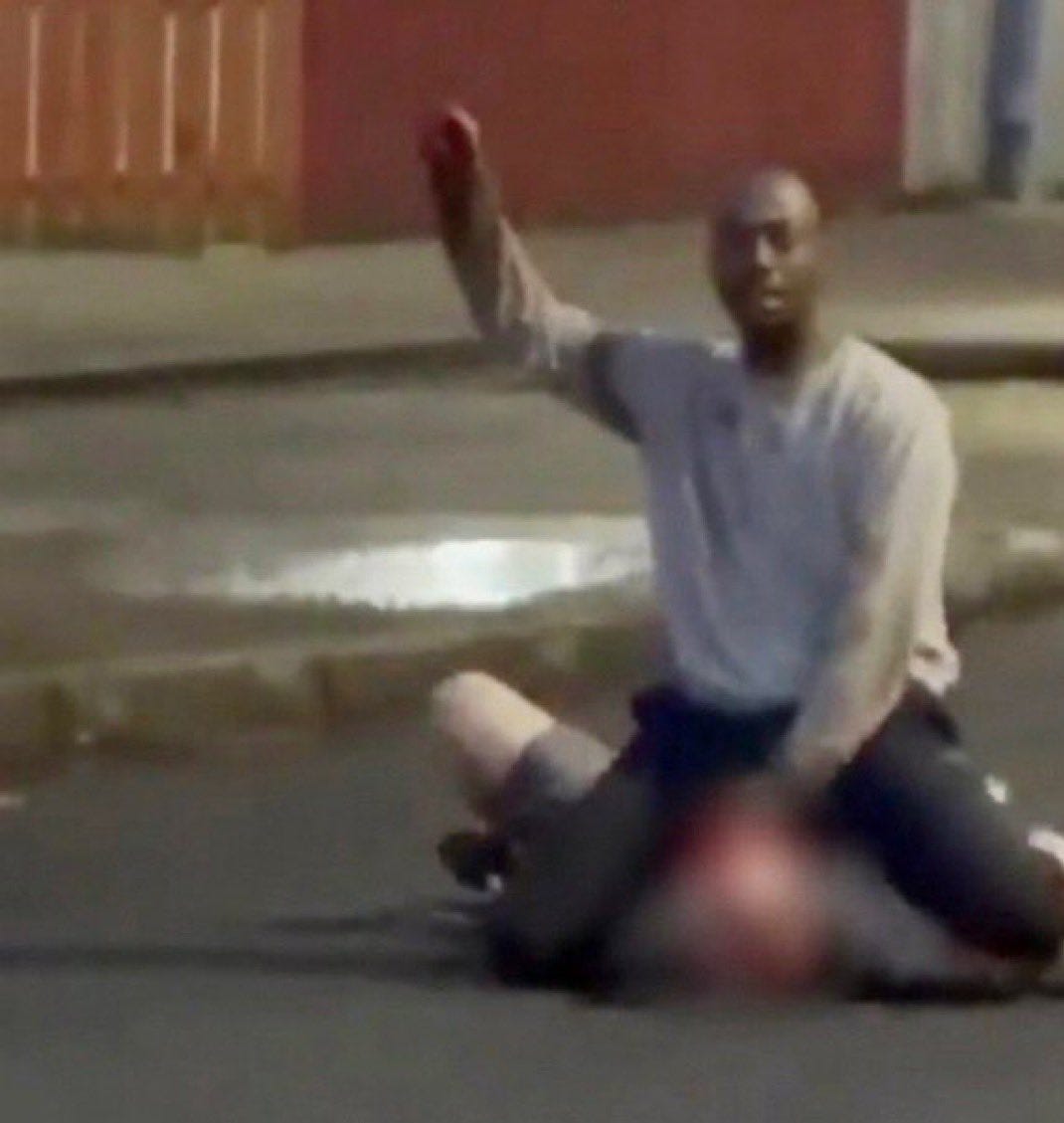
Now we have a horrific attempted murder at the hands of a Sudanese immigrant in Northern Ireland. Words cannot describe the brutality of the crime committed by this savage and other savages from the Third World:

Perhaps that this incident came just days after the full scope of the Henry Nowak murder came to light explains why the attempted beheading of 44-year-old Stephen Ogilvie had such an explosive public reaction. It resulted in rioting in Belfast, along with similar demonstrations throughout the rest of Britain.
Northern Ireland is no stranger to civil unrest, of course. Images of the rioting were reminiscent of the darkest days of The Troubles:

All the way to including checkpoints:

The rioting is threatening to shift the narrative on the situation in Britain from a long overdue discussion on immigration and multiculturalism to the overblown threat posed by the “far-right.” Unfortunately, there may also be no other way to bring attention to these issues. In addition to it coming on the heels of the Henry Nowak controversy, the sheer brutality of the stabbing in Belfast cannot be exaggerated.
Here’s the full-length video of the incident. The way I see it, anyone who watched the video of George Floyd’s death in police custody should have no issues watching this:
It’s not just the brutality of the crime. The identity of the criminal matters, too, and it has nothing to do with racism:

The Left, of course, is accusing the right of racism, saying that we’re concerned only about crime when at the hands of a non-White person, foreigner, or immigrant. This is, of course, not true. It’s actually the Left that’s in no way concerned about crime until it can be used to blunt away right-wing arguments on topics such as immigration.
More importantly, that so many crimes are committed by migrants represents an unfathomable level of state failure. People who have literally no business being in the country, people to whom neither British state nor society harbors any special obligation towards - i.e., the literal definition of citizenship - are being allowed to enter the country just because. In doing so, a country already facing insurmountable crisis is having its problems multiplied unnecessarily.
Make no mistake: this is a policy failure:
The Sudanese asylum seeker charged in connection with the attempted beheading in Belfast on Monday was granted refugee status in Britain through a fast-track Home Office process that avoided a full face-to-face interview.
The Daily Mail reported on Thursday that the 30-year-old suspect, identified as Hadi Alodid, was allowed to remain in the U.K. after completing a 10-page questionnaire under the Streamlined Asylum Process, a system introduced under the then-Conservative government to help clear tens of thousands of unresolved asylum cases.
Alodid’s case was reportedly handled under the scheme, which was set up as ministers sought to reduce a backlog of 92,000 claims. The process was overseen by then-home secretary Suella Braverman and then-immigration minister Robert Jenrick, both of whom have since joined Reform UK, the party topping national polling in Britain.
According to the tabloid newspaper, the fast-track programme was known inside parts of the Home Office as the “grant 0factory,” allowing applicants from countries with very high asylum grant rates to have their claims processed without the usual in-person interview.
It initially applied to selected nationalities and was later extended to Sudanese applicants in June 2023. Alodid had travelled from Dublin to Belfast by bus in February of that year and was granted a five-year refugee visa in September 2023.
Think about it - why’s a country with so many problems to begin with admitting so many migrants and refugees? None of it makes any sense. Furthermore, why are demands for even the most mild of limits and restrictions on immigration met with such ferocious resistance? Then there’s the rhetoric surrounding immigrants, fashioning them as the literal lifeblood of Britain, as though the country would be absolutely nothing without them, as though they need immigrants when in fact the immigrants need Britain. That sort of talk is abusive and certain to breed resentment.
Britons, Westerners in general, are being bullied into caring less about themselves and more about foreigners. But literally nobody does it. Even liberals do so only in a performative manner. Immigrants are worried only about themselves and are coming to Britain and elsewhere throughout the West for their own benefit, not for the countries they migrate too. If a country decides immigration isn’t working for them, they don’t need to bring any more in. End story.
The fact a crisis-ridden country with widespread discontent is good for nobody, including immigrants, seems to be lost on not only political leadership, but for the citizenry as well. This is a problem of unimaginable proportions, ultimately coming down to the fact there exists an unbridgeable ideological divide. Such a divide cannot be overcome through the political process. It can only be erased by war.
Prelude To Civil War?
Do recent events vindicate Dr. David Betz and others who say civil war is coming to Britain? It’s a topic I’ve covered extensively as well. The last time I broached the topic, I said that Britain was most certainly headed for a period of heightened unrest and violence, but I didn’t think a major civil war would occur. I still stand by that assessment. I don’t think the situation has changed all that remarkably and I also don’t think the British state is facing a true legitimacy crisis.
At the same time, even optimists need to face the reality that Britain isn’t a peaceful place and will become less so in the years to come. It’s easy to forget now, but during The Troubles, the entire country was affected by violence, not just Northern Ireland. Anyone who wanted to visit Britain had to be aware of the risk of terrorism. I don’t know if the country is headed back to the days of sectarian murders, shootings, and bombings. I don’t think it is. But there are other forms of violence.
Something I think keeps a cap on violence is that Britain has already become a balkanized society. Muslims, in particular, live in their own ethnic communities. In Northern Ireland, there were and still remain Catholic and Protestant neighborhoods. But they were right next door to each other
First and foremost, don’t expect the rioters in Northern Ireland or elsewhere turn into an insurgency akin to the Ulster Volunteer Force of The Troubles or anything like that. In a series of in-depth analytical articles on a future British civil war, a writer going by the name “El Inglés” explained how it’s unlikely that British nationalist faction - referred to as “Pitchfork” - aren’t likely to pose an organized strategic threat:
This section, long and complex though it is, is dedicated to establishing one single point of overwhelming importance — that Pitchfork will not, indeed cannot, cohere into a single organisation that could have a political agenda put forward by a single, coherent political wing. This is a crucial asymmetry between the Troubles and OMT — once OMT start, there will never emerge any single political interlocutor with Crown whom might, in principle, negotiate. Negotiation may take place between Pitchfork and Crown, but it will be local, piecemeal, and non-binding on Pitchfork more generally. There will never be a Pitchfork political party. Individual Pitchfork elements or organisations might issue statements of whatever sort on TikTok or social media, but they will communicate overwhelmingly through action, and only on their own behalf. Pitchfork, taken as a whole, will be mute — savage and implacable, but mute.
There are two major implications here, one good, one bad, depending on your perspective. The good news is that this is hardly any kind of revolutionary force and their ability to threaten the status quo is quite limited. The bad news is that the inability to negotiate with them also means it’s difficult to hold any leverage over them and they can keep the violence going indefinitely.
Liken them to blacks, specifically in the United States. As a demographic, they have disturbingly high crime rates and people from all races are victimized by this one group more than by any other. However, not only are they a minority group at 13 percent of the population, they also lack the ability to organize as a group despite strong in-group identity, and thus are unable to wage strategic violence, the kind which would absolutely pose a major national security threat. In that sense, the so-called far-right, Pitchfork, whatever term you’d like to label them with, pose a less formidable threat than Islamic extremists.
That said, every regime needs an enemy, so expect the British state to play up the threat posed by Pitchfork, outlets like the BBC will turn into even bigger propaganda machines than they already are, and Pitchfork will unfortunately provide fodder for it. What we’re looking at then is less than a civil war and more of a long-term low-intensity conflict, one which the state will simultaneously deny - armed conflict is generally bad for business - and exploit for political purposes. In a sick, twisted way, there’s much for the British government to gain from all this.
Something else to consider is that any future domestic conflict in Britain or anywhere else in Europe will be literally “civil” in that it won’t pit ethnic groups, races, religions against each other as conventional wisdom holds:

Given that White Britons themselves are a deeply divided demographic while still comprising the majority of the country, the reality is that the conflict will be fought between Whites more than between any other group. Certainly, non-Whites will benefit from this, since they’ll have to risk virtually nothing, all while enjoying government protection and the benefits of living in the First World. This is, ultimately, an ideological conflict.
A certain level of balkanization will occur, but this will in many ways be a convenient way for the British government to contain the chronic unrest and further marginalize communities opposed to the multicultural regime. In turn, separated communities means it’s easier to protect on-side communities.


The battle lines are being drawn as we speak. Make no mistake: the British regime has picked a side:

In a civil war, the faction which the government, military, and police side with usually emerges the victorious side. Make of that what you will.
Maybe It’s Already Over
The British government’s long-awaited report on the ugly rape gang scandal has arrived. It’s not pretty. I’m not going to get too deep into the weeds on this one, but I did want to share this passage from it [bold mine]:
The scale of the crimes committed is staggering. It has been previously established that, at the very least, 250,000 young white girls have been subjected to repeated rape, gang rape, trafficking, torture, pregnancy, forced Islamic conversion, and lifelong trauma.1 The true number is probably higher. The perpetrators bear primary responsibility, yet the institutional failures that enabled them for decades must also be confronted. In court records and official inquiries, around 87% of those convicted in these group-based child sexual exploitation (‘CSE’) cases bore distinctively Muslim names.2 The vast majority of men involved in these gangs were not convicted. Dr. Taj Hargey, an imam with the Oxford Islamic Congregation, believes the true proportion of gang members who are Muslims to be around 95%.3 This figure far exceeds the Muslim share of the overall United Kingdom population. The overwhelming majority of the rape gang networks consisted entirely of men from Muslim backgrounds - predominantly of Pakistani heritage, although smaller groups from Somali, Iranian, Syrian, Turkish, and other Muslim origins were also involved.
In the face of such horror, every Briton must ask themselves: is racism really the problem here? Is how we feel about the perpetrators really more important than the crimes and perpetrators themselves?
Unfortunately, we have an answer to the question:
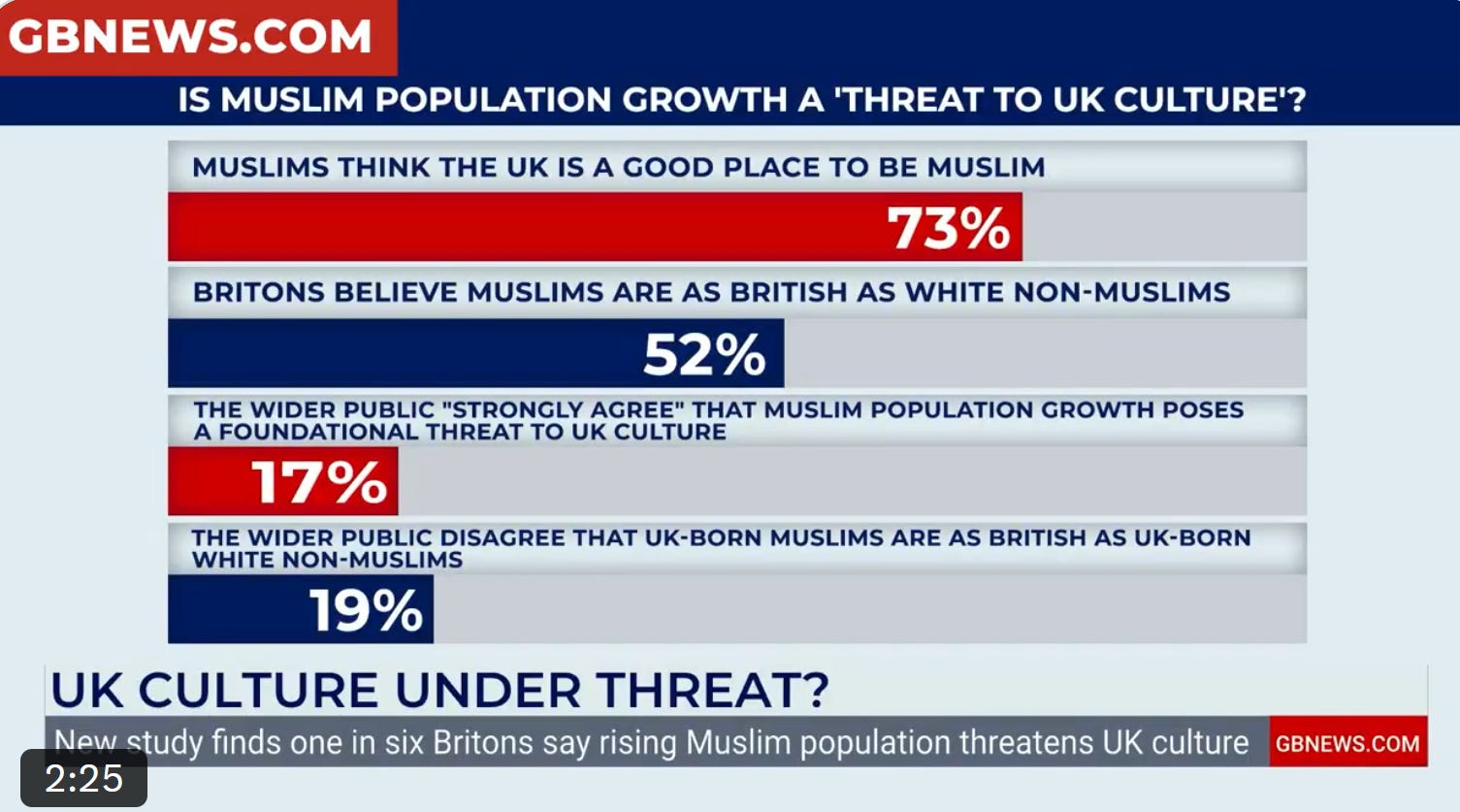
Face it - that 17 percent of the British public think Muslims pose a threat to the UK isn’t the problem here. It’s not any kind of problem. The bigger problem is that over half of Britons still believe Muslims are as British as anyone else, that they’re a part of society just as anyone else. This is a ridiculous thing to believe in the face of the facts, and will become even more so as the implications of The Rape Gang Inquiry Report sink in. Something has to give, right?
Cognitive dissonance is a real thing. People will find a way to live with contending views that don’t align. In practice, that means one set of views prevails over the other. No matter how damning The Rape Gang Inquiry Report may be, avoiding racism, finding a way, any way, to make multiculturalism work, is still what’s most important in the minds of Britons. Unless they find some new values, nothing can change.
As a result, there’s zero incentive for British leaders, let alone any Western leaders, to pivot away from the anti-racist, civil rights, pro-immigration framework. Politics is downstream of culture and culture is still very much in favor of policies which have brought us to the brink. I expect changes made on the margins for the sake of de-escalating tensions, but nothing longstanding, no major reversal of policy.
It seems, instead, that the sun has finally set on Britain, and a long night awaits a once-great civilization that appears to be dying a slow, torturous death.
What do you think? What’s your reaction to the attempting beheading in Belfast? What’s your reaction to recent events in Britain? Is the country headed for a disastrous crack-up of some kind? Or will Britons simply keep on and carry on, and if so, to where? Let’s discuss it in the comments.
Max Remington writes about armed conflict and prepping. Follow him on Twitter at @AgentMax90.
If you liked this post from We're Not At the End, But You Can See It From Here, why not share? If you’re a first-time visitor, please consider subscribing!
Remember that the British government would not grant actual UK passports to Hong Kong residents desiring them in the years before the 1997 retrocession of Hong Kong to the Peoples Republic of China. The government of Britain actively tried to keep Hong Kongers, some of the most productive people on the planet, from moving to the UK. But that same government has swung the doors wide open for "refugees" from Africa and the Islamic world. Hmmnnn. Sudan gained independence from UK administration in 1956 - full independence. So, an individual would have to be about 71 years old to even have been an infant in arms in Sudan under British colonial rule. You've got to kind of wonder about the "refugee" status claims. The UK has no reason to be granting that to Sudanese. For that matter, Pakistan became independent from the UK in 1949.
The UK as a surveillance state (and it is the most heavily surveilled place in the world, exceeding even China, and that's saying a lot), can get away with a very thin line of coppers, most of them NOT armed police, only because the general population still treats the Bobbies with a modicum of respect. When that respect is gone, conditions may change (towards the violent end) far faster than most expect possible. If guns are not available, (and it is anyone's guess how many are hidden away in the British Isles, albeit illegally,) it's fire and the sword, and the UK is awash in literal swords, many of which have blood stained histories of their own. And there is still a strong archery tradition there as well. Bodkin points were developed well over a millennia ago to penetrate armor, and even modern aramid fabric "cut proof" and "bullet proof" vests can be penetrated fairly easily by a bodkin pointed arrow. (Solid plate Level IV rifle armor is a different story of course.) But in a street fight between a Chinese box cutter or a kitchen knife and a Sheffield steel sword, it doesn't take Polymarket to predict the probable winner. Point is, guns are not the be all and end all - willingness to take up even traditional arms and kill is what makes the difference. It's one thing for grown men to abuse teenage girls. It's a far different thing to face a pissed off armed group of men intent on ending your life.
Nor does it take a majority to win a civil war. In fact, a solid three percent willing to take up arms and drive the points home has proven successful more often than not. Sad times. I fear the bloodshed has only just begun.
Good post, as usual. I guess I'm less optimistic than you are; I really don't see how any of this can be resolved without bloodshed. But I hope I'm wrong and you're right. Ugly, ugly, ugly.