Girl Meets History
If we can agree on the nature of history, we can agree on lots of other things.

X personality and Substacker Aella wrote the best X post you’ll read all week:

It’s a long post, but take your time and read it all, because it’s still shorter than my essays and you can get through it quickly. I think Aella sums up the totality of human history as well as anyone ever could, with more honesty than one can expect from even most professional historians today.
I wish I could address every point she raises, but that’d result in a very long essay. I’ll instead address the points I considered most significant for our understanding of history.
1. I sort of assumed people in the past had more freedom from their governments, but they absolutely did not. The people with the guns consistently oppressed people without, basically as much as they could get away with.
This right here is history in a nutshell. The people able to bring violence to bear, the people able to put their boot on someone else’s necks, those are the people who write history. It’s an exercise in strength, not righteousness. All the time, even now, someone’s boot is on someone else’s neck. We simply pretend that’s not how it works, because preserving the illusion is what permits the system to function.
2. Democracy is an insane invention. It feels sort of default or obvious now, and I sort of assumed that... people in the past all kinda wanted something like democracy but were oppressed by their monarchs, but this is not the case. Much of the time, calls for democracy were radical, even among the suffering unrepresented lower classes. If you went back in time and said “every man should have the right to vote” people would go ‘whoah there are you insane? that would absolutely destroy civilization!’
This is probably a fact which makes Western liberals most uncomfortable, because it shatters all assumptions underpinning their ideology. Even now, in the United States, specifically, you see democracy increasingly becoming mob rule, increasingly becoming… authoritarian. Yes, some of this is because Americans don’t believe in democracy all that strongly. Only ideologues treat democracy like it’s a religion, which isn’t how one’s supposed to treat a form of governance, anyway.
But has anyone bothered to ask why most Americans don’t really believe in democracy? Could it just be that governance isn’t for everyone? For democracy to work, it’s not enough to simply pick leaders. The body politic must be intellectually engaged. This isn’t the same as being a leader, of course. But someone who wants to vote, to make decisions which can affect a whole society, must be capable of understanding benefits, trade-offs, and implications of policy-making. Most people simply aren’t interested. When you get down to brass tacks, politics is boring as hell, and it’s a lot of work. Up for a second full-time job?
I’ve said it before, I’ll say it again: people like the idea of democracy more than its practice. People like the idea that they have a choice, even if they know, deep down inside, they really don’t. Being told they have no choice is more frightening than the reality of it.
3. Most big moves to make things better were way less radical than you think. People would get very mad at the king for being terrible, but instead pushing to overthrow the king, would just... want the king to sign a nice constitutional document or something. Progress was mostly made in smaller increments; people generally did *not* think big at all. And even when radical moves did happen, people just sorta quietly waited until everything died down and reverted them. Like, you know how they guillotined the King and Queen in the French Revolution? Well basically as soon as it all died down (and uh, post napoleon) they just put the monarchy back on the throne and continued onwards as usual. It took like another four revolutions and almost a century to actually get to a stable republic.
People are functionally conservative, not radical. Even the radicals themselves are radical only in their thinking. Nobody likes change as much as they think they do, nobody’s as ready for change as they think they are. It’s everyone else who has to change, anyway, because everyone else is the problem, right?
Another historical example illustrating this point is England. Even after Oliver Cromwell and the Puritans won the English Civil War, he was eventually overthrown and the monarchy restored. Over time, however, the monarchy lost power, and Britain became the parliamentary constitutional monarchy it remains today. So change happens, but it rarely happens overnight, and the more radical the change, the greater the reaction often is. Progress is aspirational, progressivism is an ideology. It’s not the way things work in the real world.
4. Things were local. Today I have a concept of large cause areas like ‘the environment’ or ‘war crimes on the other side of the world’, but in general, pushes for change were extremely local. People really do not see beyond what will benefit them and their own communities. The entire ‘working class’ would ostensibly want the same rights and seem to united, except the artisan class would dump the farmers the instant it was convenient, etc.
Like, at one point one of the lead slaves of the Haitian revolution, who helped start the whole thing and led an army, tried to sell his fellow slave fighters back into slavery in exchange for getting special treatment from the rulers.
At the end of the day, people can only concern themselves with things within proximity. It’s just that modern life, specifically in the West, has become so safe and secure, nobody feels like they have anything tangible at stake. As a result, today, people can pick and choose what they want to concern themselves with, or are influenced into concerning themselves with events well beyond their physical proximity, or things that nobody up until five minutes ago in historical terms would’ve ever fought over (transgenderism comes to mind).
When a person has nothing tangible at stake, they’ll find a crisis to concern themselves with, or even invent one. Even then, it’s typically only their emotions that get wrapped up in it. Few people will devote anything other than their anger towards a cause, in part because most people are in no position to do anything about the issue, since it’s beyond their proximity.
5. The US revolution was way derpier than I thought, but also way more impressive compared to how derpier everything else was. the US is actually an extremely special and anomalous thing in history, and "selecting for intense high-risk people away from the control of established governments" was a magic spark that almost never happens. The key people somehow seemed more intelligent and principled than most other people in history who ended up in decisionmaker chairs.
The American Revolution is undoubtedly one of the most misunderstood events in history, especially by Americans themselves. The narrative of the event has been re-written many times by many people to support their own agendas. Today, liberals own the narrative, and thus the Revolution was an ideological movement against authoritarianism, and the Founders were liberal democratic pluralists.
In a follow-up post, Aella asked:
One reason is because the American Revolution was less a revolution and more a reaction. It was a response to Britain trying to change the terms of colonial governance. It wasn’t an attempt at remaking or reordering society. Nor did it entail some wholesale change in governing philosophy. The Founders weren’t profoundly anti-monarchy as liberals today claim. What happened was that their appeals to the king were unrequited, which is ultimately what catalyzed the fight for independence.
In other words, the American Revolution wasn’t an ideological movement like the later French Revolution. Liberals retconned the American Revolution into an ideological movement to serve contemporary political needs. It’s also precisely because it wasn’t an ideological movement nor even a true revolution that it was so successful.
7. The mobs and common people are often very stupid. They get paranoid, they believe completely ridiculous conspiracies that were obviously not true if you thoguht for two seconds, they misinterpret normal facts as evidence the ruling class is evil. e.g. at one point a mob was tryin to send representatives to the king with a petition, then they saw the doors getting locked, and flipped their absolute shit. But - the doors got locked at that same time every day, it was routine and had nothing to do with their representative, but the mob didn't care, didn't stop to think critically, and just exploded.
I think the story of the last 10 years in American politics is about what happens when democracy descends into mob rule. Sorry, but MAGA’s a mob. So is the Left. Our politics were pretty dumb before 2016, but look at how much dumber it’s become, even as the Overton window has shifted. Minneapolis is the latest example of the stupidity of mobs. Imagine getting yourself killed so people can live in the country illegally. The one thing I’d add to Aella’s point is that mobs often form for the dumbest of reasons.
The hardest thing for people, including the more intelligent and thoughtful folks, to admit is that they’re part of a mob. Everyone likes to think they’re independent thinkers, that they aren’t susceptible to group-think. I’ll just put it to you like this: if you end up part of a mob, you’re not an independent thinker, and you’ve succumbed to group-think.
8. Mobs are really hard to predict. Things happen fast, tensions are high, and they might switch their allegiance, suddenly become violent, or just get tired and disperse. It's super high variance.
The point is that mobs are random and short-lived. Yet their consequences outlive their time. In 2020, everyone was screaming, “Black Lives Matter!” Then just as quickly as it started, it stopped. Americans endured four years of increasing disorder, and bodycam footage of blacks committing crime and fighting police made BLM a difficult movement to sustain. The damage has been done and continues to be done, however, even as crime rates have come down.
10. There was often a tension between freedom and order. Lots of people justified tightening the hand of the rulers by spreading fear about lack of order. Sure, man should be free - but obviously not free enough to cause chaos by failing to respect the law, or social propriety, or those above him, obviously.
This is a keen observation, though I don’t think there’s actually much tension there. It’s the duality of life: in order to enjoy freedom, there must be order. For example, you cannot enjoy the benefits of property ownership without laws dictating that others cannot just come to your home and take what they want, whenever they want. Otherwise, you spend all your time defending your property with force. Is that freedom? In a fundamental sense, yes. In a practical sense, no, and most people wouldn’t view it as freedom.
It’s not so much a matter of striking a balance between freedom and order. Rather, it’s about understanding that freedom, as in protection from violence, requires order, which requires the exercise of violence.
12. Militaries were not aligned with their governments, often. In the US the concept of the military acting independent of our government is pretty foreign, but much of history was plagued by the armies going rogue, doing their own assassinations of rulers, putting their own guys on thrones, etc. And sometimes oppression of the common people was downstream of rulers having to basically bribe their armies to let them stay in power.
This is a supremely profound point Aella makes. Controlling the men under arms has always been a difficult task for those in power to manage, because how do you control those who could just use those arms to force you out of power? One way is to have the warrior class also serve as a ruling class, a military dictatorship, as it were. This form of governance is a lot more common throughout history than people realize.
Civilian control of the military is a fairly modern concept, coinciding with the rise of the modern state and nation. In many ways, the idea that the people with the means of violence at their disposal are subservient to those who don’t is a radical concept, since no law, no constitution, has any force behind it without the ability to bring violence to bear.
As Aella points out, civilian control of the military has been a norm constant throughout American history, but a lot of this is because the U.S. maintained a small standing armed force with little political influence outside of wartime up until after World War II. This wasn’t the case even in modern Europe, where large, permanent military establishments were not only the norm, but the institution had tremendous political influence as well.
I don’t see civilian control of the military at risk in the U.S., even as the political situation deteriorates. I think the real problem isn’t so much that the military might go rogue, but that it would either collapse as an institution due to political failure or that it’d feel forced to pick a side: either obey the commander-in-chief, or make a judgment call and pick the side they believe won’t force them to betray their oath. Which isn’t all that different from going rogue. But that’s a discussion for another time.
13. I was surprised by how much monarchies were not dictatorships. I’d assumed that kings basically could tell people to do whatever and those people would have to do it (and sometimes this was the case), but often the king would have to get the support of key influential people beneath him, and sometimes follow laws to do this. Like the english revolution in the 1600’s iirc had the king repeatedly trying to follow laws to raise tax and the influential people refusing to vote to allow him to raise the tax, and the king got really huffy.
I’m going to quote my friend “William Estes,” who shared his thoughts on this point with me via X DM:
Monarchies were extremely decentralized. Kings were constantly negotiating with factions of power from the Nobles to the Church to the gentry/knights to the merchants to the guilds the independent peasants to the peasants, etc, etc... Louis XIV, for all of his “divine right power” couldn’t implement an income tax. Such a thing was unimaginable.
Something one comes to realize the more you study both history and politics is how governance is a matter of constant negotiation. Things never work exactly the way they’re supposed to according to the letter of the constitution. Civil-military relations, for example, are a constant negotiation, as any expert in the field will tell you. Again, it’s not supposed to be that way, but that’s how it works out in the real world.
Monarchies didn’t operate like the modern bureaucratic state, so negotiations mattered that much more. You didn’t have what you have today, un-elected officials basically running government. The key players, including the monarch, called the shots, there weren’t layers of bureaucracy to navigate to implement policy, so the conversations between these key players were the driving force in politics. It’s just that the monarch, as Aella said, couldn’t always behave unilaterally. If anything, behaving unilaterally is what caused revolts or even got kings and queens overthrown.
18. Everything is so, so complicated. Basically no single ideology value set today really feels like it would cleanly be the right option to take in the past in all cases. For almost every value you hold, you can find instances in the past where holding that value would have gotten you and everyone you loved killed.
Well - that’s history, isn’t it, folks? It’s not a simple morality tale, that’s for sure. I’d caveat what she says by in turn saying that history itself isn’t ideologically-driven. People act in their self-interest, with survival as a first instinct. The ideology often comes later as a rationalization. The ideology-first approach is something which came out of the Enlightenment, culminating in the 1789 French Revolution, meaning it’s a recent development in the grand scheme. It doesn’t mean it doesn’t have staying power, but it does mean, for the duration of human history, it’s an anomaly to be driven first and foremost by ideology. The results of ideology-first doctrine have been nothing short of catastrophic, be it the French Revolution, Marxism, fascism, the list goes on.
This post here explains what really drives historical events [bold mine]:
Something everyone needs to understand and fully internalize is that there is no mechanism in the brain that prevents one from holding two directly contradictory beliefs at once if each is advantageous. The human mind is wired for survival, not debate club
Most people are just genuinely uninterested in what is true, they are interested in Winning. You’d better be too
There’s a lot to take from there too, isn’t it? I often laugh at and make fun of all the Left’s stupid contradictions, but the fact is, those on the Left don’t care. First, they’re in power, and when you’re in power, you don’t need for anything you do to make sense. Second, when surviving and winning are what matter most at the end of the day, who cares if anything you say makes sense? History isn’t written by debate club winners.
I ended up covering most of her thoughts, but still do read Aella’s post in its entirety. It’s always fascinating to see someone’s brain at work like this. Even in today’s hyper-educated times, it’s still next to impossible to get anyone to study history in any real depth, with emotional and political detachment. To see someone who’s not even of an academic background exhibiting so much intellectual depth, self-reflection, and wisdom in their study of history isn’t only stimulating, but it’s also refreshing at a time when professionals who study history themselves have been compromised.
I think it matters that Aella’s a woman, too. At a time when political instability is both the cause and effect of gender conflict, having both be more historically interested at an intellectual level would be one way of closing that gap, because real, dispassionate conversations can take place.
If we can agree on the nature of history, we can agree on lots of other things.
History Beats Liberals
One group isn’t likely to agree on the nature of history. Unfortunately, they’re the very group rewriting history as we speak.
Here’s educated woman Cassie Pritchard sharing her wisdom in response to a post by Elon Musk which triggered a tidal wave of argument:


Liberals pretending to understand history is painfully funny to watch. To the extent anyone fought for multicultural economic zones, a.k.a. empires, was entirely by coercion or happenstance. Empires specifically tend to be ruled authoritarian regimes. You’re not going to have much of a choice if the regime tells you to go to war for them. Not to mention, liberals can’t seem to decide whether the modern-day U.S. is an empire or a nation. They can’t be both, because they’re different types of political units. If we’re an empire, then the only reason why people die to defend it is because they have some incentive to or they have no choice.
Nations don’t run on love either, but loyalty is a more significant factor, because nations are identities. Empires are associations. That said, most people throughout history identified with their tribe or locality from 3000BCE to 1789CE, the time-frame cited by Cassie Pritchard. Identification with some greater whole like a nation is a modern concept. Most subjects of empires didn’t proudly cite their association with said empire, either unless they were a member of the core ethnic or dominant group. Just look at the U.S. today - many of foreign origin identify more with their ancestral or ethnic origins than they do with their nationality.
Here’s some bad history from a guy calling himself “HistoryBoomer”:


Carl ought to know: decontextualizing history is for the intellectually dishonest or those pursuing an agenda. George Washington never had to specifically mention “English” or “British” because he didn’t need to. Americans were well-aware who they were. It’s not up to us today to assume Washington meant that Somalis could become Americans because he didn’t associate the nationality with a specific ethnic group or ancestral origin. With time, the nature of being American certainly expanded, but it still doesn’t make it open-ended, as liberals like Carl would like.
One more example of bad history:


“Wildly diverse?” Here’s wildly diverse for you:
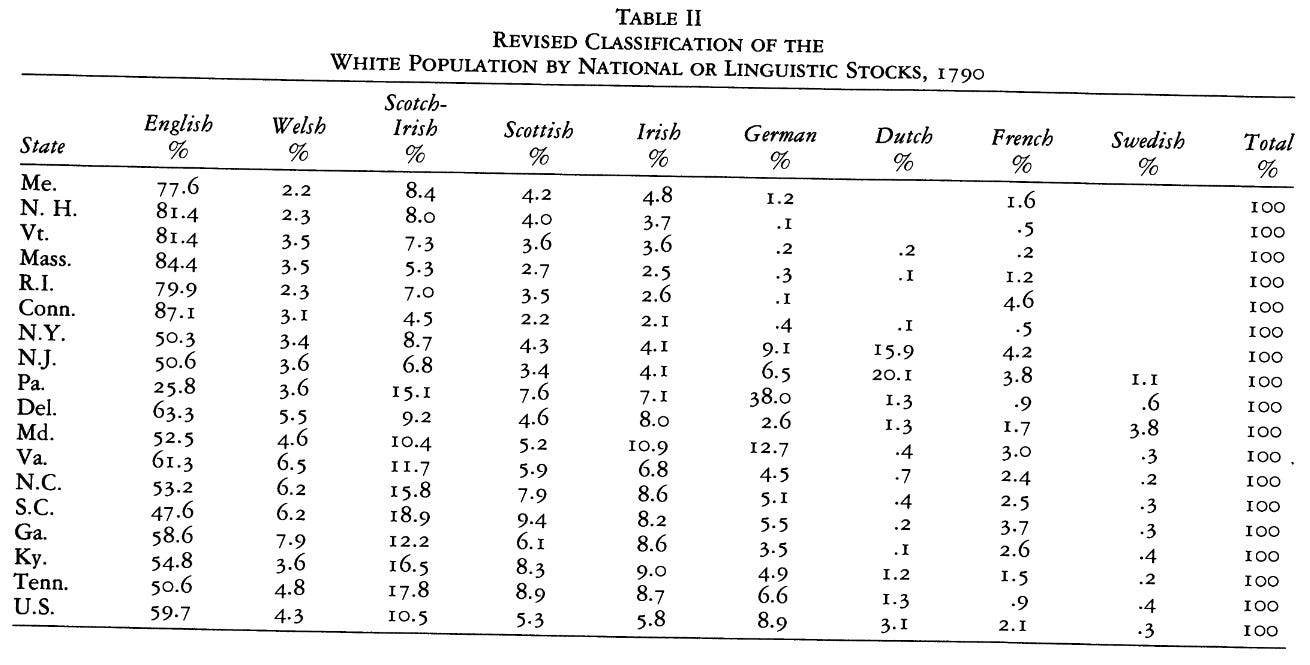
This is the furthest thing from “wildly diverse.” Most Americans were White and of British, not broadly European, origin, and that’s even factoring in the black population. Indians don’t count, since they weren’t Americans, and neither do the Spaniards, since they were of a whole different country.1
Anyway, I can’t fact-check all these liberal aspiring historians, and I’m sure there will be an endless array of them from now until thy kingdom come. It’s up to all of us to let them know that they don’t own history, that it doesn’t have a liberal bias, and it most certainly isn’t a weapon for them to against anyone.
Closing Thoughts
As Aella said, history is complicated. There exist common threads and recurring themes, however. Finding out what those are is the key to studying history, as these are what simplify things. It’s not something to be used to validate ideologies and worldviews. You may not like what history has to tell you, but you can’t correct it, either. All you can do is learn from it, manage expectations, fix what you can, while understanding that none of it’s really up to you in the end. Maybe that’s the universal lesson of history.
Discussion time - what was your reaction to Aella’s post? What broad lessons and themes have you learned from studying history? Have you any ideas for getting more people interested in understanding history in a more serious fashion?
Let’s discuss this in the comments!
Max Remington writes about armed conflict and prepping. Follow him on Twitter at @AgentMax90.
If you liked this post from We're Not At the End, But You Can See It From Here, why not share? If you’re a first-time visitor, please consider subscribing!
“American” in the sense of being a citizen or subject of the 13 colonies and subsequent United States, not American in the Bad Bunny sense of simply being present in the Western Hemisphere.
I think the most powerful antidote to mass historical ignorance is simply reading. Very few people read, and it shows. They don't think logically or have much of an imagination. They take scenes from popular fantasy movies and assume that history pretty much follows this. Thus, to even correct them on various points of fact mean little because their whole capacity for understanding is so limited. This only gets worse with moral questions, like those regarding slavery or war or minority rights. They have no clue what earlier societies were struggling with or what forces were at play.
Case in point: I once was friends with a history teacher who prided himself on being an intellectual. We were discussing the history of the Renaissance and the Middle Ages, and he condemned the Catholic Church for not developing a modern socialized healthcare system that could better address plague. He just assumed that all the infrastructure, resources, and even technology were there to organize what we now associate with modern hospitals. I found this an odd contention to make, but he thought it was purely reasonable.
Oh, and he was a card-carrying Marxist. The real stuff has never been tried, you know.
This has soured me on trying to win historical arguments. The framework is so far from existing that all our public discourse degenerates into senseless babble.
A barbarian is someone who destroys without the slightest interest in the value of what he's destroying.
The Left became a barbarians about 30 years ago. The Right became barbarians in the last 10. Both claim to be the guardians of democracy. Both should read Burke to find out why that isn't a compliment.