Nursing's Radicalism Problem
Your life’s in good hands, bigot!
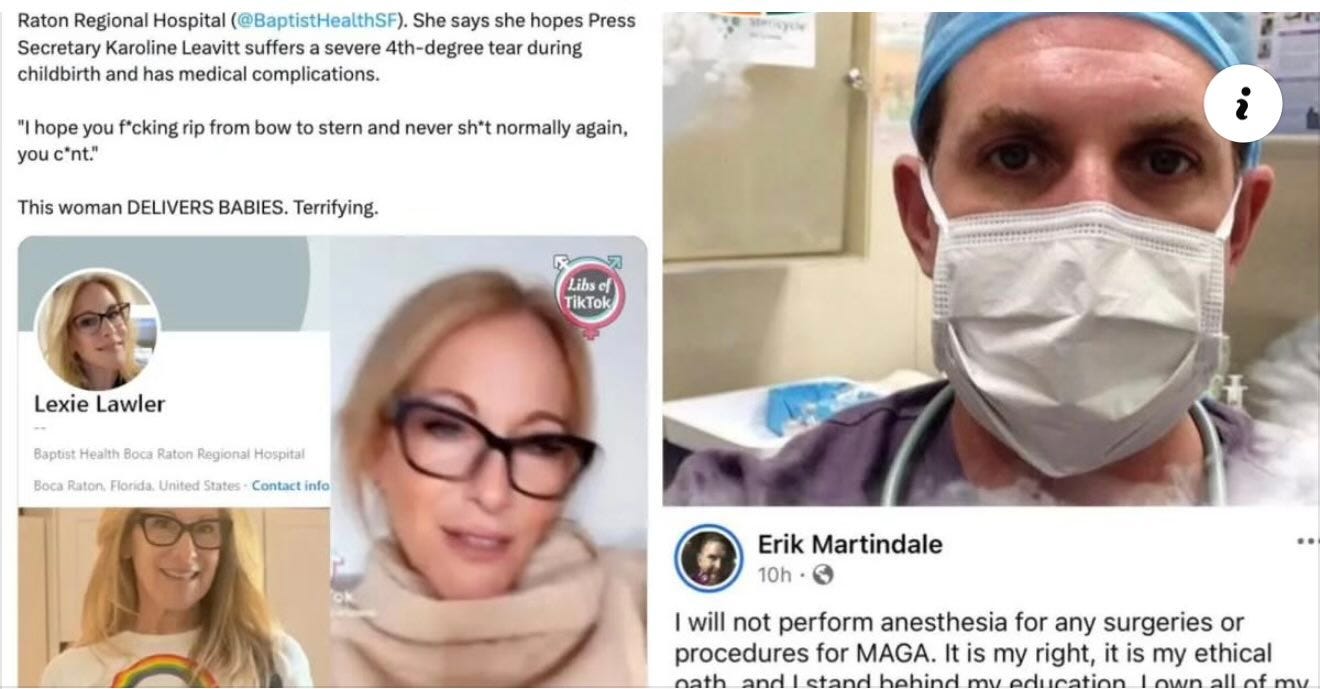
Rod Dreher shared a friend’s harrowing story on his Substack about the far-left radicalization of nursing. Excerpts:
My final nurse was a woman of about 30 who was initially very friendly, chatty, and surprisingly curious about me. She came back in for discharge with a completely different demeanor. Cold, hostile, silent. It was such a huge change that I felt nervous. The animosity as she wheeled me and my son to the exit was palpable. But I was leaving with a healthy baby and didn’t want to think about the nurse’s behavior, however dark and confusing it left the last hour of our stay.
Two days later I was at home holding my son on a Saturday morning when the phone rang from an unknown number. I thought it might be my friend living overseas calling to ask about the baby, so I answered it. A bright female voice, which in retrospect I think was that of my discharge nurse, said, “Is this [name]?” Yes, I replied. “Congratulations! We’ve just made a $1000 donation to Planned Parenthood in your name” (and here the voice switched from bright to snarling) “YOU F*CKING BITCH. ALSO, YOU ------” I am leaving that part blank because it was so shocking and horrible that I still have never managed to repeat it. She made a brief but give-away allusion to the private details of the birth which when I was calmer allowed me to identify it as someone from the hospital; she then added some more curse words, called me a cunt, and hung up on me.
The writer, who remains anonymous, was known for a pro-life essay she’d written. She suspects this nurse looked her name up on the Internet (anyone’s guess why), saw the essay, and decided to treat her as the enemy.
More:
In the following weeks I looked up information and general social media talk about nurses & social media usage, and learned that some (obviously not all or even most, but enough to be scary) nurses create exclusive groups to gossip about patients, even creating & sharing “red flag lists” based on whatever crimes the nurses think patients have committed — which can range from being genuinely disrespectful to simply having different political opinions. It seems like an extension of “MeToo” network support — they believe they’re protecting one another by sharing patient info in order to help nurses “stay safe.”
The flexibility of Woke Justice Theory means a pro-life woman like myself can put a pro-abortion nurse “at risk.” People like me are unworthy of care because our mere existence “triggers” stress in progressive nurses. I read nurses who were aware of those groups had talked about their existence publicly, but it didn’t seem like the problem was making it to the public in 2021 and I haven’t tried to find out more info specifically on these private lists. But I have continued to follow stories on nursing culture closely: just a few months ago there was an OB-GYN office in CA that had to fire most of their nurses because they were taking pictures of the exam room after patients had left and blasting them on TikTok for laughs. There were thousands of likes and at least half a dozen nurses participating. These are actual red flags that there is a collapse of ethics in nursing which is being ignored by healthcare and hospital networks.
Nursing is a profession which has become disturbingly radicalized over the years to an extreme degree. How this happened is a long story, one which I’ll only briefly touch upon later. The point is, the profession has become a hotbed of far-left radicalism. That became apparent in the wake of the killings of Renee Good and Alex Pretti, especially, by federal agents this month. Social media is full of examples of nurses loudly protesting, going as far as issuing death threats against ICE agents, right-wing public officials, against anyone who doesn’t conform politically.
This isn’t just a case of “bad apples,” either. Far-leftism is baked into nursing at the institutional level. A nurse in Minnesota explains:

In other words, nurses are being encouraged by their leadership to effectively be political activists, forcing them to undergo indoctrination. To what extent nurses are being programmed or simply having their preexisting views reinforced is unknown, but immaterial. What’s important is that nursing has been compromised politically.
The Most Trusted Profession In America
Why does this matter? I’d hope the answer would be self-evident to all, but for one, nursing has been the most trusted profession in America for many years now. Take a look at these figures:
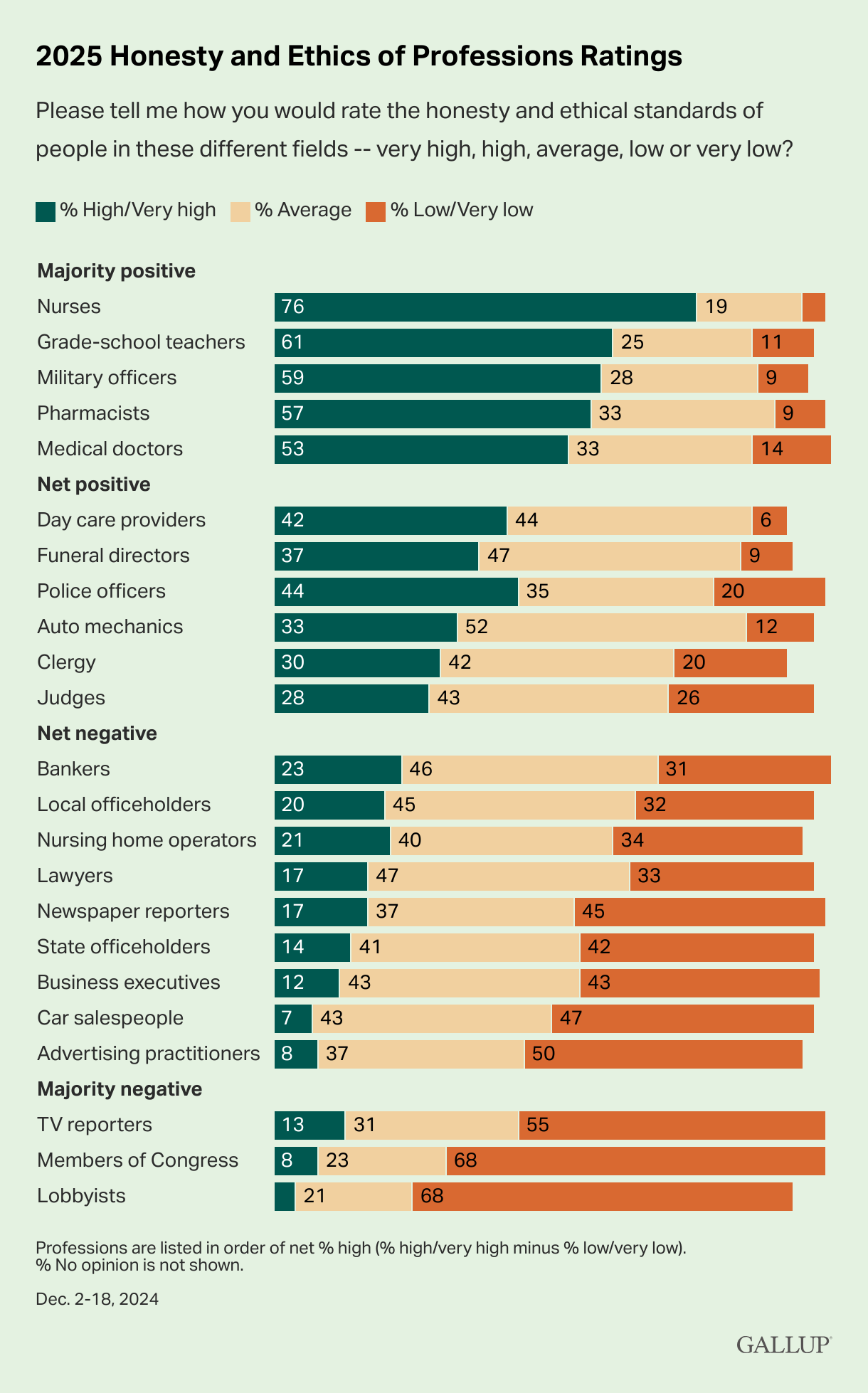
Compare the favorability of nurses to that of doctors. I’m not sure why the gap is so large - maybe it’s because nurses spend more one-on-one time with patients? Maybe it’s because they’re perceived as doing more work? Maybe it’s because of high-profile incidents of malpractice or even crimes at the hands of doctors? Maybe it’s because doctors make too much money (as if nurses are underpaid)? Whatever the case may be, Americans have decided nurses are the best people in the country.
The most trusted profession in America is performed by far-left radicals. Your life’s in good hands, bigot!
It raises the question: how aware Americans are to the extent of radicalization among nurses? I don’t want to imply that every nurse is a far-left radical, but again, we’re talking about something entrenched at the institutional level. The stuff is far too widespread to say these are isolated cases. If radicalization of this extent wasn’t only prevalent in another profession, but on the other end of the political spectrum, it’d probably be a much bigger story. And it has been.
For example, the military remains among America’s most trusted institutions, even as that trust has fallen precipitously over the last half-decade. Yet, concerns about far-right radicalization was a major storyline in the first few years of the Biden administration, before fizzling out because there wasn’t much to it. The media tried making a big deal out of a small number of servicemembers who were revealed to be right-wing extremists, with no concern whatsoever about cases of far-left radicalization within the ranks.
Likewise, police officers, the Regime’s most hated profession (though the public still mostly trusts cops), are routinely scrutinized for even the slightest degree of impropriety. A single Internet search reveals endless examples of cops losing their jobs over social media posts. Typically, these posts, if politically-charged, reflect views associated with the right. To be fair, left-wing radicalism can get officers canned, too. But the profession of law enforcement not only attracts more right-wing-minded individuals, it also cultivates such thinking due to the nature of the profession. It’s just not easy being a liberal in a job where you have to deal with people at their worst, the worst society has to offer, and where chaos and disorder is the norm. At the same time, policing doesn’t have right-wing radicalism baked into it at an institutional level like nursing does.
Point being, we as a society accept the fact that having political radicals in any profession isn’t just bad, we also accept that radicals who cannot keep politics out of their work shouldn’t keep their jobs. That norm clearly hasn’t hit nursing yet, not to the degree necessary. The only other, more troubling, explanation is that Americans are aware that many nurses hold radical left-wing views, but aren’t bothered one bit, because, well, America itself is a far-left society, and far-left radicalism is given far more rope than its polar opposite. We all know it to be true.
It’s also true that the Left doesn’t see this sort of radicalism as “doing politics.” They see it as “upholding values,” “doing the right thing,” take your pick. This suggests leftists believe social values are essentially set in stone, and those who don’t share said values are the ones who are doing politics, in addition to being indecent. It hits at a much deeper reality about politics, democracy in particular, in that no system can tolerate an excess of dissent, an excess of diversity in thought, yet both dissent and diversity are precisely the virtues of democracy. Even liberals seem to get this, though it’s not something they’d ever say out loud.
It’s a big problem. So many of our institutions have been politicized. But since politicization has been propagandized as something the Right, not the Left, engages in, most people just don’t see the problem even as it stares at them right in the face. It’s also true that most nurses, regardless of their political views, don’t let it get in the way of their professional duties. As such, many people don’t see the problem because they don’t personally experience it. That said, if we’re going to worry about the fact that “too many” cops and soldiers are right-wing, why shouldn’t we worry about the fact that too many nurses are left-wing? Like cops and soldiers, nurses can kill us, too.
A Mean Girl’s Job
How did nursing become so radicalized in the first place? This is a question one could write an entire academic paper on. My quick and dirty hypothesis is that nursing is a female-dominated occupation, the institutionalization of feminist thought over the last 20 years, the rise of social media, all coalesced to turn nursing into a far-left echo chamber. In other words, the same phenomenon that radicalized women these last two decades is the same reason why nursing has become radicalized.
A YouTuber named “TradNurse” shared a video recently discussing radicalism within nursing in the wake of Alex Pretti’s death:
Though almost two dozen minutes long, I still hope you watch it because it’s an insider’s look into what nursing has become. She cites the role played by professional organizations, nursing’s susceptibility to activism, and how a lot of it comes down to a matter of conformity: being a radical leftist is simply how a nurse stays on the job.
There’s also a biological explanation. While radicalization of women is a relatively recent phenomenon, it’s also true that female-dominated fields, like male-dominated fields, do suffer from their own unique forms of social friction. We often hear about “toxic masculinity” (since when are men not blamed for anything?), but how often do we hear about “toxic femininity?” We all know it exists. But since femaledom cannot be criticized, it’s treated by our society as something which “just is,” whereas toxic masculinity is something that must change.
Double-standards aside, despite its caring and compassionate outward image, the reality within nursing can be quite different. I’m sure many nurses are happy with where they’re working and that not everyone works in a toxic environment. At the same time, however, many do. A YouTube search will reveal a litany of testimony from nurses or former nurses who have experienced toxic cultures at their workplace, and almost everyone involved is female. It’s an unspoken case of “MeToo,” effectively.
Here’s a short video of a nurse who cites a study where a shocking 86 percent of respondents said they left a nursing job due to a toxic work environment:
Remember that America has a nursing shortage, one which will only grow more acute with time as the population ages. Yet how can this profession attract more people with stories like these? If you knew that 86 percent of people left their job because of a toxic culture, would that make you more or less interested in doing that job?
Whether it’s cause or effect, toxic cultures breed toxic, conformist mindsets. It’s possible the radicalization of nursing has something to do with the bullying, backstabbing, and general “mean girl” attitude that’s apparently so prevalent throughout the profession. The only way to survive in such an environment is to become a mean girl yourself, and becoming a mean girl today includes adopting the appropriate political views. Otherwise, you stand out, and as the Japanese like to say, “the nail which stands out gets the hammer.”
As I’ve said many times before, women aren’t rebels. They’re conformists. This is a biological imperative at work, as women survive and benefit from conformity more than they do from rebellion. So do men, but men are also more capable of rebel against the system, surviving, and establishing new institutions and power structures in their place. Today’s nurses are basically radical conformists.
As X account “Devon Eriksen” says:
Women are evolved to believe what the rest of the tribe appears to believe. Evidence is not considered.
Of course, nurses, along with women today in general don’t think of themselves as conformists, because conformity itself has become a politicized label, implying an ideological leaning when none exists. But facts are facts. The toxicity of nursing culture is that conformist impulse driven to extremes. Many nurses describe life at the hospital similar to that of life in high school. They never grew out of it because you can’t grow out of something you inherently are at a biological level.
Here’s testimony from a male nurse, proving the toxicity of nursing spares no one:
It really makes you wonder: how’d nursing become America’s most trusted profession, anyway?
Crisis Of Professionalism
Nurses, of course, are only human. It means a lot, yet it doesn’t really, because every job is still done by a human being, It shouldn’t stop us from holding them to a high, yet reasonable, standard of behavior. Dr. Samuel Huntington, my intellectual superhero, once explained that professionalism is defined in part by a willingness to hold its own accountable. I think nursing does a good job of holding its own to standard with respect to competency and expertise. But are they holding nurses accountable for their personal conduct?
A lot of nurses might say this is simply not anyone else’s business but their own. Or is it? What about the notorious “TikTok nurses,” those suffering from “main character syndrome,” where they’re more concerned about chasing clicks and clout on social media, to the point where they’re engaging in malpractice on the job? Many of these nurses have been fired, proving that the line between the personal and professional is ultimately a blurry one. Nobody leaves their personal lives entirely at home, anyhow. Our professional selves are in some small way a manifestation of our private selves.
Radicalization is a different matter, however, because, as previously explained, politics has become embedded at the institutional level in nursing. As long as this remains the case, nursing will remain politicized. What this does to the profession long-term, it’s hard to say. Society needs nurses, so it’s not like it’s headed for a collapse. The demand for nurses will only grow higher due to the aging of the population. But continued radicalism in doctor’s offices and emergency rooms may ultimately lead to a gradual discrediting of the profession. As with any institution, once politicized, it loses its professional pedigree. The same argument Samuel Huntington made against politicizing the military applies to nursing as well.
For years, many on the Right have spoken of a burgeoning “crisis of competency,” one where everyone just stops knowing what they’re supposed to be doing, and the country undergoes a systemic breakdown as a result. I think this wasn’t just yet another failed doomer fantasy, but it’s also the wrong way of putting it. The American workforce remains competent as ever. The problem is professionalism - conducting oneself with dedication in a way which reflects honorably and with dignity on one’s chosen line of work. It’s not just an issue of politics, either. The decline in professionalism in America is reflected in changing social norms, the way Americans have come to treat one another less as fellow countrymen and more like competitors, as well as a more casual, comfort-first mentality. Social media also gives us all an opportunity to have more than just 15 minutes of fame, and it shouldn’t come as any surprise some choose to take up the offer.
The cost of all this, of course, is credibility, which is followed by trust. Who can imagine living in a world where we cannot trust those charged with our health, maybe our lives?
The ultimate outcome of all this may thus be quite boring: nursing, like policing, may ultimately suffer a reputational downfall. It already happened to doctors. What this means in practice, who knows? Again, people aren’t going to quit seeking medical care. But this also means more opportunities for error. Maybe acts of malpractice will increase. Around 85,000 such cases occur annually on average. It may not seem like a lot, but one study estimates medical errors amount to the third leading cause of death in America. That’s more than the number of people who get killed by police. Yet which profession, which institution, suffers from greater reputational harm?
Whatever the case may be, I think we can all agree that a society built on distrust will become a dysfunctional society. It need not result in anything especially dramatic. Things just won’t work as smoothly as they once did, what used to be simple, straightforward, pleasant interactions will turn fraught and hostile in a hurry. Life will become needlessly complex and difficult, everything will cost more, while the quality of service will decline. But the world keeps turning.
In the end, there’s probably only one solution to all this, and that’s to make as much money as possible and get away from it all as much as possible. If you can afford better service, spend the money. It sucks, but what else are you going to do?
Respect Isn’t An Entitlement
I think most nurses are aware of the occupational prestige they currently enjoy. I also think many of them have allowed it to go to their heads, that there’s nothing they can do to lose that prestige. Perhaps this is why politicization continues apace at an institutional level - because they think the public will simply go along with it, maybe allow themselves to be influenced by it.
The problem is, nursing’s favorability has already declined. Their high-water mark came during the COVID pandemic, when they were among the vaunted “essential employees” of the period. While the decline hasn’t been significant, it does prove that, eventually, the star does fade, even a little bit. Not a single nurse should treat their high favorability marks at present as perpetual. Respect can be easily lost.
Maybe a further decline in favorability is necessary. There are risks in seeing anything with too much admiration; it makes it difficult to assess honestly, to see glaring issues even when they’re right in front of us. It’s what many once said about the high respect the military enjoyed for two decades following 9/11. We all want to trust our institutions and professions. But that trust comes in large part from the ability to honestly assess both virtues and shortcomings. If nursing is abusing the trust of Americas by allowing itself to become politicized, that’s intolerable, and we should view them in a less positive light. We cannot have nurses representing a political faction. They represent patients, whatever their political leanings. They represent people.
In closing, the employable lesson here is that one’s profession is hardly any marker of one’s character. Be good at your job; you don’t really have a choice there. But being good at a job, let alone having one, doesn’t make someone good. People have different motivations for becoming nurses, not all of it motivated by altruism. Note that salaries of nurses varies throughout the world; American nurses are exceptionally well-compensated. Even in First World countries like Finland, not only is nursing a comparatively low-pay profession, it isn’t considered high-status like it is in the U.S.
Similarly, being a police officer doesn’t make someone virtuous. But I think Americans have come to accept that by now. At the same time, police make less money than nurses, working longer hours under more arduous and dangerous conditions than nurses. Who’s making more of a sacrifice here? If virtue is a matter of one’s willingness to sacrifice for others, who’s more prepared to make a sacrifice? Cops or nurses?
Again, the point is to reassess the reasons why we respect certain professions more than others, as well as not judging personalities based off profession. It’s also a reminder that professions, as well as institutions, can be compromised, and it need only happen once to become a problem. Yet that draw to allow oneself to be compromised often proves too strong. In the end, the problem isn’t nursing, but that American society has become so ideological. In an ideological society, ideology comes for us all, no matter what we do with our lives.
It’s time for the group discussion. What do you think is behind the increasing leftist radicalism of nurses today? What can be done about it? What do you think the long-term effects will be on the profession and on healthcare? How have your experiences with nurses been in these politically contentious times?
Share your thoughts in the comments section.
Max Remington writes about armed conflict and prepping. Follow him on Twitter at @AgentMax90.
If you liked this post from We're Not At the End, But You Can See It From Here, why not share? If you’re a first-time visitor, please consider subscribing!
I had a VA nurse in a class I taught. It was during covid. She was told she would be fired because she would not get the covid "vax". The other nurses TORTURED her. Put garbage in her coffee mug, screamed at her, refused to assist in critical situations. She called me a few weeks after the class in tears with even more horror stories of what the hospital was forcing her to do (basically kill people with certain "medicines." ) I knew an ER nurse years ago who told me stories of how the nurses would share embarrassing information about patients. She did it too. That seems almost quaint now.
I worked in senior living for five years. It was eye-opening and wrecked any rose-colored view I had about healthcare workers. Dysfunction and chaos are the norm in so many of their personal lives. Professional caregiving was a cope, or an offset of bad behavior elsewhere. Examples of extreme behavior that have splashed the front pages lately are no surprise.